
 Cart is empty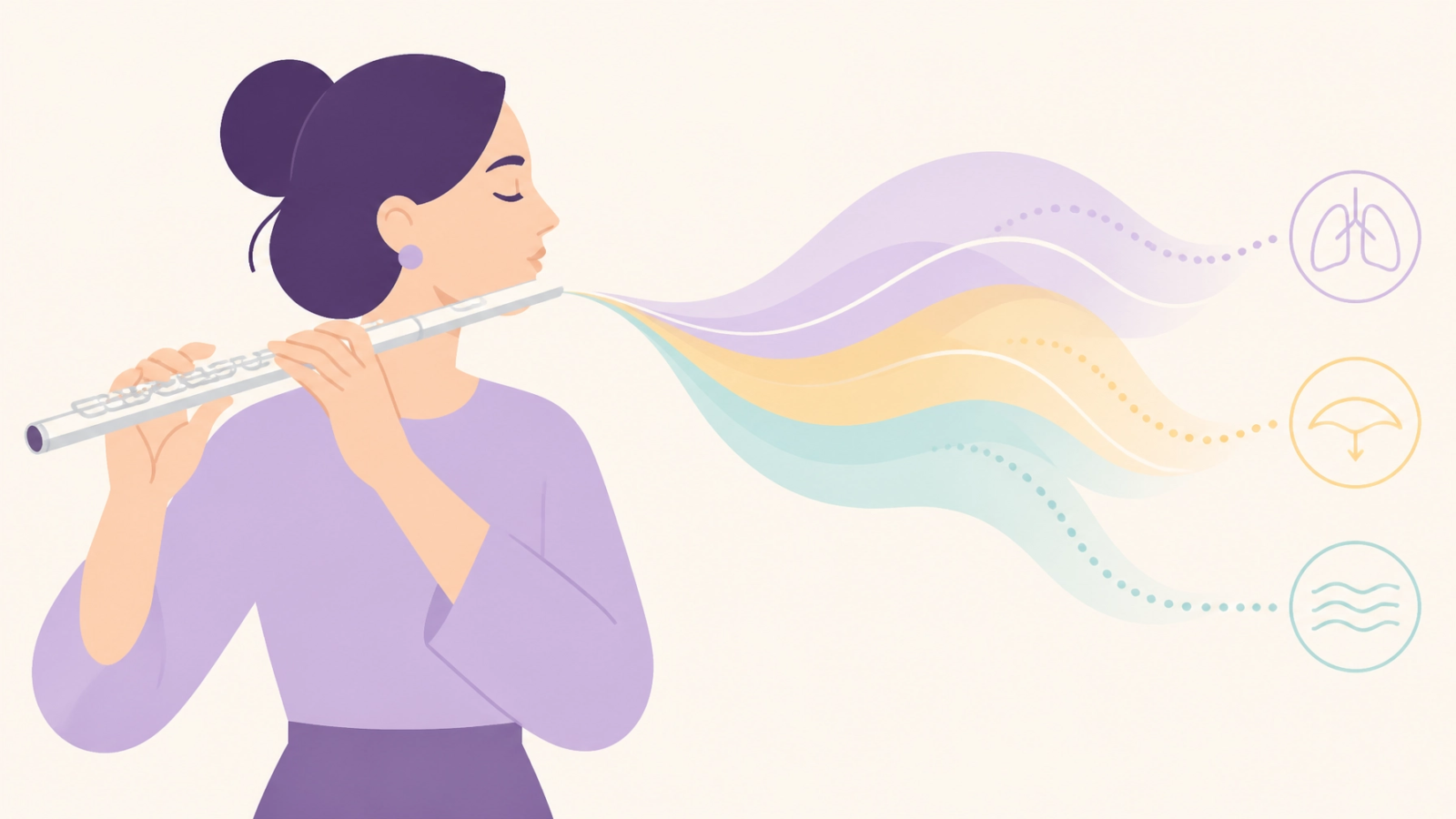
When you observe an expert flutist on stage, the visual and acoustic fluidity conceals a complex matrix of neurocognitive planning, respiratory-motor coordination, and physiological self-regulation. Achieving mastery on the transverse flute requires far more than repetitive physical drills. Recent empirical investigations in cognitive neuroscience and pedagogy demonstrate that advanced instrumental proficiency relies heavily on the tight coupling between anticipatory score processing, precise breathing mechanics, and embodied cognitive awareness. Whether you are pursuing professional orchestral standards or exploring structured flute lessons Ottawa, understanding these underlying mechanisms transforms how you approach technical acquisition and cognitive development.
In the bilingual community of Ottawa, where instruction is seamlessly offered in both English and Spanish, students across diverse age groups engage with music education not merely as an artistic pastime, but as a rigorous stimulus for neural plasticity and executive function enhancement. By examining peer-reviewed research from cognitive psychology, respiratory physiology, and pedagogical studies, you can systematically decode how expert musicians synchronize their internal physiological states with external musical structures.
The Neurocognitive Architecture of Anticipation in Score Reading
To understand expert flute performance, you must first examine how the central nervous system processes visual notation and translates it into motor execution before sound is produced. In cognitive studies examining music reading, researchers measure the eye-hand span, which indexes the temporal and spatial distance between the notes currently being read and those currently being played.

- Advanced flutists exhibit an expanded eye-hand span, allowing them to anticipate upcoming melodic contours, harmonic shifts, and rhythmic subdivisions several beats in advance.
- This anticipatory processing relies on working memory networks and visual-spatial mapping, enabling the brain to scaffold upcoming motor commands without cognitive overload.
- Eye-tracking data reveals that expert performers maintain shorter fixation durations paired with more efficient information intake compared to intermediate or novice students.
- The musical structure itself dictates how visual attention and motor planning unfold, requiring the performer to adapt continuously to phrasing and tonal harmonic changes.
When you engage in disciplined study through professional music lessons Ottawa, training your visual span and anticipatory mechanisms accelerates your ability to process complex scores. This cognitive scaffolding directly enhances your auditory processing capabilities, ensuring that your auditory-motor feedback loop operates with minimal latency.
Respiratory Mechanics and Chest Wall Dynamics in Wind Performance
Breathing in flute performance is frequently misunderstood as a simple mechanism for sustaining airflow. In reality, respiratory mechanics serve as an active regulatory system intimately linked with motor control and cognitive anticipation. Research into chest wall dynamics and respiratory parameters highlights distinct physiological adaptations among expert wind players.

- Thoraco-abdominal motion during expert flute playing exhibits a highly coordinated balance between thoracic expansion and abdominal wall engagement, stabilizing posture and pressure.
- Respiratory amplitude adapts dynamically to the structural phrasing of the musical work, ensuring that air volume matches the dynamic and tonal requirements of each phrase.
- Studies on respiratory parameters indicate that expert performers maintain optimal end-expiratory lung volumes, preventing excessive muscular fatigue in the intercostal muscles and diaphragm.
- The synchronization between inhalation timing and cognitive anticipation ensures that breaths are integrated seamlessly into musical rests and structural punctuation points rather than disrupting the line.
Whether you participate in in-studio sessions or utilize online flute lessons, refining your breathing mechanics transforms your tone production. By pairing proper respiratory control with complementary disciplines such as clarinet lessons or foundational music theory, you cultivate a comprehensive understanding of acoustic physics and respiratory efficiency.
Embodied Cognition and Physiological Regulation in Advanced Students
Beyond mechanics and score reading, advanced musical proficiency is heavily mediated by embodied cognition: the concept that bodily states and sensorimotor interactions shape cognitive processing. Recent educational research into advanced flute students demonstrates that somatic awareness and metacognitive monitoring directly influence performance outcomes and anxiety regulation.

- Students with higher self-confidence frequently report anticipating breathing patterns and preparing their physical posture prior to execution, rather than relying on rigid, pre-determined respiratory schemes.
- Elevated anxiety levels in instrumentalists are often correlated with increased upper-body muscle tension, restricted thoraco-abdominal movement, and a diminished ability to adapt breathing dynamically.
- Embodied awareness exercises, such as silent breathing protocols and targeted air column regulation, help calibrate the neuromuscular feedback loops necessary for precise embouchure control.
- Metacognitive monitoring allows performers to evaluate their internal somatic states in real-time, making micro-adjustments to posture, finger pressure, and air velocity.
This synthesis of mind and body ensures that every note you play resonates with clarity and intonation stability. Recognizing how physiological self-regulation impacts cognitive function allows you to approach your practice sessions with scientific precision.
Practical Pedagogical Applications for Your Musical Journey
Integrating these research findings into your daily practice requires structured methodologies that bridge cognitive anticipation and motor execution. Master-level instruction provides the necessary guidance to optimize your learning curve through evidence-based pedagogical frameworks.
- Implement slow practice routines where you intentionally expand your eye-hand span, reading two measures ahead while maintaining steady, relaxed abdominal breathing.
- Utilize targeted air column exercises without the instrument to isolate respiratory muscle engagement from finger coordination, reducing upper-body tension.
- Practice structural analysis of your repertoire, identifying phrasing boundaries and harmonic shifts so your breathing strategy aligns naturally with the musical architecture.
- Take advantage of flexible learning environments, including comfortable home setups for online flute lessons or our fully equipped Ottawa studio, which provides an acoustically optimized space for focused study.
By tailoring your instruction to your specific cognitive profile and technical goals, expert educators ensure that every practice session yields measurable improvements in motor fluency and auditory refinement.
Transparent Scheduling, Pricing, and Lesson Structure
At Allegro Ma Non Troppo, we believe in complete transparency regarding our educational offerings and pricing structures, ensuring that advanced music education remains accessible to individuals and families throughout the Ottawa community. Bilingual instruction in English and Spanish is available across all programs to accommodate our diverse local demographic.
- Trial Session: Experience your initial consultation at no cost with our complimentary trial lesson policy, allowing you to evaluate our teaching methodology before committing.
- Single Lesson Rates: Standard private instruction is structured across flexible durations to match your cognitive stamina and scheduling needs, with 30-minute sessions available at
$40$30, 45-minute sessions at$55$45, and 60-minute sessions at$70$55. - Lesson Bundles: Save on long-term skill acquisition by purchasing prepaid packages, offering reduced per-session rates for dedicated students pursuing continuous development.
- Family Plan: Households enrolling three or more family members receive specialized community savings, making collaborative family learning both practical and economically viable.
- Specialized Support: Comprehensive preparation for school band students, conservatory examinations, and advanced repertoire is integrated seamlessly into our standard curriculum.
Whether you prefer the immersive acoustics of our Ottawa studio or the convenient flexibility of our online platform, our Master-level teachers provide the expert scaffolding required to elevate your musicianship.
References
-
- B. Huet et al., "Coupling of anticipation and breathing in expert flute players," Frontiers in Cognition, vol. 3, 2024. Available: https://www.frontiersin.org/journals/cognition/articles/10.3389/fcogn.2024.1425005/full
-
- G. N. Costa et al., "Chest wall dynamics and muscle recruitment during professional flute playing," Respiratory Physiology & Neurobiology, vol. 160, no. 3, pp. 325–333, 2008.
-
- J. P. Schoentgen et al., "Respiratory parameters during professional flute playing," Respiratory Physiology, vol. 126, no. 1, pp. 71–81, 2001.
-
- M. S. de A. Nascimento et al., "Embodied awareness during preparation of an exam repertoire in advanced flute students," Frontiers in Education, 2026.
-
- R. J. Zatorre, "The impact of musical expertise on disentangled and contextual neural encoding of music," Nature Communications, 2025.
Leave A Comment