
 Cart is empty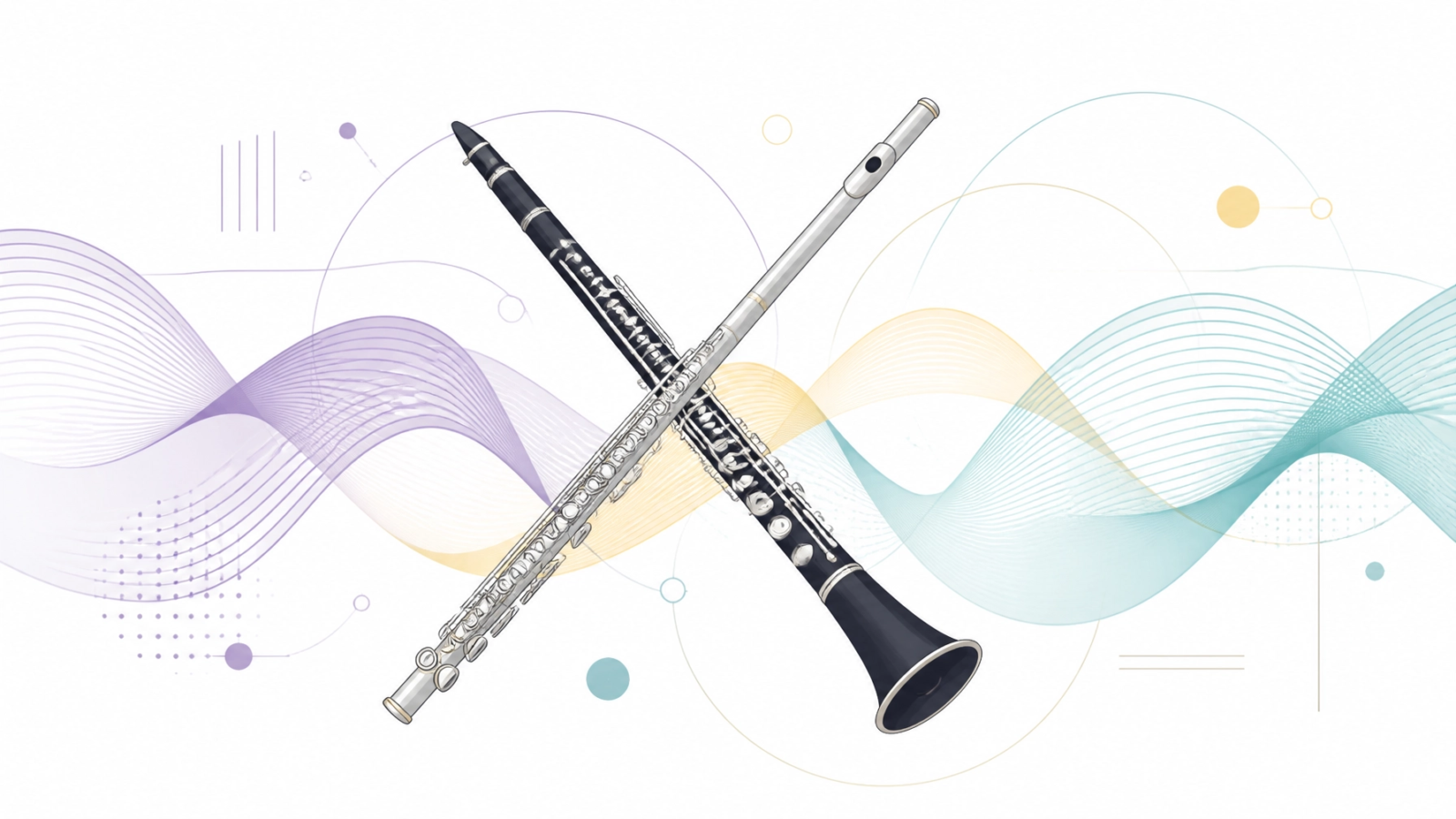
The production of sound in woodwind instruments is a sophisticated process involving the manipulation of air columns, pressure gradients, and acoustic resonances. While a student may experience the act of playing as an artistic endeavor, the underlying mechanics are governed by the principles of fluid dynamics and wave mechanics. Understanding these physical properties is not merely an academic exercise; it is a foundational component of technical mastery. When you engage in online flute lessons or online clarinet lessons, you are essentially learning to control a biological-mechanical interface to excite standing waves within a resonant cavity.
The Mechanics of Sound Production in Woodwinds
At the most fundamental level, woodwind instruments are resonators. Sound begins with an initial source of vibration, known as an exciter, which then couples with a column of air inside the instrument. This coupling creates longitudinal waves: oscillations that move parallel to the direction of the wave's travel. These waves reflect off the ends of the tube, interfering with incoming waves to establish a standing wave.
A standing wave is characterized by nodes and antinodes. A node is a point where the air pressure remains constant, while an antinode is a point of maximum pressure variation. The frequency at which these waves oscillate determines the pitch you hear. The geometry of the instrument, specifically whether it is an open or closed pipe, dictates the harmonic content and timbre of the resulting sound.

Flutes and the Bernoulli Principle: An Open-Pipe System
The flute is classified as an open-open pipe resonator. Unlike many other woodwinds, it does not possess a mechanical reed. Instead, the player creates an air jet that is directed across the sharp edge of the embouchure hole. This process relies heavily on the Bernoulli principle, which states that an increase in the speed of a fluid occurs simultaneously with a decrease in static pressure.
As the air jet passes the edge, it becomes unstable. Small fluctuations in pressure within the flute's bore cause the jet to oscillate back and forth, moving alternately into and out of the instrument. This oscillating jet provides the energy necessary to sustain the air column's resonance. Because the flute is open at both the embouchure and the foot joint (or the first open tone hole), it creates a pressure node at both ends.
Physically, this allows the flute to produce a full harmonic series, including both even and odd harmonics. This structural reality is why the flute possesses its characteristic bright and pure timbre. In our pedagogical approach, we emphasize the precise control of the air jet's velocity and angle, as these factors directly influence the instrument's ability to lock into the desired harmonic.

Clarinets and Reed Dynamics: The Closed-Pipe System
In contrast to the flute, the clarinet functions as a closed-open pipe. The end with the mouthpiece and reed acts as a closed boundary because the reed restricts air movement while allowing pressure to build. This configuration significantly alters the acoustic profile of the instrument.
The clarinet reed acts as a pressure-controlled valve. When you blow into the mouthpiece, the steady stream of air is converted into periodic pulses as the reed vibrates against the table of the mouthpiece. This vibration is influenced by the feedback from the standing waves inside the bore. Because the clarinet is closed at one end, the fundamental standing wave must fit a quarter-wavelength into the tube, rather than a half-wavelength.
This physical constraint has two major consequences:
- The clarinet plays approximately an octave lower than a flute of similar length.
- The instrument primarily reinforces odd harmonics, which accounts for its distinctive, woody resonance and the leap of a twelfth when overblowing into the higher register.
Students in our online clarinet lessons focus on developing a stable embouchure to manage the acoustic impedance of the reed, ensuring a clear and consistent tone across all registers.

Cognitive Benefits of Structural Music Understanding
The study of woodwind physics provides more than just technical proficiency; it enhances executive function and auditory processing. By understanding the causal relationship between breath pressure, finger placement, and acoustic output, students develop a higher level of cognitive scaffolding. This analytical approach to music resonates with the same neural pathways used in mathematics and linguistic syntax.
Research in pedagogy suggests that when students grasp the underlying mechanics of their instrument, they exhibit improved problem-solving skills during practice. They move from a trial-and-error method to an evidence-based approach. This transition is essential for advancing beyond intermediate levels and achieving professional-grade precision in intonation and articulation. Furthermore, integrating music theory with physical practice ensures that the student is not just a performer, but a knowledgeable musician.

Logistics and Educational Framework at Allegro Ma Non Troppo
Allegro Ma Non Troppo provides an environment where scientific rigor meets personalized instruction. Our Master-level teachers are experts in the physics of their respective instruments, whether you are pursuing online flute lessons, online clarinet lessons, or even other disciplines like beginner piano and ukulele.
We offer a transparent and flexible logistics framework designed to support consistent progress:
- Standard pricing for 30-minute lessons is available, with increased value for 45 and 60-minute sessions.
- Lesson bundles offer a reduction in the per-lesson cost compared to individual sessions.
- A Family Plan provides substantial savings for households with three or more active students.
- All new students are eligible for a free trial lesson (original price
25.000.00) to evaluate our teaching methodology. - Scheduling is managed through a streamlined digital platform, allowing for easy adjustments to fit your professional or academic calendar.
By removing logistical friction, we allow you to focus entirely on the cognitive and physical development required to master the flute or clarinet. Our bilingual instruction in English and Spanish ensures that these scientific principles are accessible to a diverse community of learners in Ottawa and beyond.
Leave A Comment