
 Cart is empty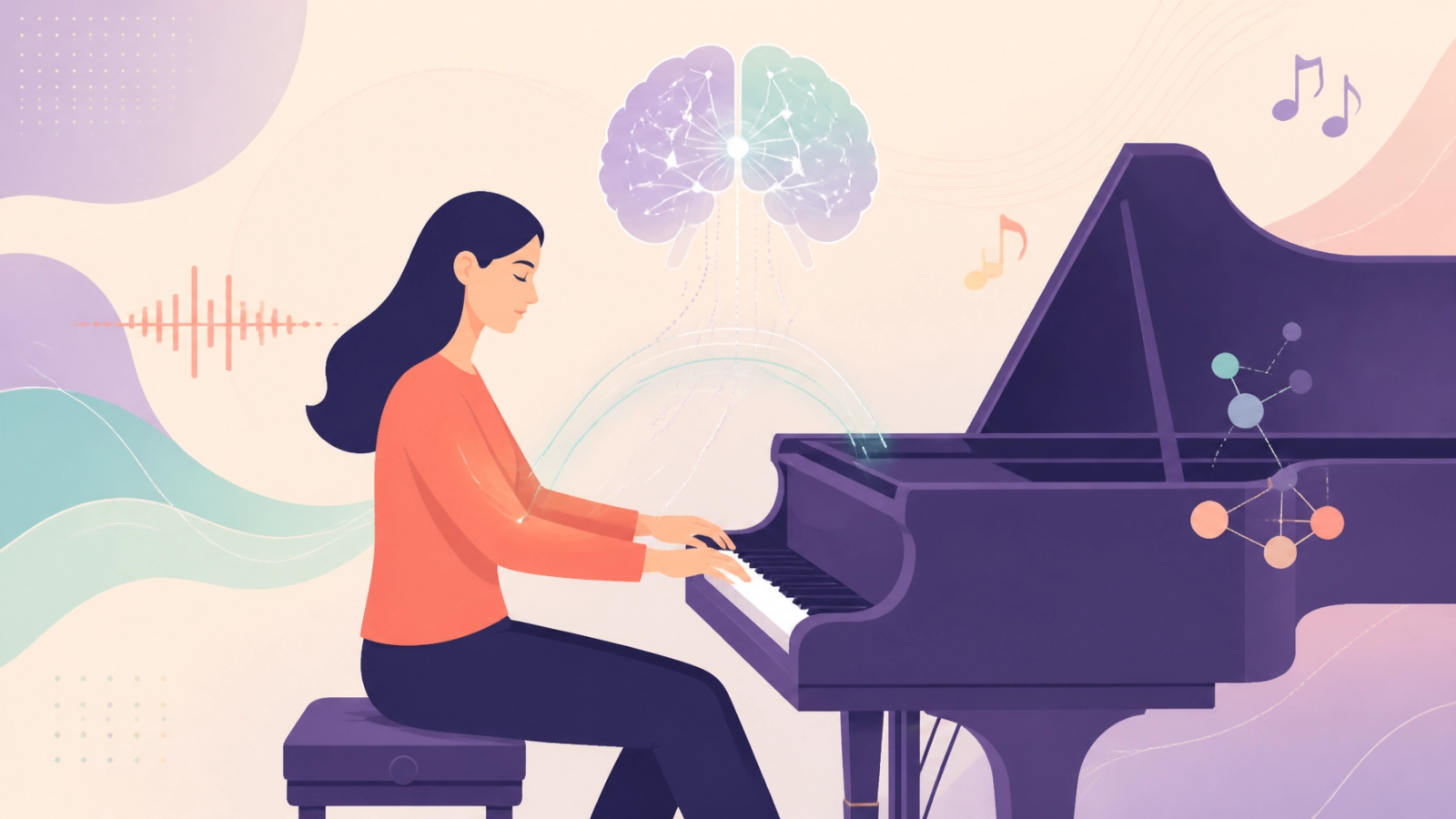
Piano mastery is a demanding form of multisensory learning. You read symbols, predict sound, coordinate both hands, monitor errors, and adjust movement. Consequently, music lessons Ottawa students pursue can train specific cognitive and motor systems through structured practice.
However, piano lessons do not automatically improve every aspect of intelligence. The strongest evidence concerns trained skills and closely related processes. These include bimanual coordination, auditory-motor integration, executive control, fine motor precision, and procedural memory.
At Allegro Ma Non Troppo, your piano study can take place at the Ottawa studio or online. Master-level teachers adapt instruction to your goals, experience, repertoire, and learning pace. Lessons are also available in English or Spanish.
How music lessons Ottawa train bilateral control
Piano playing requires each hand to perform a distinct role. The right hand may carry a melody. Meanwhile, the left hand may play an accompaniment with a different rhythm, articulation, and force.
This creates a bimanual coordination problem. Your brain must organize two motor sequences while maintaining one shared pulse. It must also inhibit movements that interfere with accuracy or musical balance.
A 2025 longitudinal study examined novice pianists during a six-month training period. The researchers observed dynamic changes in cortical and subcortical activity during piano tasks. These changes depended on the coordination demands of the performance.
The study found that increased activation in premotor and parietal regions diminished as participants gained experience. This pattern is consistent with motor automatization. In other words, the brain gradually performs a familiar movement sequence with less conscious effort.
The researchers did not find equivalent changes in auditory processing. Therefore, the findings support a precise conclusion. Piano training may reshape motor coordination networks without producing broad changes across every auditory function.
The full citation is:
- Olszewska, A. M., Gaca, M., Droździel, D., Jednoróg, K., Marchewka, A., & Herman, A. M. (2025). “Piano Training Induces Dynamic Neuroplasticity of Bimanual Coordination but Not Auditory Processing in Young Adults.” Journal of Neuroscience Research, 103(7), e70067. DOI: 10.1002/jnr.70067.

This evidence informs effective pedagogy. Your teacher should not begin with speed. Instead, you first establish accurate movement patterns.
Useful strategies include:
- Practising each hand separately.
- Combining hands at a reduced tempo.
- Using rhythmic subdivisions.
- Repeating short, clearly defined fragments.
- Increasing speed only after accuracy stabilizes.
- Varying starting points to strengthen retrieval.
These methods provide scaffolding. Scaffolding breaks a complex task into manageable stages. Then, the teacher gradually removes assistance as your motor control improves.
Somatosensory inhibition and precise touch
Piano performance depends on more than muscle activation. It also requires selective sensory processing.
Every keystroke generates tactile and proprioceptive information. Your nervous system receives signals about pressure, joint position, finger contact, and movement. Yet, not every signal deserves equal attention.
Somatosensory inhibition helps the brain filter competing sensory information. This filtering can sharpen the representation of the fingers and hand. As a result, you can distinguish subtle differences in touch, timing, and force.
Hirano and colleagues studied this process in pianists. Their 2025 paper linked enhanced somatosensory inhibition with sharper hand representation and stronger sensorimotor performance. The findings suggest an association between refined sensory filtering and advanced piano skill.
Importantly, the study does not prove that piano training alone caused every observed difference. Pianists may also differ in practice history, attention, physical technique, or other forms of experience.
The full citation is:
- Hirano, M., Kimoto, Y., Shiotani, S., & Furuya, S. (2025). “Enhanced Somatosensory Inhibition Sharpens Hand Representation and Sensorimotor Skills in Pianists.” Journal of Neuroscience, 45(8), e1486242024. DOI: 10.1523/JNEUROSCI.1486-24.2024.
In practice, refined sensory control supports:
- Balanced voicing between melody and accompaniment.
- Efficient finger release.
- Clear articulation.
- Reduced unnecessary force.
- More accurate dynamic changes.
- Better awareness of tension and fatigue.
Therefore, serious learners should treat technique as sensory-motor education. You are not simply pressing keys. You are calibrating force, timing, position, and sound.

Executive function during piano acquisition
Executive function includes planning, inhibitory control, working-memory updating, and cognitive flexibility. Piano practice recruits these processes repeatedly.
For example, you may need to:
- Hold a chord progression in working memory.
- Read the next measure while playing the current one.
- Inhibit the impulse to stop after an error.
- Shift attention from rhythm to articulation.
- Monitor balance between the hands.
- Change your strategy when a passage remains unstable.
This sequence creates a continuous perception-action loop. You encode information, perform a movement, hear the result, and update your next decision.
A 2026 study examined affective pathways related to executive function in musicians. The researchers reported improved Stroop performance after instrumental lessons. However, the participants were experienced musicians, and the study design limits causal conclusions.
The full citation is:
- Gkintoni, E., Kanellopoulou, H., Pouris, C., Vassilopoulos, S. P., Nikolaou, G., & Halkiopoulos, C. (2026). “Cognitive Enhancement Through Music Education: Affective Pathways to Executive Function Improvement in Musicians.” Brain Sciences, 16(2), 161. DOI: 10.3390/brainsci16020161.
The practical implication is not that one lesson produces permanent cognitive enhancement. Rather, structured lessons provide repeated opportunities to plan, monitor, inhibit, and revise.
This is especially relevant for advanced learners. As repertoire becomes more complex, you must coordinate several layers of information. These layers include harmony, form, fingering, rhythm, articulation, pedaling, and interpretation.
Motor learning requires deliberate practice
Practice duration alone does not explain mastery. Motor learning depends on practice quality, feedback, spacing, and task design.
A serious practice session should have one primary objective. For example, you might target rhythmic stability rather than attempting to correct every issue at once.
A practical session can include:
- Technical preparation with relaxed posture.
- Scales or coordination patterns.
- One short repertoire passage.
- Sight-reading or rhythm work.
- Memory-based retrieval.
- A complete performance attempt.
- Brief written reflection.
Moreover, practice should alternate between repetition and variation. Repetition stabilizes a movement pattern. Variation tests whether you can retrieve that pattern under different conditions.
You can vary:
- Tempo.
- Starting points.
- Rhythmic groupings.
- Dynamics.
- Articulation.
- Eyes-open and eyes-away conditions.
- Hands-alone and hands-together formats.
This approach supports transfer within the musical domain. It can also reduce dependence on automatic visual cues.
The PIANO-Cog project offers a relevant example of remote learning research. The study examined an eight-week, self-guided piano programme for older adults. Participants practised at home for approximately 30 minutes, five days per week.
However, the specific 2026 report is a bioRxiv preprint. It has not undergone peer review. Therefore, its findings should be treated as preliminary rather than conclusive.
The full citation is:
- Rogers, F., Erdem, E., & Metzler-Baddeley, C. (2026). “Feasibility of PIANO-Cog for Older Adults: A Randomised Controlled Pilot Trial Exploring Changes in Cognition and Brain Microstructure.” bioRxiv preprint. DOI: 10.64898/2026.01.28.702269.
The peer-reviewed PIANO-Cog protocol provides stronger information about the study design. However, a protocol describes planned methods. It does not establish final outcomes.
What current evidence supports
Current research supports a measured view of piano training.
Piano lessons can provide repeated practice in:
- Bimanual coordination.
- Fine motor control.
- Auditory-motor prediction.
- Executive attention.
- Error monitoring.
- Procedural memory.
- Visual-to-motor translation.
In contrast, broad cognitive transfer remains uncertain. Some studies report improvements in executive function or processing speed. Others find limited differences compared with active control activities.
A 2026 review by Cui describes piano interaction as an integrated auditory, motor, visual, and cognitive process. The review also emphasizes methodological limitations. These include small samples, varied lesson designs, and inconsistent outcome measures.
The full citation is:
- Cui, L. (2026). “The Neuro-Psychological Dimensions of Piano Interaction: From Mental Health Therapy to Intelligent Systems.” Frontiers in Psychology, 17, 1725791. DOI: 10.3389/fpsyg.2026.1725791.
Therefore, piano should not be marketed as a guaranteed academic shortcut or medical treatment. Instead, it should be understood as a demanding skill-learning system. Its cognitive value emerges through sustained engagement, precise feedback, and progressive challenge.
Applying neuroscience to your piano lessons Ottawa plan
Your programme should match your current abilities and objectives. Beginners require clear sequencing and manageable motor demands. Intermediate learners may need more work on voicing, pedaling, sight-reading, and interpretation. Advanced students may require performance planning, harmonic analysis, and nuanced technical refinement.
At Allegro Ma Non Troppo, piano lessons Ottawa are available in person or online. You can study in English or Spanish through personalized, bilingual music lessons.
The Ottawa studio provides a dedicated learning environment. Online instruction offers comfort and flexibility from your home. Both formats can support consistent practice when your instrument, technology, and schedule are suitable.
You can also connect piano study with music theory lessons online. Theory helps you identify harmonic patterns, predict musical structure, and strengthen sight-reading. Additionally, students interested in other instruments can explore online flute lessons.
A free trial lesson allows you to assess instructional fit before committing. During the trial, you can discuss:
- Your musical background.
- Your preferred repertoire.
- Your practice schedule.
- Your coordination challenges.
- Your language preference.
- Your desired lesson length.
- Your short- and long-term goals.
Mastery develops through a sequence of accurate decisions. Each note contributes to a larger network of movement, sound, memory, and interpretation. With expert instruction, your practice can become more efficient, measurable, and neurologically informed.
Leave A Comment