
 Cart is empty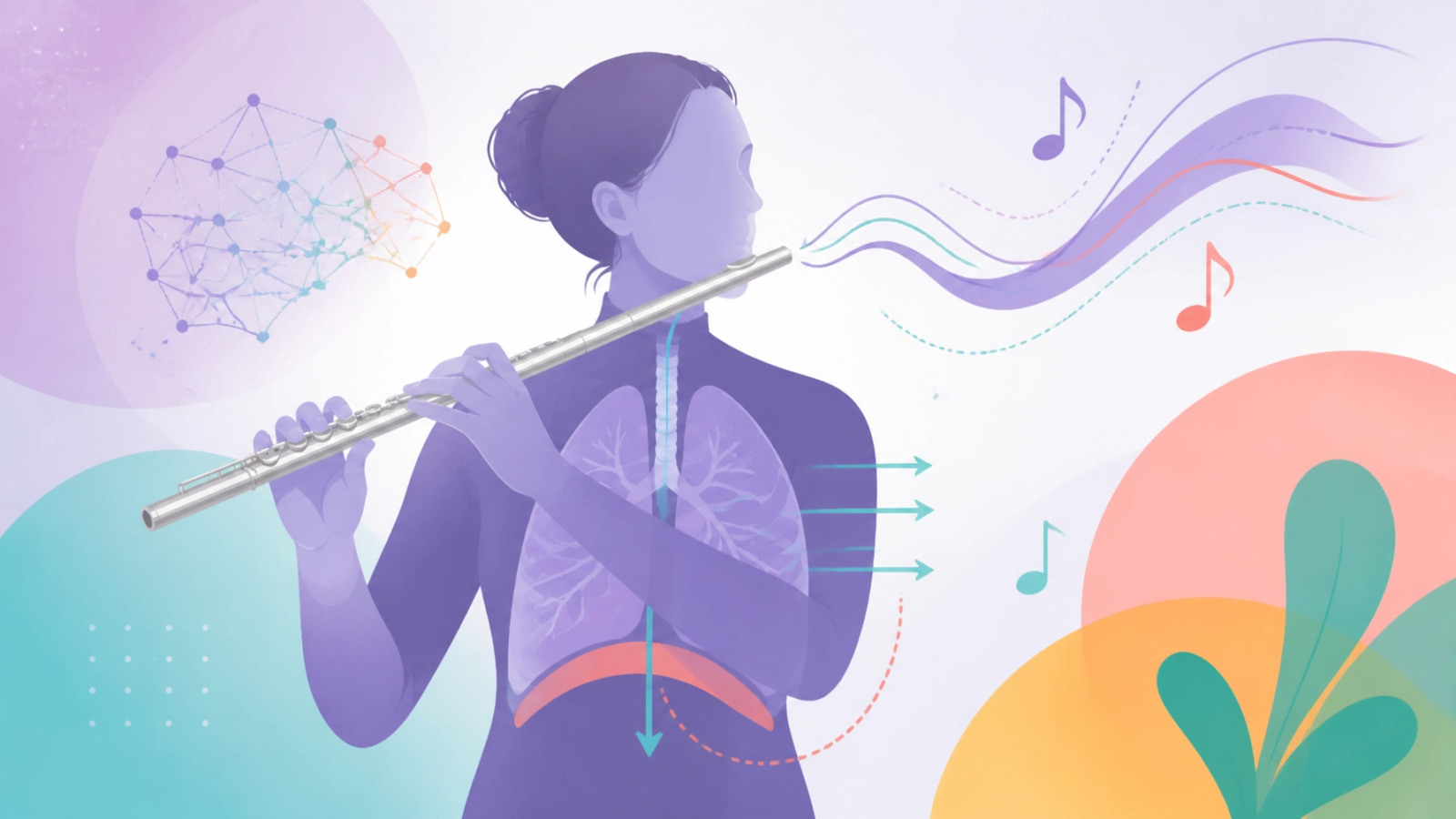
Advanced flute performance depends on more than finger coordination and accurate notation. Your breathing, posture, attention, and sensory predictions also shape the result. This integrated process is known as embodied awareness.
In serious music lessons Ottawa, embodied awareness helps you connect internal sensations with external sound. You learn to notice how preparation affects airflow, how anticipation influences phrasing, and how subtle physical adjustments change timbre. The goal is not to monitor every body part during performance. Instead, you develop efficient coordination until musical intention and physical action work together.
Recent research offers useful evidence. Studies now examine embodied learning in advanced flute students, unconscious overtone control, and respiratory training among wind instrumentalists and vocalists.
What Embodied Awareness Means in Flute Performance
Embodied awareness combines several systems:
- Interoception, or awareness of internal bodily signals
- Proprioception, or awareness of body position and movement
- Auditory processing and feedback
- Motor planning and prediction
- Emotional regulation and attentional control
For a flutist, these systems interact before the first note. You anticipate the phrase, estimate the required breath, prepare the embouchure, and orient your attention toward the musical goal.
Interoception is especially relevant. You may sense rib expansion, airflow, throat position, jaw tension, or changes in heart rate. These sensations provide information. However, they do not always require conscious correction. Excessive internal monitoring can interrupt automated motor patterns. Effective practice therefore alternates between awareness and release.
This distinction matters during demanding repertoire. You need enough awareness to detect inefficient tension. You also need enough flexibility to let well-trained movements operate without interference.

Music Lessons Ottawa and the Evidence on Embodied Learning
Cara, Lobos, Ceardi, and Rojas studied five advanced flute students during a six-week preparation period for an examination repertoire. Their mixed exploratory case study combined weekly logbooks with repeated self-ratings of anxiety and self-confidence.
The study identified a relationship between breathing, anticipation, body awareness, and self-regulation. Students with higher anxiety reported more physical sensations, breathing difficulties, tension, and fatigue. Students with greater self-confidence more often described preparing their bodies and anticipating upcoming musical events.
The study does not prove that embodied awareness causes lower anxiety or better performance. Its sample was small, and the data relied mainly on self-report. Still, it shows how advanced students interpret physical information during real preparation.
The findings suggest three practical principles:
- Body awareness should include preparation, not only correction.
- Breathing should be planned in relation to musical structure.
- Physical sensations should provide information rather than become evidence of failure.
This approach supports pedagogical scaffolding. You first isolate a technical demand. Then, you connect it to a phrase. Finally, you practise the complete musical context. Each stage reduces unnecessary cognitive load.
For example, you might begin with a silent inhalation and a four-second exhalation. Next, you transfer that pattern to a sustained note. Then, you apply it to a phrase with a planned crescendo. Finally, you perform the passage while focusing on musical direction rather than respiratory mechanics.
Cara MA, Lobos C, Ceardi A, and Rojas C. (2026). “Embodied awareness during preparation of an exam repertoire in advanced flute students.” Frontiers in Education, 11, 1794272. https://doi.org/10.3389/feduc.2026.1794272
Anticipation Links Breathing to Musical Structure
Breathing is not merely a response to depleted air. It is also a predictive action. Before a phrase begins, your nervous system estimates its length, dynamic shape, register, articulation, and expressive direction.
This prediction influences the timing and depth of your inhalation. A short articulated figure requires a different preparation from a long cantabile line. Likewise, a phrase that rises toward a climax requires different respiratory planning from one that releases toward silence.
Anticipatory practice can include:
- Marking structural cues in the score
- Identifying phrase peaks and recovery points
- Practising the breath before playing the passage
- Imagining the first note before inhaling
- Rehearsing entrances after different durations of silence
This process resembles feedforward motor control. You prepare an action before receiving feedback. Then, auditory feedback confirms or modifies the plan.
A useful practice question is: “What must my body know before this phrase begins?” The answer may include the breath location, the intended tone colour, the dynamic destination, or the amount of physical effort required.
This method also supports self-regulation. You plan, perform, evaluate, and revise. That cycle aligns with established models of metacognition in music learning.
Timbre Control and the Overtone Structure of the Flute
Timbre refers to the perceptual quality that distinguishes one sound from another at the same pitch and loudness. On the flute, timbre depends on several interacting factors:
- Air speed and direction
- Embouchure shape
- Lip aperture
- Tongue position
- Oral cavity configuration
- Dynamic level
- Vibrato and breath noise
These variables influence the balance of overtones. A tone with relatively greater high-frequency energy may sound brighter or more projecting. A different balance may sound warmer or more subdued.
Hiraiwa and Miura examined this relationship through acoustic analysis and listening experiments. They used principal component analysis to study overtone components up to the fifth overtone. Their findings indicate that flute timbre depends on both overall overtone strength and the balance among specific overtones.
The researchers also found that performers adjusted overtone structures for expressive purposes without consciously targeting individual frequencies. In other words, a flutist may seek a “warm” or “intense” sound through auditory imagery. The resulting embouchure and airflow changes then modify the spectrum.
Listeners could distinguish several intended timbral differences. Professional players also communicated intended timbre more consistently. The middle register showed particularly strong potential for expressive variation.
This research has a direct pedagogical implication. You do not need to think about every overtone while performing. Instead, you can develop a reliable auditory vocabulary:
- Dark and warm
- Bright and projecting
- Focused and clear
- Airy and distant
- Quiet but resonant
You then test which physical adjustments produce each result. Record the sound when possible. Compare the recording with your intended quality. Over time, auditory imagery and motor control become more closely coupled.

Hiraiwa K, and Miura M. (2025). “Unconscious overtone manipulation and transmission in flute performance: insights into musical expression and perception.” Frontiers in Psychology, 16, 1393689. https://doi.org/10.3389/fpsyg.2025.1393689
What Respiratory Training Can and Cannot Do
Respiratory training may improve physiological capacity. However, it should not replace instrument-specific practice.
Ces-Lafuente, Rodríguez-Gude, Martín-Palomo, and Lantarón-Caeiro reviewed randomized controlled trials involving wind instrumentalists and vocalists. Seven studies met their eligibility criteria. Most used threshold-loaded respiratory devices, including POWERbreathe-style protocols.
The review found improvements in:
- Respiratory muscle strength
- Spirometric measures
- Ventilatory capacity
- Some phonation outcomes
However, the effect on overall musical performance remained inconclusive. The studies used different protocols and outcome measures. Most also lacked participant blinding. Small samples further limited generalization.
Therefore, respiratory muscle training may serve as an adjunct. It should not become a substitute for phrase planning, embouchure coordination, listening, and repertoire practice. You should also avoid intensive respiratory exercises without appropriate professional guidance. Stop if you experience dizziness, chest pain, unusual fatigue, or persistent breathlessness.
Ces-Lafuente P, Rodríguez-Gude C, Martín-Palomo A, and Lantarón-Caeiro E. (2026). “Impact of Respiratory Training on Wind Instrumentalists and Vocalists: A Systematic Review and Meta-Analysis.” Journal of Voice. https://doi.org/10.1016/j.jvoice.2026.04.017
A Practical Embodied Practice Sequence
You can integrate embodied awareness into a regular practice session without making it complicated.
1. Prepare the environment
Choose a comfortable space with enough room to hold the flute without compressing your shoulders. Temperature also matters. Cold hands, restrictive clothing, and poor seating can change movement and attention.
Online lessons can offer a consistent home environment. In-person lessons allow direct observation of posture, movement, and sound projection. Both formats can support structured learning.
2. Establish neutral alignment
Stand or sit with an elongated spine. Keep the shoulders mobile. Let the head balance without forcing the neck backward.
Do not pursue a rigid posture. Efficient alignment should permit movement and breathing.
3. Anticipate the phrase
Before playing, identify the phrase goal. Mark the breath, dynamic peak, and release point. Imagine the first note and its timbre.
Then inhale in a way that matches the phrase. Avoid taking the largest possible breath by default.
4. Transfer awareness to sound
Play a long tone at a moderate dynamic. Notice the relationship among airflow, pitch, resonance, and physical effort.
Next, repeat the tone with a darker or brighter colour. Use listening as the primary guide. Physical sensations can inform the process, but the acoustic result remains the central measure.
5. Increase complexity gradually
Add articulation, register changes, rhythmic variation, and performance pressure one at a time. This progression supports motor learning and attentional flexibility.

Applying This Approach in Music Lessons Ottawa
At Allegro Ma Non Troppo, flute lessons in Ottawa can address breath coordination, tone production, school band repertoire, audition preparation, and musical interpretation. Lessons are available online or in person at the Ottawa studio.
You can also connect performance work with music theory instruction. Harmonic direction, phrase structure, meter, and form can improve anticipatory breathing. Theory gives your body a clearer musical map.
Instruction is available in English and Spanish. You can select 30-, 45-, or 60-minute lessons. A free trial allows you to assess the instructional fit before making a longer commitment.
The choice of instrument is secondary to your musical goals. Flute may suit your interest in breath-led phrasing and overtone colour. Clarinet, piano, ukulele, or music theory may better support another objective. The important question is how the learning process develops your attention, coordination, auditory processing, and expressive control.
References and Research Boundaries
The three studies discussed here provide valuable but limited evidence. Cara and colleagues used a small qualitative sample. Hiraiwa and Miura studied a limited number of performers and listeners. The respiratory review found physiological benefits but inconclusive musical outcomes.
These limitations do not reduce the value of the research. Instead, they clarify how to apply it responsibly. Use embodied awareness as a structured learning tool. Measure progress through sound, consistency, ease, musical clarity, and recovery. Avoid treating one technique or device as universally effective.
In advanced flute learning, the body is neither an obstacle nor a separate technical object. It is part of the perceptual and motor system that transforms musical intention into sound.
Leave A Comment