
 Cart is empty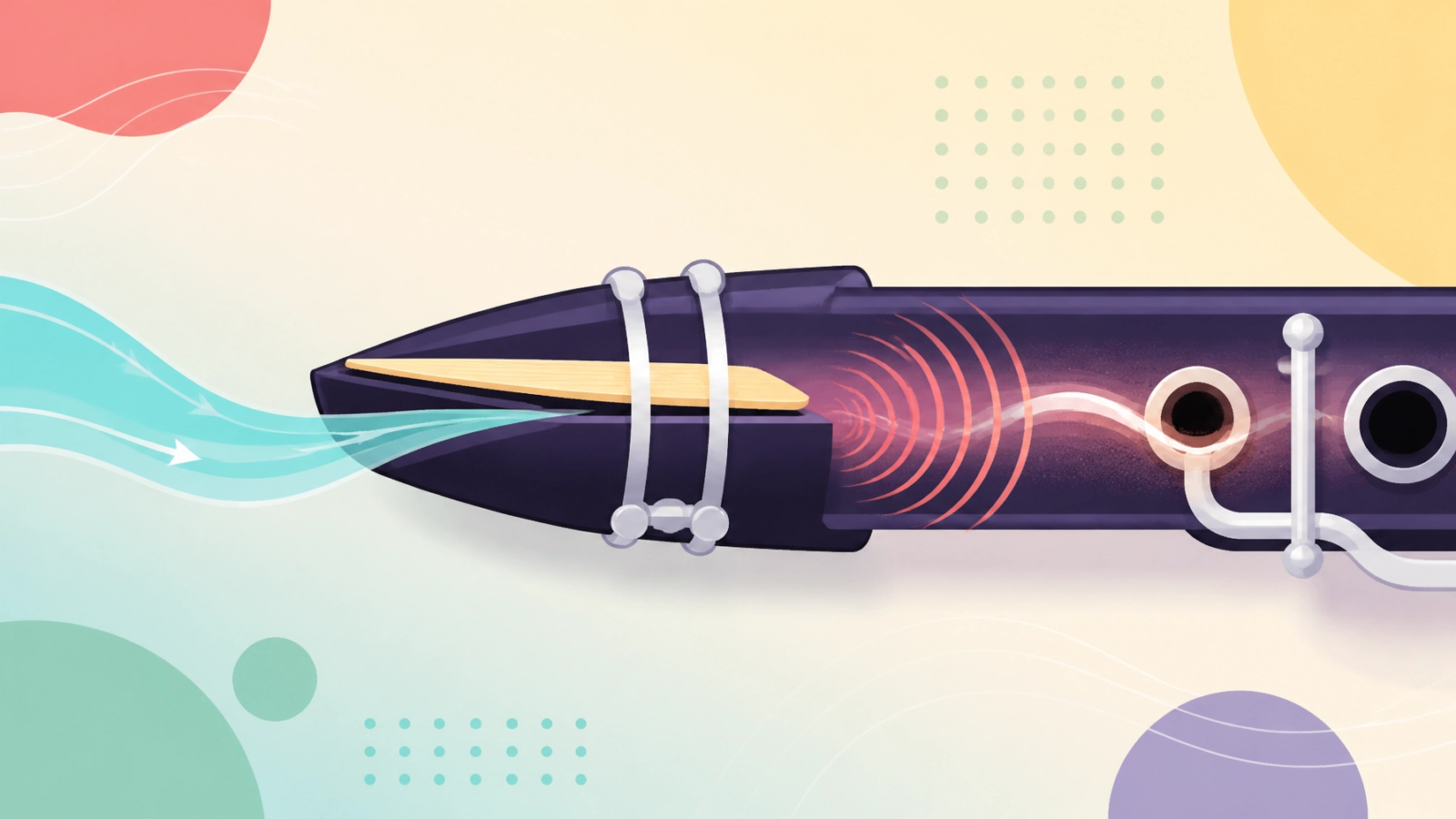
Clarinet tone begins with a coordinated biological and acoustic system. Your respiratory muscles create pressure. Your embouchure regulates the reed. The reed then couples your airstream to the clarinet’s resonant bore.
Therefore, tone production is not simply a matter of blowing harder. It involves biomechanics, auditory feedback, motor prediction, and precise control of small muscular forces. In serious music lessons Ottawa, understanding these mechanisms can make your practice more efficient.
The goal is not to create unnecessary tension. Instead, you learn to produce a stable reed vibration with the least wasted effort.
How Music Lessons Ottawa Explain Clarinet Tone Production
The clarinet uses a single reed attached to a mouthpiece. When you exhale, pressure develops inside the mouth. That pressure moves the reed away from the mouthpiece. Then, the reed returns toward the mouthpiece as airflow and acoustic pressure change.
This cycle occurs rapidly. It creates pressure pulses that travel through the clarinet’s air column.
The reed and mouthpiece function as a pressure-sensitive valve. However, the bore determines much of the instrument’s pitch and resonance. Your embouchure influences how efficiently the reed transfers energy into that bore.
This distinction matters. Your lips do not create the clarinet’s pitch by themselves. Instead, they regulate the reed’s operating conditions.
Small changes can affect:
- Response at soft dynamics
- Tone colour across registers
- Intonation stability
- Articulation clarity
- Squeak frequency
- Perceived resistance
- Endurance during long phrases
The acoustic process also explains why equipment matters. Reed strength, mouthpiece geometry, facing length, and reed symmetry all change the mechanical conditions of vibration.
Gaillard and colleagues examined this interaction experimentally. They measured unmounted cane reeds and then studied reed–mouthpiece behaviour with force sensing and imaging. Their findings investigated whether measurements of a reed alone can predict its mounted performance. The results reinforce a practical principle: reed quality cannot be evaluated fully without considering the mouthpiece and playing interface.
Embouchure Biomechanics: Control Without Clamping
Your embouchure includes the lips, jaw, cheeks, teeth, and surrounding facial muscles. These structures must create a reliable seal. At the same time, they must allow the reed to vibrate.
An effective clarinet embouchure balances firmness and mobility. Too little control can cause air leaks and unstable response. Too much pressure can restrict the reed and increase fatigue.

A useful biomechanical sequence includes the following:
- Place the lower lip over the lower teeth.
- Rest the reed on the lower lip rather than directly on the teeth.
- Place the upper teeth securely on the mouthpiece.
- Form a continuous seal around the mouthpiece.
- Keep the jaw stable without biting downward.
- Draw the mouth corners inward.
- Keep the chin relatively flat rather than bunched.
- Maintain a focused oral shape for the airstream.
These instructions describe coordination rather than a rigid facial pose. Your teacher should adjust them according to your anatomy, mouthpiece, reed, and musical goals.
The orbicularis oris helps maintain lip closure. The masseter and temporalis contribute to jaw control. Cheek muscles help stabilize the sides of the embouchure. Meanwhile, your tongue shapes the oral cavity and influences the speed and direction of the airstream.
As a result, tone work requires more than isolated lip exercises. You must coordinate facial posture, air pressure, articulation, and listening.
Reed Mechanics and Mouthpiece Interaction
A reed is a flexible structure with nonlinear behaviour. That means its response changes as force and displacement increase. At low pressure, it may open gradually. At higher pressure, it can close the channel more rapidly.
Your lower lip applies force to the reed. Your jaw changes the angle and contact conditions. Intraoral pressure pushes against the reed from the opposite side.
The result is a dynamic balance.
If you increase lip pressure excessively, the reed’s opening becomes smaller. The sound may become pinched or resistant. Pitch can also rise because the reed–airflow system operates under altered conditions.
By contrast, insufficient support may allow excessive reed movement. The tone can become diffuse. Attacks may become unreliable. Squeaks may also occur more easily.
For that reason, serious clarinet practice should test tone under several conditions:
- Soft long tones
- Moderate sustained notes
- Crescendos and decrescendos
- Slurred register changes
- Tongued attacks
- Low-register response
- Upper-register stability
You should listen for consistent resonance. You should also notice whether your jaw, lips, or throat become tired. Fatigue often indicates inefficient force distribution rather than inadequate effort.
The physics of woodwind instruments provides additional context about reed excitation, standing waves, and acoustic resonance.
The Neuroscience of Clarinet Tone and Motor Learning
Clarinet playing requires continuous sensory prediction. Before you play a note, your brain predicts its timing, pitch, resistance, and tone colour. Then, auditory and tactile feedback update that prediction.
This process involves several interacting systems:
- Auditory cortex for pitch and timbre analysis
- Motor cortex for voluntary movement
- Cerebellum for timing and error correction
- Basal ganglia for sequencing and procedural learning
- Premotor regions for action planning
- Somatosensory regions for lip, jaw, and finger feedback
With repetition, these systems become more efficient. This process reflects neural plasticity. However, repetition alone does not guarantee improvement. The quality of the feedback matters.
For example, playing a passage repeatedly with a compressed embouchure can strengthen that inefficient motor pattern. Therefore, your practice should include deliberate monitoring.
Use a short feedback loop:
- Play one sustained note.
- Identify the tone’s centre and stability.
- Check your jaw and lip pressure.
- Repeat with less unnecessary force.
- Compare the sound.
- Record the most efficient version.
This is a form of pedagogical scaffolding. You first isolate one variable. Then, you add articulation, fingering, dynamics, and musical phrasing.

Auditory processing also shapes your tone concept. You need to distinguish a bright spectral change from a pitch change. You must hear whether an attack begins cleanly. In addition, you must evaluate whether your sound projects without excessive force.
A tuner can measure frequency. It cannot fully evaluate resonance, articulation, or tone colour. Consequently, structured listening remains essential.
Respiratory Training: What Recent Evidence Shows
Breath control supports clarinet tone, phrasing, and endurance. Nevertheless, respiratory training should be interpreted carefully.
A 2025 randomized study examined inspiratory muscle training in wind players. The intervention focused on strengthening the muscles used during inhalation. This type of training can be relevant when a player experiences respiratory fatigue or difficulty sustaining long phrases.
However, respiratory strength is not the same as musical control. Stronger inspiratory muscles do not automatically produce a more resonant tone. You still need to coordinate inhalation, oral pressure, embouchure, articulation, and phrase structure.

A 2026 systematic review and meta-analysis reached a similar conclusion. Respiratory training improved measures such as respiratory muscle strength and some ventilatory outcomes. However, direct effects on musical performance remained inconsistent.
Therefore, treat respiratory muscle training as an adjunct. It should not replace clarinet-specific practice.
Before using a resistance-breathing device, consult a qualified health professional. This is particularly important if you have asthma, cardiovascular disease, respiratory symptoms, or a history of voice or breathing problems.
For most learners, instrument-specific breath practice can begin with:
- Silent, efficient inhalation
- Controlled long tones
- Phrase-length planning
- Gradual dynamic changes
- Rest intervals between repetitions
- Monitoring for dizziness or excessive tension
If your tone deteriorates near the end of a phrase, examine the full system. The problem may involve breath planning, embouchure pressure, posture, or an unrealistic phrase length.
A Science-Based Tone Routine
Use this sequence during individual practice or clarinet lessons Ottawa.
1. Stabilize posture
Sit or stand with your head balanced over your spine. Keep your shoulders free. A comfortable position reduces unnecessary muscular activity.
2. Establish the seal
Play a comfortable note at a moderate dynamic. Check for air leaks. Then, reduce jaw pressure while preserving the seal.
3. Sustain the vibration
Hold long tones across the chalumeau, clarion, and altissimo registers. Listen for changes in resonance and resistance.
4. Add controlled movement
Practise slurs between registers. Keep the embouchure stable while the tongue and fingers coordinate the change.
5. Add articulation
Use repeated attacks at different dynamics. Your tongue should interrupt the airstream without collapsing the tone.
6. Apply the skill to repertoire
Transfer the same control to scales, etudes, school-band excerpts, and performance pieces. This final step supports generalization.
Music theory can strengthen this process. Understanding harmonic function, phrase structure, and rhythmic hierarchy helps you decide where to breathe and how to shape a line. Explore music theory services to connect physical technique with musical structure.
Personalized Clarinet Instruction in Ottawa and Online
The learning environment affects concentration and motor control. A quiet room makes subtle tone differences easier to hear. A comfortable chair supports efficient posture. Online instruction can also reduce travel demands and allow you to practise in your familiar environment.
Allegro Ma Non Troppo offers private clarinet instruction at its Ottawa studio and online. Lesson lengths include 30, 45, and 60 minutes. You can choose the format that matches your schedule, age, attention span, and repertoire.
Instruction is available in English and Spanish. Students can also receive specialized support for school-band auditions, ensemble excerpts, intonation, articulation, and practice planning.
Lesson bundles and the Family Plan provide additional savings. A free trial lesson lets you evaluate the instructional approach before making a longer commitment.
Recent Research Citations
-
Gaillard, A., Tahon, M., Urban, C., Brasseur, E., & Gazengel, B. (2025). Is it possible to predict single cane reed mouthpiece interaction by measuring the reed alone? Proceedings of the 11th Convention of the European Acoustics Association, Forum Acusticum/EuroNoise 2025, Málaga, Spain, 2807–2813. https://doi.org/10.61782/fa.2025.0509
-
Monteiro, C., Alvarelhão, J., Marques, A., & Lopes, M. (2025). Effect of inspiratory muscle training on wind players: A randomized study. Minerva Respiratory Medicine, 64(3), 88. https://doi.org/10.23736/S2784-8477.25.02199-0
-
Ces-Lafuente, P., Rodríguez-Gude, C., Martín-Palomo, A., & Lantarón-Caeiro, E. (2026). Impact of respiratory training on wind instrumentalists and vocalists: A systematic review and meta-analysis. Journal of Voice. https://doi.org/10.1016/j.jvoice.2026.04.017
-
For general information about hearing, sound, and auditory processing, consult the National Institute on Deafness and Other Communication Disorders.
Clarinet tone develops through coordinated control. Your breath supplies pressure. Your embouchure regulates the reed. Your auditory system evaluates the result. With accurate feedback and progressive practice, these systems can resonate as one efficient mechanism.
Leave A Comment