
 Cart is empty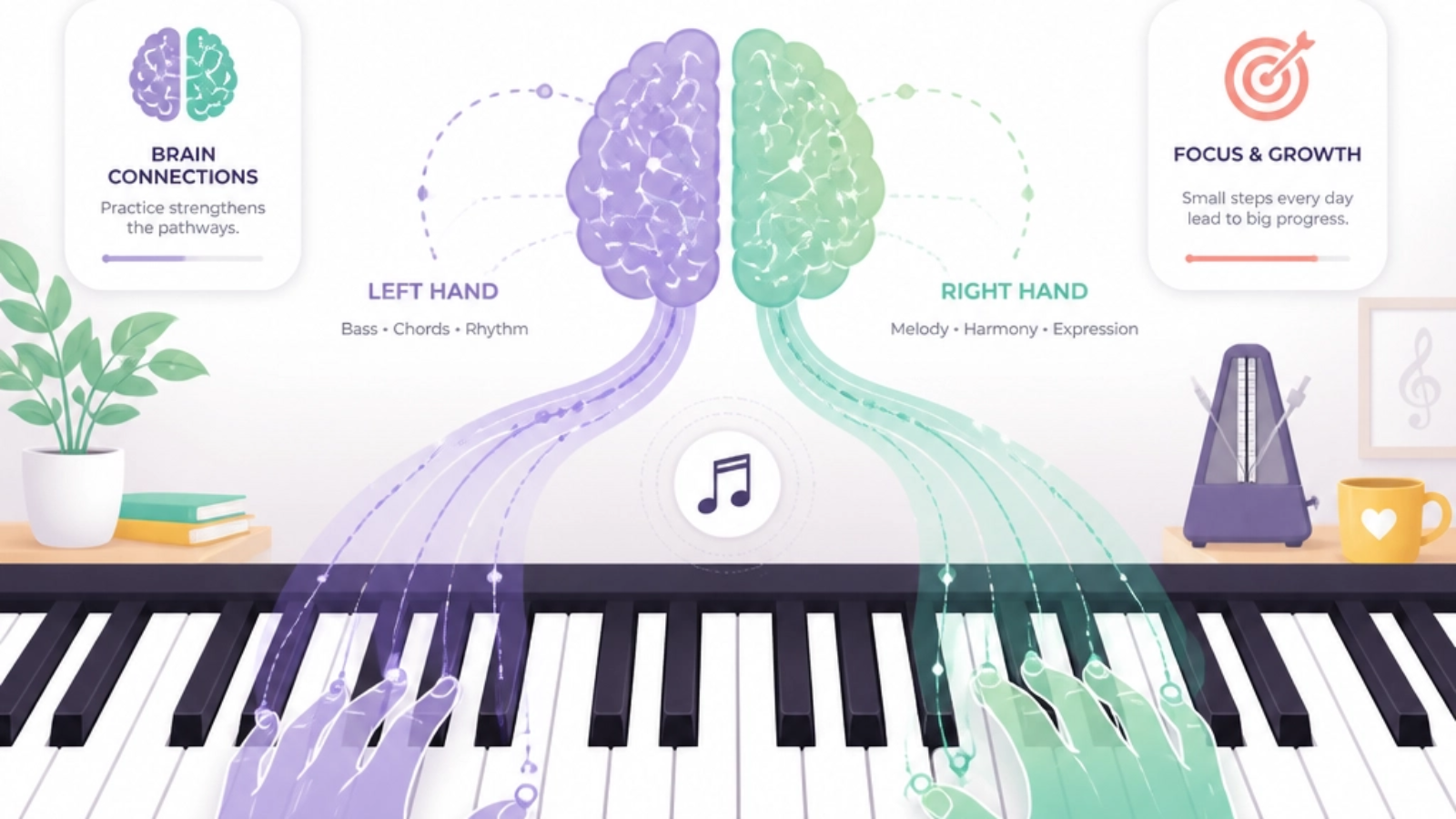
When you begin music lessons Ottawa families often choose for structured learning, piano offers a useful laboratory for studying skill development. You coordinate two hands, read visual symbols, predict sound, control timing, and monitor errors.
However, piano is not valuable because it is universally superior. The instrument remains secondary to your musical goals. If you want to play songs, prepare for school band, understand harmony, or build a foundation for another instrument, piano can provide an efficient pathway.
The science is also more precise than common claims suggest. Piano practice may strengthen neural networks for movement and attention. Yet transfer depends on the quality, duration, and progression of practice. It does not happen automatically.
How music lessons Ottawa build piano coordination
Piano requires simultaneous control of both hands. Each hand may perform a different rhythm, direction, or articulation. Meanwhile, your eyes read notation and your auditory system evaluates the result.
This creates a complex sensorimotor task. You must:
- Plan a sequence of movements.
- Maintain a steady pulse.
- Coordinate left and right hands.
- Track visual information from two staves.
- Compare intended and actual sounds.
- Correct errors without stopping the musical flow.
This process engages motor planning, auditory processing, attention, and working memory. Over time, repeated practice can reduce the cognitive effort needed for familiar patterns.
A 2025 study examined novice pianists across six months. The researchers found dynamic changes in brain activity during piano tasks. These changes depended on the demands of bimanual coordination. The study also found that neural reorganization was context-dependent. Piano training did not produce identical changes in every brain system.
This finding has a direct teaching implication. You need varied tasks. Repeating one easy pattern may improve that pattern. It may not develop flexible coordination.
A teacher can therefore use scaffolding. First, you may play each hand separately. Next, you combine short sections. Then, you vary tempo, articulation, or starting points. Finally, you apply the skill within meaningful repertoire.

Neuroplasticity responds to purposeful repetition
Neuroplasticity describes the nervous system’s capacity to change through experience. In music learning, those changes reflect repeated perception and action.
For example, you hear a rhythm, interpret notation, move your fingers, and evaluate timing. This loop connects auditory, visual, and motor systems. With enough accurate repetition, the brain can make the sequence more efficient.
Accuracy matters. Incorrect repetition can also stabilize inefficient movements. Therefore, practice should include frequent feedback and manageable challenges.
Effective practice usually includes:
- A clear technical or musical objective.
- Slow repetitions that preserve accuracy.
- Short sections rather than unfocused runs.
- Immediate correction of recurring errors.
- Gradual increases in speed or complexity.
- Retrieval without constant teacher prompts.
- Application in a complete musical phrase.
The goal is not to remove conscious attention too quickly. Instead, you should automate basic movements while preserving attention for phrasing, dynamics, and musical structure.
This approach also protects against cognitive overload. If every task is difficult at once, working memory becomes saturated. A qualified teacher can reduce one demand while increasing another. For example, you might maintain the rhythm while playing fewer notes. Later, you can restore the full texture.
Executive function develops through musical decision-making
Executive function includes inhibition, working memory, and cognitive flexibility. Piano practice engages all three.
Inhibitory control helps you stop an incorrect automatic movement. Working memory helps you retain a pattern while reading the next measure. Cognitive flexibility helps you change strategy when a fingering or rhythm does not work.
A 2025 three-level meta-analysis examined 46 studies involving 3,530 children aged 3 to 12. The authors reported a modest overall association between musical training and executive function. Inhibitory control showed the strongest effect among the measured components.
The findings also suggested that longer sessions and longer training periods produced larger effects. Sessions of at least 45 minutes and programs lasting more than 10 weeks showed stronger outcomes in the pooled analysis. Still, the studies varied considerably. These results do not establish one ideal schedule for every learner.
They do support a practical principle: cognitive transfer requires sustained engagement. A single lesson may create attention and motivation. Consistent learning provides the repeated challenge required for adaptation.
One 2026 pilot study also reported improved Stroop performance after a single instrumental lesson among trained musicians. However, the researchers used a single-group, pre–post design. They warned that controlled studies are necessary before drawing causal conclusions.
Therefore, piano lessons should not be marketed as a guaranteed cognitive treatment. They are structured learning experiences that can train several processes at once.
Practice intensity drives transfer
Practice intensity does not simply mean playing loudly or spending more hours at the keyboard. It means the level of purposeful cognitive and motor demand.
High-quality intensity includes:
- Concentrated attention.
- Accurate repetition.
- Progressive difficulty.
- Retrieval from memory.
- Variation across musical contexts.
- Feedback that changes your next attempt.
- Enough spacing for consolidation.
Transfer occurs when you use a learned process in a new setting. For example, you may transfer rhythmic prediction from piano to clarinet. You may transfer score reading from piano to flute. You may transfer harmonic awareness to ukulele accompaniment.
A 2025 longitudinal study followed 68 older adult novices through 12 months of online musical instrument training. Participants used piano keyboards and a tablet-based instrument. The researchers found that objective gains in musical ability predicted some improvements in general cognitive and motor tasks.
The central point is important. Cognitive transfer was associated with the extent of musical learning. Participation alone was not the only variable. Progress mattered.
This supports a goal-based lesson design. If your goal is school-band performance, piano exercises should connect with rhythm, phrasing, key signatures, and score analysis. If your goal is songwriting, practice should include chord progressions and form. If your goal is recreational playing, repertoire selection should remain central.
The instrument is a means. The music gives the practice its direction.

Benefits across childhood, adulthood, and later life
Music learning can be adapted across the lifespan. The neural system remains capable of change in adulthood. However, the learning conditions may differ.
For children, piano can reinforce sequencing, listening, symbol interpretation, and self-regulation. Short, clearly bounded tasks can help maintain attention. A 45-minute lesson may provide enough time for technique, repertoire, and review without excessive cognitive load.
For adults, lessons can support deliberate skill acquisition alongside work and family responsibilities. Flexible scheduling also makes spaced practice more realistic. You can learn online from a quiet room at home. You can also attend the Ottawa studio for direct acoustic feedback.
For older adults, learning a new instrument creates a sustained, multisensory challenge. The 2025 older-adult study suggests that progressive musical development may predict some cognitive transfer. Yet music lessons do not replace medical care or cognitive treatment. They provide an educational activity with potential benefits for coordination, attention, and mental engagement.
At Allegro Ma Non Troppo, instruction is available in English and Spanish. Bilingual teaching can reduce unnecessary language barriers. It also lets families discuss goals and practice strategies in the language that feels most precise.

Piano as a bridge to other instruments
Piano can provide a visual map of pitch. Each key produces one clearly organized note. This layout can support beginners who are learning scales, intervals, chords, and tonal relationships.
Those concepts transfer to other instruments, although the motor demands differ.
- Flute lessons can connect piano pitch patterns with breath control and fingering.
- Clarinet lessons can connect keyboard harmony with register changes and ensemble intonation.
- Ukulele lessons can connect piano chords with chord shapes, strumming, and accompaniment.
- Music theory lessons can connect notation, harmony, rhythm, and analysis across instruments.
For school-band students, piano is optional rather than required. It can help you hear your part within a chord. It can also help you check entrances, identify rhythmic subdivisions, and understand how your line relates to other sections.
However, the best instrument remains the one that matches your purpose. If your primary goal is to improve clarinet tone, clarinet practice must remain central. If you want to perform flute repertoire, flute technique deserves priority. Piano can complement those goals, but it should not replace instrument-specific instruction.
Personalized piano lessons in Ottawa
Allegro Ma Non Troppo offers beginner piano lessons at the Ottawa studio at 90 Genest Street. The teaching approach adapts repertoire, pacing, and technical work to your needs.
You can choose:
- 30-minute in-person lessons at $35.
- 45-minute in-person lessons at $48.
- 60-minute in-person lessons at $63.
- Lesson bundles with transparent savings.
- A Family Plan with 10% savings for three or more members.
- Online lessons for added comfort and scheduling flexibility.
- English or Spanish instruction.
- A free trial lesson before making a commitment.
For example, four 30-minute lessons are $140 $120. Four 45-minute lessons are $192 $180. Four 60-minute lessons are $252 $240.
Online learning can reduce travel time, winter-weather concerns, and transportation demands. You can practise in a familiar environment. In-person lessons can provide direct acoustic interaction and access to the studio’s learning space.
To begin, follow these steps:
- Identify your main musical goal.
- Choose piano or another instrument based on that goal.
- Select a 30-, 45-, or 60-minute format.
- Book a free trial lesson.
- Discuss repertoire, practice time, and learning preferences.
- Use feedback to build a progressive practice plan.
Research references
Olszewska, A. M., Gaca, M., Droździel, D., Jednoróg, K., Marchewka, A., & Herman, A. M. (2025). “Piano Training Induces Dynamic Neuroplasticity of Bimanual Coordination but Not Auditory Processing in Young Adults.” Journal of Neuroscience Research, 103(7), e70067. https://doi.org/10.1002/jnr.70067
Cai, Y., Kang, D., & Xu, X. (2025). “Boosting executive function in children aged 3–12 through musical training: A three-level meta-analysis.” Frontiers in Psychology, 16, 1659927. https://doi.org/10.3389/fpsyg.2025.1659927
Correction: Cai, Y., Kang, D., & Xu, X. (2026). “Correction: Boosting executive function in children aged 3–12 through musical training: A three-level meta-analysis.” Frontiers in Psychology, 17, 1773874. https://doi.org/10.3389/fpsyg.2026.1773874
MacRitchie, J., Chmiel, A., Stevens, C. J., & Dean, R. T. (2025). “Progressively learned musical ability predicts cognitive transfer in older adult novices: A 12-month musical instrument training programme.” Royal Society Open Science, 12(12), 251022. https://doi.org/10.1098/rsos.251022
Gkintoni, E., Kanellopoulou, H., Pouris, C., Vassilopoulos, S. P., Nikolaou, G., & Halkiopoulos, C. (2026). “Cognitive Enhancement Through Music Education: Affective Pathways to Executive Function Improvement in Musicians.” Brain Sciences, 16(2), 161. https://doi.org/10.3390/brainsci16020161
Leave A Comment