
 Cart is empty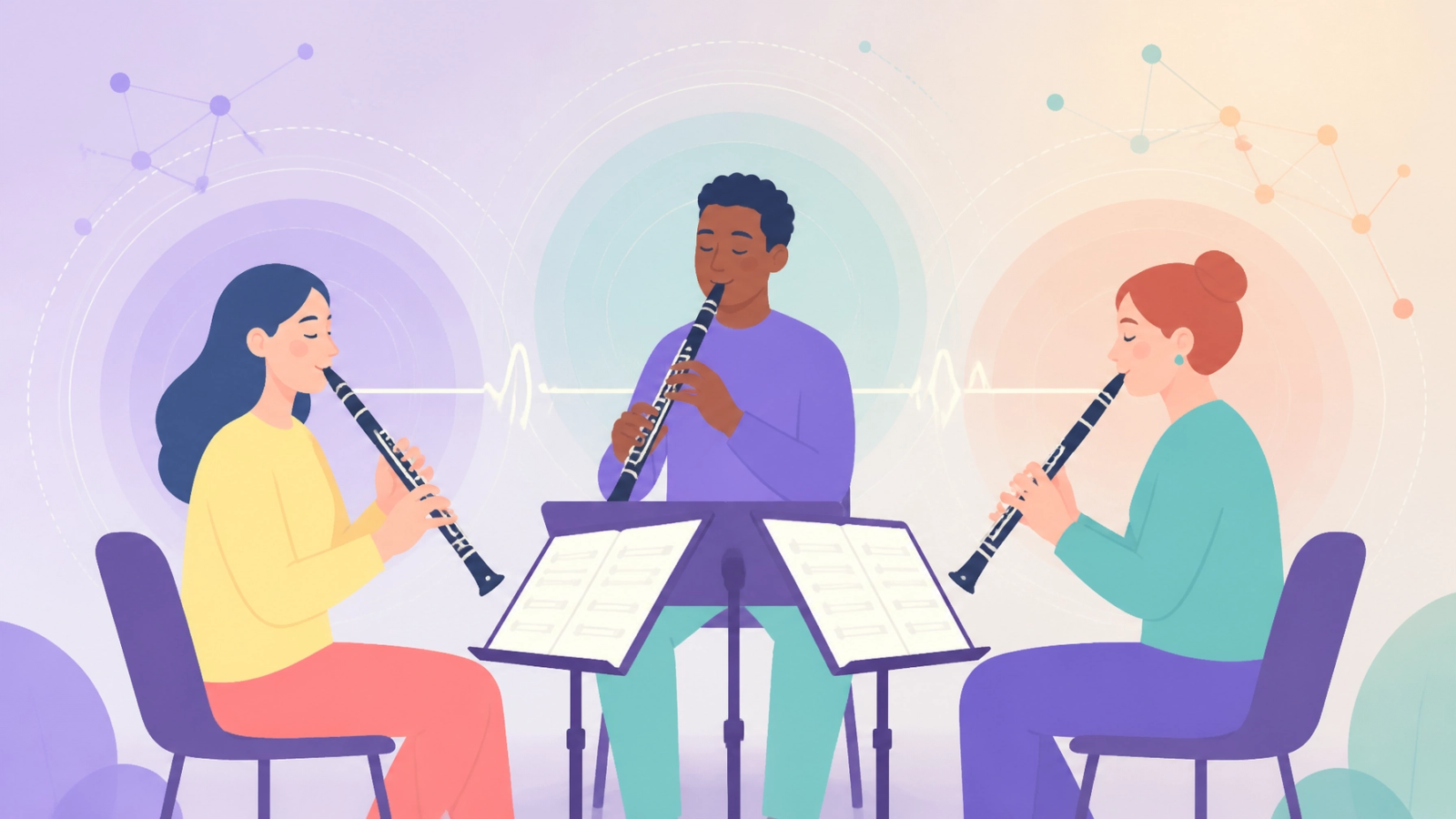
Clarinet ensemble performance depends on more than accurate notes. You must coordinate timing, intonation, articulation, tone, breathing, and attention with other players. This coordination places demands on auditory processing and motor control at the same time.
For that reason, effective music lessons Ottawa students receive should include ensemble-specific preparation. You need to learn how to hear your section, predict its timing, and adjust your motor actions without losing your own internal pulse.
At Allegro Ma Non Troppo, ensemble preparation can also support school band students who are preparing auditions, concerts, festivals, and challenging repertoire. Lessons are available in English and Spanish, both online and in person at the Ottawa studio.
Music Lessons Ottawa and the Science of Ensemble Coordination
When you play in an ensemble, your brain continuously compares intended sound with produced sound. This process involves action–perception coupling. Your fingers, tongue, embouchure, and respiratory muscles generate an action. Your auditory system then evaluates the result.
The nervous system uses this information to update the next motor action. In practice, that means you do not simply play a note and move on. You listen to its timing, pitch, colour, and relationship to the group.
Recent research also shows that feedback can affect different stages of motor learning in different ways. Ploettner and colleagues studied pitch feedback during a repeated finger sequence. Congruent pitch feedback improved immediate, or online, learning. However, those gains did not transfer fully when the feedback disappeared. In contrast, less predictable feedback produced stronger offline improvement after a delay.
This finding has a direct implication for clarinet practice. A teacher should not provide one type of feedback all the time. Instead, practice should move through several stages:
- Use a clear reference tone or model recording during early learning.
- Ask you to identify pitch and timing discrepancies while playing.
- Reduce external guidance so you must monitor your own sound.
- Re-test the passage without the recording, visual cue, or metronome.
- Return to the reference only when you need to diagnose a specific problem.
This approach helps prevent dependence on a single external cue. It also strengthens the internal representation that allows you to perform when the acoustic environment changes.

Auditory Feedback and Clarinet Motor Learning
Clarinet technique involves tightly coordinated motor sequences. A scale, articulated passage, or register transition requires precise timing between finger movement, tongue release, air pressure, and embouchure adjustment.
Auditory feedback helps you detect whether these systems are working together. For example, a rough register change may involve a delayed finger, unstable air pressure, or an altered voicing position. Listening narrows the diagnosis.
In a clarinet ensemble, the listening task becomes more complex. You must distinguish your own sound from the section while tracking the group’s pulse. Therefore, ensemble preparation should use focused listening rather than general repetition.
Try the following sequence with a short passage:
- First, listen for note onsets and rests.
- Next, listen for intonation and unison stability.
- Then, focus on articulation length and consonant timing.
- Finally, listen for balance, blend, and phrase direction.
Record a short excerpt when possible. After playback, answer two questions: What did you expect to hear, and what did you actually hear? This distinction turns vague dissatisfaction into an observable learning target.
However, the evidence should be interpreted carefully. Ploettner, Muehlberg, Psurek, Fricke, and Rumpf studied non-musicians performing a keyboard sequence, not clarinetists in an ensemble. The study therefore supports a motor-learning principle rather than a clarinet-specific prescription.
For individualized technical work, explore our clarinet lessons in Ottawa.
Mental Representations: Hear It, Feel It, Then Play It
Skilled musicians rely on mental representations before movement begins. These representations include an anticipated sound and an anticipated physical sensation.
For clarinetists, the auditory representation may include:
- The target pitch and its stability.
- The desired tone colour.
- The length and shape of an articulation.
- The balance between melody and accompaniment.
- The timing of an entrance within the ensemble.
The kinesthetic representation may include:
- The sensation of relaxed finger motion.
- The position of the tongue before an attack.
- The pressure and direction of the airstream.
- The physical preparation for a register change.
- The amount of effort required for a soft or sustained phrase.
Research on mental representations in clarinet performance has examined how performers anticipate auditory and kinesthetic feedback. Although this work is a scholarly dissertation rather than one of the journal studies listed below, it provides a clarinet-specific framework for understanding imagery.
Use a short imagery cycle before a difficult entrance:
- Read one or two measures without playing.
- Hear the ideal ensemble sound internally.
- Imagine the timing of the breath and first tongue movement.
- Feel the fingers moving through the passage.
- Play once without stopping.
- Compare the result with the original mental model.
This is not passive visualization. It is a form of cognitive rehearsal. It links perception, prediction, and motor planning before physical execution begins.
Music theory can strengthen this process. Understanding harmonic function, rhythmic subdivision, and your role in the texture gives the brain a clearer map of the passage. Our music lesson plans include personalized theory work that can support this type of preparation.

Collaborative Listening Reduces Uncertainty
Ensemble anxiety often increases when you do not know where to direct your attention. You may focus only on your own part. Alternatively, you may attempt to follow every player at once. Both strategies can overload working memory.
Collaborative listening provides a more efficient structure. Zeng’s 2025 study identifies physical coordination, critical peer feedback, distributed leadership, flow, and anxiety reduction as important dimensions of ensemble learning.
The practical goal is not to eliminate every performance error. Instead, you learn how to respond to small discrepancies without treating them as threats. A section can develop this skill through rotating listening roles:
- One player listens for vertical timing.
- One player listens for intonation.
- One player listens for articulation.
- One player listens for balance and phrase direction.
- Players then exchange observations and repeat the excerpt.
This process creates shared responsibility. You do not carry the entire performance alone. You also learn which musical cues deserve priority.
Research on ensemble timing supports this approach. Li, Ward, Stables, Chua, Howe, Quinn, and Wing examined how violinists corrected timing through auditory cues. Their results showed that rhythmic complexity affected how strongly players adjusted to accompaniment parts. The study also showed that players often relied more on parts that were rhythmically or melodically similar to their own.
For clarinet ensemble work, this suggests a useful rehearsal order. First, stabilize passages with shared rhythm. Next, add contrasting accompaniment patterns. Finally, practice with reduced visual guidance. This sequence develops auditory prediction gradually.
Respiratory Muscle Training for Wind Players
Breathing in ensemble performance has two functions. It supports sound production, and it communicates timing. A coordinated breath can prepare an entrance across an entire section.
Respiratory muscle training has received increasing attention in wind-player research. The requested 2025 randomized study, “Effect of inspiratory muscle training on wind players: a randomized study,” is identified by DOI 10.23736/S2784-8477.25.02199-0. The accessible indexed record did not provide verified author names or complete publication details. Therefore, those details should be checked against the publisher’s record before formal academic citation.
A 2026 systematic review and meta-analysis by Ces-Lafuente, Rodríguez-Gude, Martín-Palomo, and Lantarón-Caeiro examined respiratory training in wind instrumentalists and vocalists. The review’s DOI is 10.1016/j.jvoice.2026.04.017. A separate 2026 review by Bhattacharjee, Fahim, and Kansal synthesized evidence on inspiratory muscle training in musicians. Its DOI is 10.7860/JCDR/2026/88435.22898.
Together, these sources suggest potential benefits for inspiratory strength, respiratory endurance, breath control, and perceived fatigue. They also emphasize that musician-specific evidence remains limited and methodologically varied.
In practical clarinet preparation, respiratory work should remain measured and individualized:
- Practice silent inhalations that align with the written phrase.
- Coordinate the breath with a steady internal subdivision.
- Sustain comfortable tones without forcing volume or duration.
- Use gradual repetition rather than maximal effort.
- Stop if you experience pain, dizziness, or unusual breathlessness.
- Consult a qualified clinician before using resistance-based respiratory devices.
Online lessons can make this work easier to schedule. They also provide a comfortable home environment and remove travel, traffic, and seasonal weather barriers. In-person lessons at 90 Genest Street in Ottawa provide direct acoustic interaction and immediate teacher feedback.

A Practical Ensemble Preparation Protocol
Use this 25-minute structure before a rehearsal, audition, or school band performance:
- Five minutes: silent score study, including breaths, entrances, rests, and harmonic landmarks.
- Five minutes: long tones or simple unison notes with attention to pitch stability.
- Five minutes: rhythm-only work using clapping, tapping, or articulated air.
- Five minutes: short excerpts with one listening target at a time.
- Five minutes: complete performance without stopping, followed by structured reflection.
The final run should test transfer. Remove one support, such as the metronome or reference recording. Then assess whether your internal timing and sound concept remain stable.
This protocol combines scaffolding with progressive independence. It also develops auditory processing, executive attention, respiratory coordination, and motor prediction. Most importantly, it turns ensemble performance into a trainable system rather than an unpredictable event.
How Allegro Ma Non Troppo Supports Ensemble Preparation
Allegro Ma Non Troppo offers private clarinet instruction for beginners and intermediate musicians. Specialized support is available for school band repertoire, auditions, festivals, and performances.
You can choose:
- Online instruction from the comfort of your home.
- In-person instruction at the Ottawa studio.
- English or Spanish instruction.
- Flexible 30-, 45-, or 60-minute lesson options.
- A free trial lesson before making a commitment.
- Lesson bundles and family savings for three or more members.
Lessons are personalized to your repertoire and goals. They can combine clarinet technique, music theory, critical listening, mental rehearsal, and ensemble timing.
Research Sources
-
Ploettner, P., Muehlberg, C., Psurek, F., Fricke, C., & Rumpf, J.-J. (2025). “Divergent effects of pitch feedback on online and offline motor sequence learning.” Frontiers in Behavioral Neuroscience, 19, 1680277. DOI: 10.3389/fnbeh.2025.1680277.
-
Zeng, W. (2025). “Developing Collaborative Skills: How Music Students Learn to Listen and Respond in Ensemble Settings.” International Journal of Education and Humanities, 20(3), 87–89. DOI: 10.54097/02g38933.
-
“Effect of inspiratory muscle training on wind players: a randomized study.” Minerva Respiratory Medicine (2025). DOI: 10.23736/S2784-8477.25.02199-0. Author details were not available in the accessible indexed record.
-
Ces-Lafuente, P., Rodríguez-Gude, C., Martín-Palomo, A., & Lantarón-Caeiro, E. (2026). “Impact of Respiratory Training on Wind Instrumentalists and Vocalists: A Systematic Review and Meta-Analysis.” Journal of Voice. DOI: 10.1016/j.jvoice.2026.04.017.
-
Bhattacharjee, B., Fahim, T., & Kansal, K. J. (2026). “The Impact of Inspiratory Muscle Training on Musicians: A Comprehensive Review.” Journal of Clinical and Diagnostic Research, 20(2), 52. DOI: 10.7860/JCDR/2026/88435.22898.
-
Li, M. S., Ward, D., Stables, R., Chua, W. L., Howe, J., Quinn, K. A., & Wing, A. M. (2026). “Phase correction in violin ensemble performance.” Scientific Reports, 16, 24231. DOI: 10.1038/s41598-026-46205-6.
-
Allen, D. R. “Mental Representations in Clarinet Performance.” Doctoral dissertation, University of North Carolina at Greensboro. Scholarly dissertation.
Leave A Comment