
 Cart is empty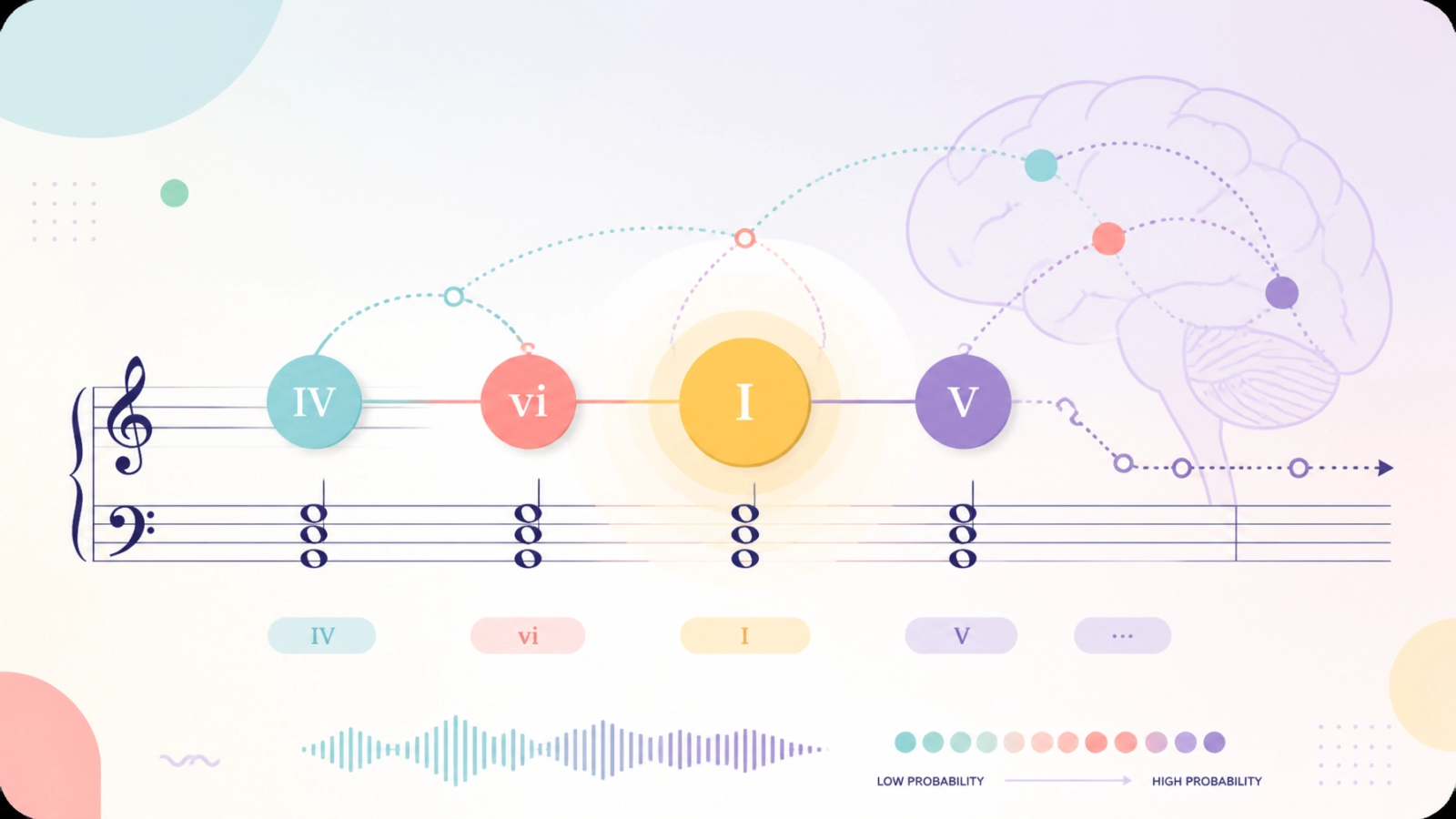
When you hear a dominant seventh chord, you often anticipate its resolution before it arrives. This response reflects more than stylistic familiarity. It reveals how your brain predicts musical structure through statistical learning, tonal context, and auditory working memory.
In music lessons Ottawa students can study these processes as both theory and perception. Harmonic expectation explains why a cadence can feel complete, delayed, or surprising. It also clarifies how musicians interpret chord progressions, analyze form, and perform with structural awareness.
This article examines predictive coding in tonal music. It also connects current neuroscience with practical study methods for serious learners, composers, performers, and students preparing for advanced theory examinations.
How music lessons Ottawa explain harmonic prediction
Harmonic expectation describes your anticipation of a future chord or tonal event. The brain estimates which event will follow the current context. It then compares the prediction with the sound that actually arrives.
Predictive processing models describe perception as an ongoing cycle:
- The brain constructs an internal model of the musical context.
- That model generates probabilities for possible upcoming events.
- Incoming sound provides sensory evidence.
- The brain calculates a prediction error.
- The system updates its model when the event differs from expectation.
This process operates at several timescales. Your auditory system tracks individual intervals within milliseconds. It also monitors chord functions across measures. At a broader level, it predicts phrase endings, key changes, and formal returns.
Therefore, harmonic listening involves both bottom-up and top-down processing. Acoustic frequencies provide the sensory input. However, tonal knowledge determines how you interpret those frequencies within a musical hierarchy.
Tonal hierarchy and the stability of chords
In tonal music, not all notes and chords possess equal psychological weight. The tonic functions as a central reference point. Other scale degrees relate to it with varying levels of stability.
A major-key hierarchy often gives strong structural roles to:
- The tonic, which establishes rest and tonal identity.
- The dominant, which creates directional pressure toward the tonic.
- The subdominant, which increases departure from the tonic.
- Diatonic chords, which receive different levels of contextual support.
- Chromatic chords, which may create greater uncertainty or redirect the tonal center.
This hierarchy does not operate as a rigid rulebook. Instead, it provides a probabilistic framework. A V–I progression usually carries a high probability of resolution. Yet composers can delay, avoid, or reinterpret that resolution.
Your brain detects these relationships through repeated exposure. Statistical learning gradually extracts regularities from the music you hear. With enough experience, you no longer need to calculate every chord consciously. Your auditory system activates likely continuations before conscious analysis begins.
Cassano-Coleman, Izen, and Piazza’s 2025 study provides relevant evidence. Their findings indicate that listeners systematically integrate hierarchical tonal context, regardless of formal musical training. Thus, tonal organization can influence perception even when you cannot name the chords.
Predictive coding, surprise, and harmonic tension
Predictive coding distinguishes between expected information and surprising information. In information theory, surprise increases when an event has a low probability within the current context.
For example, a tonic chord after a dominant may generate a small prediction error. A deceptive cadence may generate a larger one. The unexpected chord does not simply sound “wrong.” Instead, it forces your brain to revise its current model.
This distinction matters in analysis. A deceptive cadence, such as V–vi, remains intelligible because the listener has already established a tonal context. The progression violates one expectation while preserving others. The key may remain stable, even though the predicted harmonic destination changes.
Researchers often distinguish surprise from entropy:
- Surprise measures how unexpected the event becomes after it occurs.
- Entropy measures the uncertainty present before the event occurs.
- Low entropy supports confident predictions.
- High entropy allows several continuations to remain plausible.
A well-prepared cadence usually reduces uncertainty over time. By contrast, chromatic sequences, tonicizations, and modulatory passages can increase entropy. However, a later confirmation may restore a stable tonal model.
This framework helps explain why harmonic tension depends on context. The same chord can sound stable in one progression and unstable in another. Meaning emerges from relationships among notes, chords, meter, and phrase position.
Auditory working memory and tonal context
Harmonic expectation relies on auditory working memory. You must retain recent pitches and chords while integrating new information. This process allows you to compare the present harmony with earlier tonal events.
Working memory does not store every acoustic detail equally. Instead, it compresses musical information into structured representations. You may remember a progression as “moving away from the tonic” rather than retaining each individual frequency.
Tonal hierarchy supports this compression. It organizes a sequence into functional categories such as tonic, predominant, and dominant. Consequently, you can follow complex harmonic motion without consciously rehearsing every note.
Formal study strengthens this ability through deliberate attention. In a structured music theory lesson plan, you can practice identifying:
- Chord functions within a key.
- Cadential patterns and phrase closure.
- Secondary dominants and tonicizations.
- Modulations and pivot chords.
- Voice-leading tendencies.
- Chromatic events that create prediction error.
These exercises connect symbolic notation with auditory evidence. That connection matters because advanced theory should not remain abstract. You should hear the harmonic function, label it, and explain its effect on expectation.
What musical expertise changes
Musical expertise does not create an entirely separate auditory system. Rather, training refines the internal models that guide perception. Expert musicians often form more detailed predictions. They also detect smaller deviations from expected structure.
Mischler and colleagues’ 2025 study examined how musical expertise influences neural encoding. The research suggests that expertise affects both disentangled representations and contextual encoding of music. In practical terms, trained listeners can separate musical features while also integrating them within a broader context.
For you, this means that theory study can improve more than vocabulary. It can sharpen auditory categorization, strengthen structural memory, and increase sensitivity to voice-leading patterns.
However, expertise does not mean predicting every event correctly. Advanced musicians often maintain several competing hypotheses. They may recognize that a phrase could resolve to the tonic, move toward a related key, or continue sequentially.
This flexible prediction supports interpretation. A performer who understands several possible continuations can shape timing, articulation, and emphasis without reducing music to mechanical rules.
A research-informed method for studying harmony
You can train harmonic expectation through a cycle of prediction, listening, and explanation. Begin with short examples. Then increase complexity as your predictions become more reliable.
Use this sequence:
- Establish the key by singing or playing the tonic and scale.
- Hear a progression without looking at the score.
- Predict the next chord before it sounds.
- Identify the actual chord and compare it with your prediction.
- Label the function, inversion, and voice-leading.
- Explain why the event felt stable, tense, or surprising.
- Repeat the progression in another key.
- Test the same function in a different musical style.
This method develops statistical learning while preserving analytical precision. It also encourages error-based learning. A wrong prediction becomes useful when you can identify which assumption produced it.
You can apply the method through music theory lessons online. Online study offers a comfortable environment for repeated listening, screen sharing, and score annotation. It also removes travel time, which can make regular practice easier to sustain.
At Allegro Ma Non Troppo, instruction is available in English or Spanish. You can request lecciones de teoría musical when bilingual access improves clarity. Lessons also adapt to your level, whether you are beginning formal harmony or reviewing advanced tonal analysis.
From tonal prediction to neural plasticity
Repeated prediction and correction can support experience-dependent neural plasticity. Each practice cycle strengthens associations among notation, sound, motor action, and harmonic function.
This process does not imply that every music lesson produces a measurable neurological change. Instead, it describes how sustained learning can refine neural representations over time. Consistent practice helps you recognize patterns faster and allocate attention to higher-level musical decisions.
Benjamin and colleagues’ 2026 PLOS Biology study offers an important developmental perspective. The reported findings show that newborns form musical predictions based on rhythmic, rather than melodic, structure. This result suggests that predictive auditory processing develops unevenly across musical dimensions.
Development and training therefore interact. Some predictive capacities may emerge early. Tonal and harmonic expertise, however, requires extensive exposure, cultural learning, and deliberate instruction.
Kendüzler’s 2026 scoping review adds a pedagogical perspective. It identifies interval training as a foundation for pitch cognition, tonal awareness, and auditory feedback. Because intervals connect local pitch movement with larger tonal relationships, they provide an important bridge into harmonic expectation.
How to begin advanced harmonic study
You do not need perfect pitch to study harmonic expectation. Relative pitch, attentive listening, and systematic feedback provide effective foundations.
A practical starting plan includes:
- Study one tonal function at a time.
- Compare authentic, half, deceptive, and plagal cadences.
- Sing the bass line before analyzing upper voices.
- Reduce progressions to Roman numerals.
- Listen for scale-degree tendencies.
- Predict before checking the score.
- Transpose short examples to strengthen generalization.
- Record your explanations and review them later.
You can also connect harmonic analysis with an instrument. Beginner piano lessons provide a direct visual and tactile model of chord structure. Flute lessons and clarinet lessons can apply harmonic expectation to phrasing, intonation, and ensemble timing.
The learning environment matters as well. Online and in-person formats offer different advantages. Your choice can depend on comfort, access, schedule, and the amount of screen-based notation work you prefer.
Conclusion
Harmonic expectation emerges from the interaction of tonal hierarchy, statistical learning, auditory working memory, and predictive coding. Your brain does not receive chords as isolated objects. Instead, it interprets them within a continuously updated model of tonal structure.
That model explains why cadences create direction, why deceptive resolutions remain meaningful, and why musical expertise improves contextual prediction. It also provides a practical framework for advanced study.
When you predict, listen, analyze, and revise your interpretation, you train the same cognitive systems that make harmonic structure perceptually coherent. In that process, theory begins to resonate as sound rather than remain only a system of labels.
Research Cited
-
Cassano-Coleman, R. Y., Izen, S. C., & Piazza, E. A. (2025). “Listeners systematically integrate hierarchical tonal context, regardless of musical training.” Psychological Science. https://doi.org/10.1177/09567976251400331
-
Mischler, G., Li, Y. A., Bickel, S., Mehta, A. D., & Mesgarani, N. (2025). “The impact of musical expertise on disentangled and contextual neural encoding of music revealed by generative music models.” Nature Communications. https://doi.org/10.1038/s41467-025-63961-7
-
Benjamin, L., et al. (2026). “Human newborns form musical predictions based on rhythmic but not melodic structure.” PLOS Biology. https://doi.org/10.1371/journal.pbio.3003600
-
Kendüzler, M. (2026). “Intervals as musical fingerprints: Perceptual and pedagogical insights: a scoping review.” Frontiers in Psychology, 17, 1740840. https://doi.org/10.3389/fpsyg.2026.1740840
-
For broader context, consult the review by Vuust, P., Heggli, O. A., Friston, K. J., & Kringelbach, M. L. (2022). “Music in the brain.” Nature Reviews Neuroscience, 23, 287–305. https://doi.org/10.1038/s41583-022-00578-5
Leave A Comment