
 Cart is empty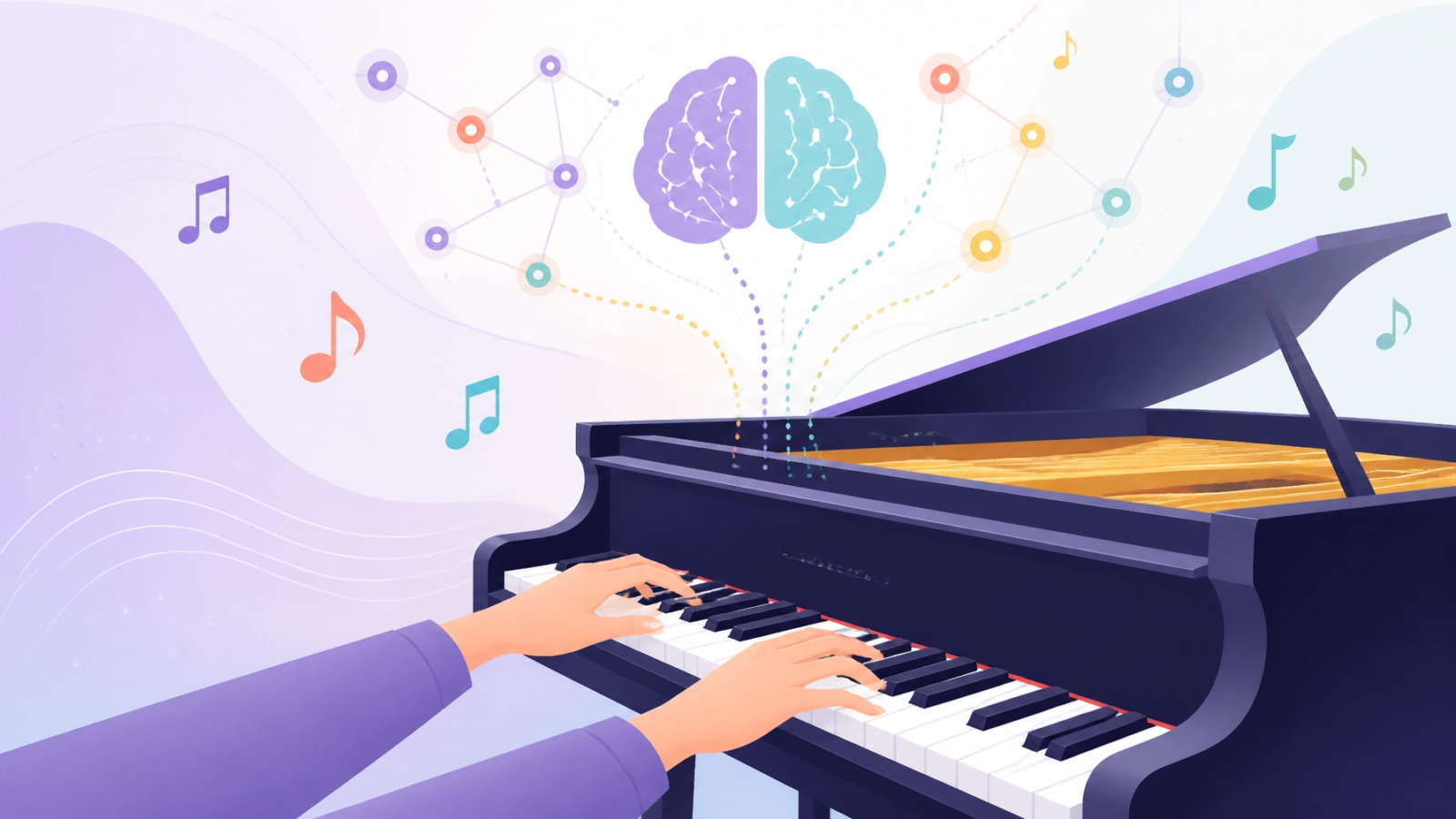
Piano mastery is a complex form of sensorimotor learning. You read notation, predict sound, coordinate both hands, monitor errors, and adjust movement. Therefore, music lessons Ottawa students pursue can train specific motor and cognitive processes through structured practice.
However, piano study does not guarantee a general increase in intelligence. Current evidence supports more precise conclusions. The strongest findings concern bimanual coordination, motor automatization, executive control, working memory, and fine motor precision.
At Allegro Ma Non Troppo, you can study piano in person at the Ottawa studio or online. Lessons are available in English or Spanish. Expert teachers adapt the repertoire, pacing, and practice demands to your experience and goals.
How music lessons Ottawa support bimanual coordination
Piano performance requires both hands to act independently and together. One hand may play a melody. The other may provide harmony, rhythm, or accompaniment.
These roles often differ in timing, articulation, dynamics, and movement direction. Your nervous system must coordinate them while maintaining a shared pulse. It must also inhibit movements that interfere with accuracy.
This process depends on distributed motor networks. These networks include premotor regions, parietal areas, primary motor cortex, the cerebellum, and subcortical structures. Together, they support planning, sequencing, timing, and error correction.
A 2025 study examined novice pianists across six months of training. The researchers used functional MRI during piano performance and auditory tasks. They found dynamic changes in cortical and subcortical motor networks.
The changes reflected the demands of bimanual coordination. Early performance required greater spatial attention. With training, movement execution became more automated. Increased activation in dorsal premotor and parietal cortices also diminished compared with skilled musicians.
Importantly, the researchers did not find equivalent training-related changes in auditory processing. This distinction matters. Piano training may reshape motor coordination networks without broadly changing every auditory function.
The full citation is:
- Olszewska, A. M., Gaca, M., Droździel, D., Jednoróg, K., Marchewka, A., & Herman, A. M. (2025). “Piano Training Induces Dynamic Neuroplasticity of Bimanual Coordination but Not Auditory Processing in Young Adults.” Journal of Neuroscience Research, 103(7), e70067. https://doi.org/10.1002/jnr.70067. See also the PubMed record.

This evidence supports a gradual teaching sequence. You should not begin complex coordination at performance speed. Instead, your teacher can use scaffolding.
Scaffolding divides a difficult task into manageable steps. Then, the teacher reduces assistance as control improves. A structured sequence may include:
- Practising each hand separately.
- Combining hands at a slower tempo.
- Using rhythmic subdivisions.
- Repeating short musical fragments.
- Varying the starting point of each fragment.
- Increasing tempo only after accuracy stabilizes.
- Applying the pattern to new repertoire.
This approach develops coordination without allowing inefficient movement to become automatic.
Motor automatization and the transition from effort to fluency
Motor automatization does not mean that the brain stops working. Instead, control becomes more efficient.
At first, you may consciously monitor every finger. You may also rely heavily on visual attention. With accurate repetition, the sequence becomes easier to retrieve. Attention can then shift toward phrasing, voicing, harmony, and interpretation.
This transition resembles learning a new route. Early navigation requires deliberate decisions. Later, the route becomes familiar. Piano practice follows a similar progression, although complex repertoire can return you to a more effortful stage.
Effective practice should therefore distinguish between two goals:
- Building a reliable movement pattern.
- Applying that pattern under musical and performance demands.
To support both goals, vary the conditions of retrieval. Practise with different tempos, articulations, dynamics, and starting points. This process strengthens procedural memory and reduces dependence on a single context.
You should also monitor tension. Excess force can reduce precision and limit speed. Efficient technique uses appropriate movement, not maximum muscular effort.
Executive function and working memory in piano learning
Executive function includes inhibitory control, cognitive flexibility, planning, and working-memory updating. Piano learning places repeated demands on each process.
For example, you may need to hold a chord sequence in working memory. At the same time, you read the next measure and monitor the current sound. You must also continue after an error rather than stopping automatically.
A complex passage can require you to:
- Retain a rhythm while changing finger patterns.
- Read ahead while performing the current measure.
- Inhibit an incorrect fingering.
- Shift attention from rhythm to articulation.
- Compare the sound with your intended interpretation.
- Revise your strategy when a passage remains unstable.
These actions create a continuous perception–action loop. You encode information, produce a movement, hear the result, and update the next response.
The cognitive transfer question requires caution. Improvements in piano-related working memory do not automatically transfer to every academic or daily task. Researchers distinguish between near transfer and far transfer.
Near transfer involves related skills. For example, a learner may improve at musical sequence recall. Far transfer involves unrelated outcomes, such as broad reasoning ability. Current evidence for far transfer remains mixed.
Therefore, piano should be approached as an integrated cognitive and motor discipline. Its clearest benefits relate to the skills you practise consistently.
What the PIANO-Cog protocol adds to the evidence
The PIANO-Cog study examines whether remote piano training can influence executive function, motor performance, and brain microstructure in adults over 50.
It is important to identify the study correctly. The 2026 publication is a peer-reviewed study protocol. It describes planned methods. It does not report final treatment outcomes.
The protocol proposes an eight-week randomized feasibility trial. It includes 50 healthy non-musicians over age 50. Participants in the training group receive weekly instructional videos and a manual. They practise for 30 minutes, five days per week.
The study targets several outcomes:
- Processing speed.
- Response inhibition.
- Attention switching.
- Working-memory updating.
- Fine and gross motor performance.
- Gray matter microstructure.
- White matter microstructure.
The researchers plan to use advanced diffusion MRI methods. These methods may help examine neurite density, soma characteristics, and other microstructural measures.
The protocol also uses progressive task design. Participants begin with separate hands. Later, they practise hands together, scales, arpeggios, sight-reading, and metronome activities.
The full citation is:
- Rogers, F., Erdem, E., & Metzler-Baddeley, C. (2026). “Protocol for an unblinded randomised controlled feasibility trial of Piano Instruction for Adult Novices as Online Cognitive intervention (PIANO-Cog): a novel remote piano training programme for cognitive and motor functions in older age.” Pilot and Feasibility Studies, 12, 13. https://doi.org/10.1186/s40814-025-01746-x.
The study design is relevant to online learners. It tests whether structured home practice is acceptable and feasible. It does not yet prove that remote piano training produces cognitive or brain changes.

What older-adult piano research currently shows
A 2025 randomized controlled trial examined piano practice and quality of life in 156 healthy older adults. Participants joined either piano practice or music listening groups.
Both groups attended weekly 60-minute sessions for 12 months. Compared with music listening, piano practice improved physical, psychological, and environmental quality-of-life domains. The study did not find a significant group difference in social quality of life.
The researchers also examined gray matter volume. Changes in quality of life were associated with volume increases in the bilateral amygdala and left pallidum. These regions participate in reward, motivation, and emotional processing.
The findings support a measured interpretation. Piano practice can contribute to quality of life and may relate to neural plasticity. However, the results do not establish that piano lessons prevent disease. They also do not imply identical outcomes for every learner.
The full citation is:
- Worschech, F., Marie, D., Sinke, C., Kliegel, M., Jünemann, K., Scholz, D. S., Krüger, T. H. C., James, C. E., & Altenmüller, E. (2025). “Quality of life in older adults is enhanced by piano practice: Results from a randomized controlled trial.” Annals of the New York Academy of Sciences, 1550(1), 239–254. https://doi.org/10.1111/nyas.15397. The abstract is available through PubMed.

A structured lesson design for piano mastery
Research on skill acquisition supports progressive overload, feedback, spacing, and variation. Your lesson should therefore have a clear cognitive and motor purpose.
A 45- or 60-minute lesson might include:
- Posture, movement efficiency, and technical preparation.
- Scales or coordination patterns.
- A focused repertoire passage.
- Rhythm or metronome work.
- Sight-reading and visual-to-motor translation.
- Memory retrieval without continuous visual reference.
- A performance attempt.
- A specific practice assignment.
Your home practice should follow the same logic. Short, focused sessions often produce better information than unfocused repetition.
Try this sequence:
- Select one measurable objective.
- Practise slowly enough to detect errors.
- Stop and correct inaccurate movements.
- Repeat the corrected pattern.
- Test it with a different starting point.
- Record a brief performance.
- Note the next adjustment.
This method turns practice into an evidence-informed feedback system. Each note becomes part of a larger network involving movement, prediction, working memory, and sound.
At Allegro Ma Non Troppo, piano lessons Ottawa are available online or in person. The studio offers a dedicated learning environment. Online lessons provide comfort and scheduling flexibility from home.
You can study in English or Spanish. A bilingual lesson can reduce language barriers while preserving precise musical terminology. A free trial lesson also allows you to assess the teacher, repertoire, format, and practice expectations before committing.
You may also review the studio’s music lesson plans for available lesson formats. Students who want deeper analytical preparation can explore Allegro’s article on the neuroscience of piano mastery.
Piano practice does not change the brain through repetition alone. It changes learning demands through accurate, sustained, and progressively challenging practice. When your lessons align coordination, working memory, executive control, and musical interpretation, your practice can resonate with the principles of motor learning and neuroplasticity.
Leave A Comment