
 Cart is empty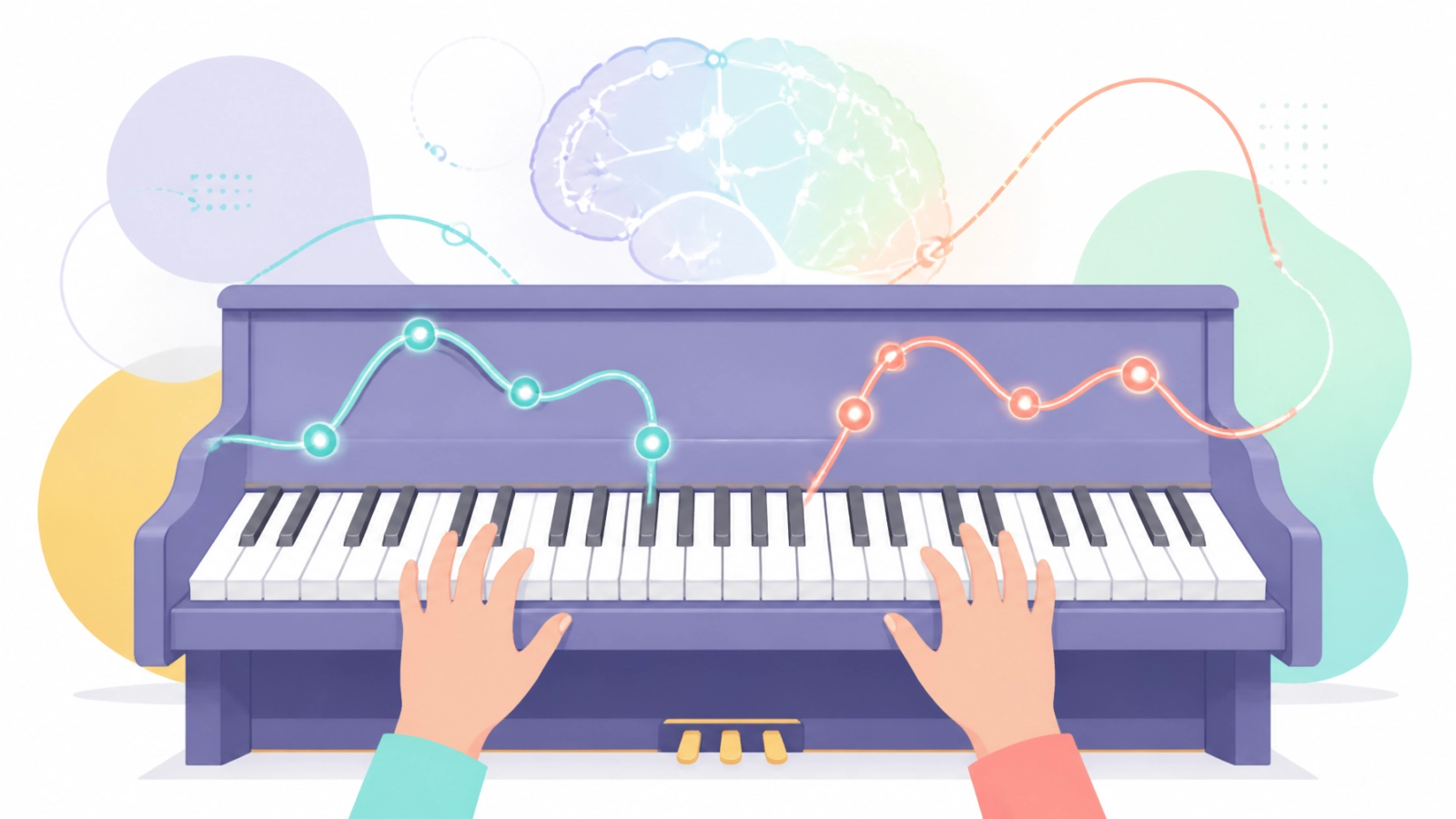
When you begin piano, your brain must coordinate timing, movement, attention, memory, and auditory feedback at the same time. This makes piano an effective model for studying learning-related brain change. Current evidence provides a more precise message than the common claim that music simply “makes you smarter.” Piano training appears to reshape motor and auditory-motor networks in a context-dependent way.
For students considering music lessons Ottawa, this research has practical relevance. It shows why carefully sequenced practice matters, why coordination develops gradually, and why a teacher’s scaffolding can help you move from conscious effort toward efficient musical action.
What neuroplasticity means in piano learning
Neuroplasticity refers to the nervous system’s capacity to change in response to experience. These changes can involve synaptic efficiency, functional brain activity, network coordination, and, over longer periods, structural adaptation.
When you learn a piano passage, several systems interact:
- Motor regions plan and control finger movements.
- Auditory regions process pitch, rhythm, and sound quality.
- Parietal networks support spatial attention and keyboard orientation.
- The cerebellum contributes to timing, prediction, and movement refinement.
- Working memory temporarily holds patterns, fingering, and musical instructions.
- Performance-monitoring systems detect errors and guide correction.
At the beginning, each note may require deliberate attention. You may need to look at your hands, count aloud, and consciously remember which finger comes next. With practice, some of this processing becomes more automated. Your movements can then follow larger patterns rather than isolated instructions.
This does not mean that attention becomes irrelevant. Instead, attention can be redirected toward phrasing, dynamics, harmonic structure, and expressive decisions. In this sense, technical fluency creates cognitive space for musical interpretation.
Music lessons Ottawa and the evidence on bimanual coordination
The featured study examined how piano training changes the brain over time:
Olszewska, A. M., Gaca, M., Droździel, D., Jednoróg, K., Marchewka, A., & Herman, A. M. (2025). Piano Training Induces Dynamic Neuroplasticity of Bimanual Coordination but Not Auditory Processing in Young Adults. Journal of Neuroscience Research, 103(7), e70067. https://doi.org/10.1002/jnr.70067
You can read the PubMed record and the publisher’s DOI record.
The researchers studied 24 healthy female novice pianists between 18 and 23 years of age. The participants completed 26 weeks of piano training. They underwent fMRI scans at weeks 1, 6, 13, and 26. During scanning, they used an MRI-compatible keyboard while completing bimanual and unimanual coordination tasks.
The design allowed the researchers to observe how brain activity changed during the learning process rather than only comparing beginners with experienced musicians at one point in time.

The main findings were specific:
- Piano training produced dynamic neuroplastic reorganization in motor and auditory-motor integrative networks.
- Brain activation changed across the 26-week period rather than following one simple linear pattern.
- Activation decreased over time in several regions, especially right motor areas associated with control of the left hand.
- The pattern was consistent with a shift from spatial attention toward more automated movement.
- Bimanual coordination improved behaviorally.
- The researchers found no significant training-related changes in auditory processing, either neurally or behaviorally.
The decrease in activation should not be interpreted as reduced learning. In many motor-learning contexts, lower activation can reflect improved efficiency. A beginner may recruit more attentional and planning resources to perform a movement. As the movement becomes more predictable, the brain may execute it with less need for conscious control.
However, this interpretation requires care. Reduced activation does not always mean better performance. The meaning depends on the task, brain region, timing, and behavioral results. In this study, the imaging findings were paired with improved bimanual coordination, supporting an optimization account.
What the study does not prove
The study provides strong evidence for training-related changes in coordination networks. It does not show that piano training automatically improves every form of cognition.
Most importantly, the researchers found no significant changes in auditory processing. This result matters because it places a boundary around popular claims about music education. Learning to play piano may improve the trained coordination between movement and sound without necessarily changing basic auditory processing within a six-month period.
The sample also had important limitations. It included young adult women who were piano novices. Therefore, you should not assume that the same time course applies identically to children, older adults, experienced musicians, or every learner.
The findings also do not establish direct improvements in intelligence, academic achievement, or general executive function. Other research reviews have explored broader relationships between musical training and the adult brain, including Olszewska and colleagues’ review in Frontiers in Neuroscience. Still, evidence should be interpreted according to the task that was trained and the outcome that was measured.
A precise conclusion is more useful: structured piano practice can strengthen the neural systems that support coordinated musical movement, while transfer to unrelated abilities may be limited or variable.
How to apply the findings to piano practice
The study supports several principles for effective instruction. These principles do not reproduce the experiment directly. Instead, they translate its motor-learning findings into practical pedagogy.
First, you should practise coordination in small, controlled units. If both hands fail at once, reduce the task:
- Learn each hand separately.
- Combine the hands at a slower tempo.
- Isolate the transition where coordination breaks down.
- Repeat the pattern with consistent fingering.
- Increase speed only after accuracy becomes stable.
This sequence acts as scaffolding. It reduces task demands while preserving the musical goal. Then, as your control improves, the teacher can gradually remove the support.
Second, use rhythmic structure as a coordination framework. For example, one hand may play steady quarter notes while the other plays a repeating pattern of eighth notes. This trains temporal prediction and helps you hear each layer within the larger harmony.
Third, use spaced repetition. Several short practice periods distributed across the week can give your brain repeated opportunities to consolidate a motor sequence. A single long session may create fatigue without producing the same quality of attention.
Fourth, include error monitoring. When a passage fails, do not simply restart from the beginning. Identify whether the problem involves timing, fingering, visual orientation, tension, or memory. Specific feedback helps your nervous system update the movement plan.
Finally, connect technique with musical meaning. Once a passage becomes more automatic, direct attention toward articulation, balance, phrasing, and harmonic direction. Automation should not flatten the music. It should give you greater control over it.
From piano coordination to other instruments
Bimanual coordination principles transfer most directly to tasks that require simultaneous control of different physical actions. The exact movements differ across instruments, but the learning logic remains comparable.
In flute lessons, you coordinate finger patterns, breath pressure, articulation, posture, and auditory feedback. A teacher can scaffold these demands by separating tone production from complex fingering, then recombining them through short musical phrases.
In clarinet lessons, the fingers must coordinate with embouchure, airflow, tongue movement, and register changes. Slow transitions help your motor system predict the timing between the fingers and the sound.
In ukulele lessons, one hand forms chord shapes while the other controls strumming or picking. This creates a clear parallel with piano’s division of labor between simultaneous movement patterns.
Music theory provides the cognitive map behind these actions. Through online music theory lessons, you can identify meter, chord function, intervals, and harmonic expectations. That knowledge can reduce the memory burden of treating every note as unrelated information.

The result is not a claim that every instrument produces identical brain changes. Instead, it is a coordinated educational approach. You learn to connect perception, prediction, movement, and feedback within the specific demands of your instrument.
Choosing a practical piano learning environment
Motor learning depends on consistency. Therefore, the best lesson format is the one you can sustain.
You can study online from a comfortable home setting or attend lessons in person at the Ottawa studio. Online instruction can reduce travel demands, winter-weather barriers, and scheduling conflicts. In-person lessons can provide direct observation of posture, hand position, and keyboard technique.
At Allegro Ma Non Troppo, you can select 30-, 45-, or 60-minute lessons. This allows the lesson structure to match your age, attention span, experience, and goals. Master-level teachers can adjust the level of scaffolding as your coordination develops.
Flexible scheduling also helps you maintain regular exposure to the skill. In addition, bilingual instruction is available in English and Spanish. For families searching for lecciones de música en Ottawa, this provides a more accessible learning environment while preserving clear technical instruction.

Whether you are an adult beginner, a school band student, or part of a family learning together, your plan should include realistic practice targets. A free trial lesson can help you evaluate the teaching approach before committing to a longer schedule. You can also explore piano lessons in Ottawa to identify an appropriate starting point.
A precise conclusion about piano and brain change
The 2025 study gives you a valuable view of learning in motion. Over 26 weeks, novice pianists improved bimanual coordination while their brains showed dynamic reorganization in motor and auditory-motor networks. Activity decreased in important regions as movement became more efficient, particularly in areas associated with left-hand control.
At the same time, auditory processing did not significantly change. This distinction is scientifically important. Piano training can reshape the neural systems that support coordinated musical action without producing universal changes across every auditory or cognitive function.
For your learning, the practical message is clear. Use structured repetition, gradual coordination tasks, precise feedback, and consistent scheduling. With appropriate scaffolding, individual notes can become organized movement patterns. Over time, those patterns can resonate as more accurate, efficient, and musically controlled performance.
Leave A Comment