
 Cart is empty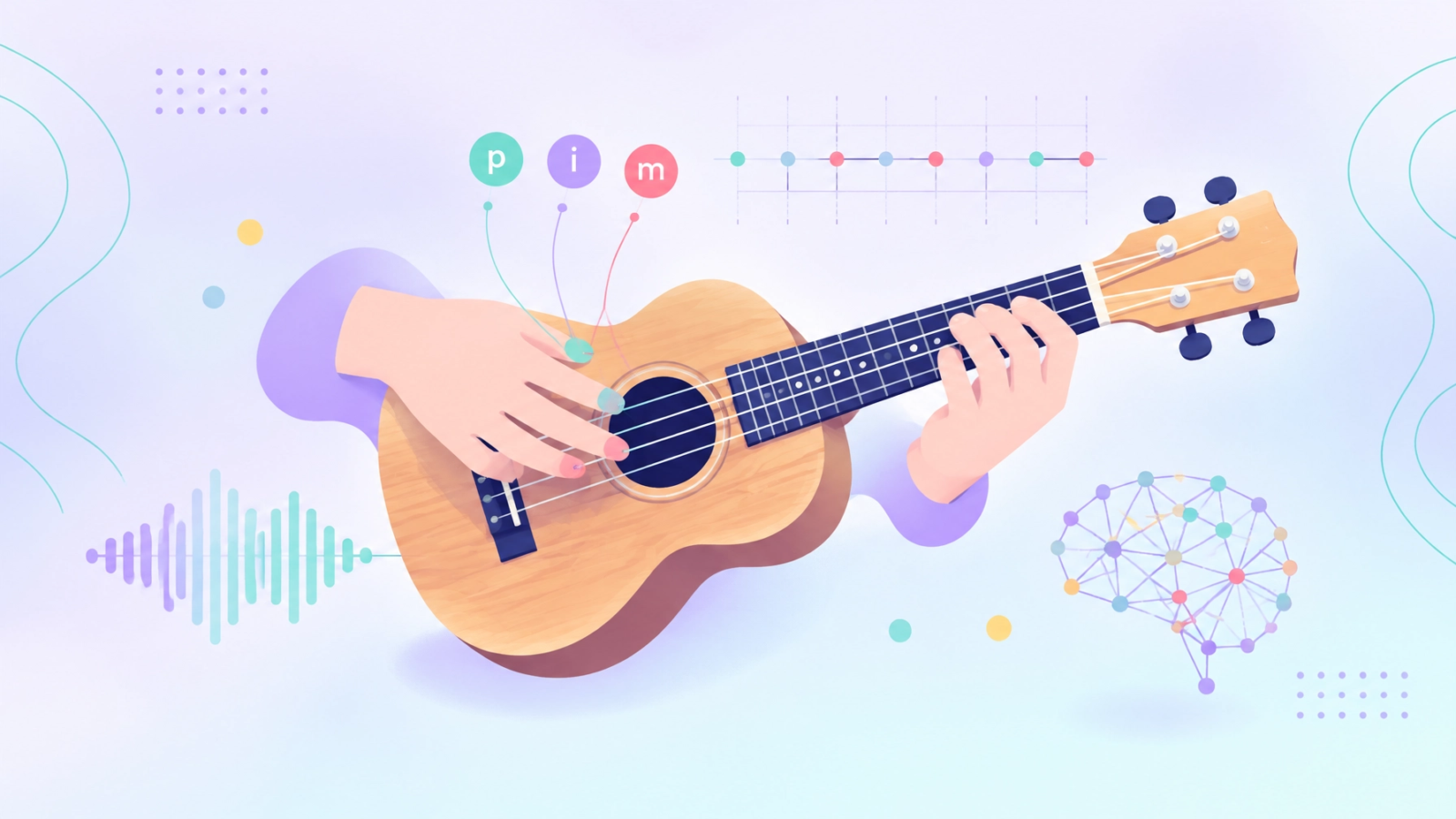
Meta description: Explore advanced ukulele fingerstyle, p-i-m independence, timing precision, and auditory-motor coupling through evidence-based music lessons Ottawa.
Advanced ukulele fingerstyle is a motor-control problem as much as a musical one. You must assign different tasks to the thumb, index, and middle fingers. At the same time, your left hand must organize chord shapes and position changes. Your auditory system must then evaluate whether each note arrives with the correct timing, volume, and tone.
This makes fingerstyle a valuable focus for intermediate and advanced students seeking music lessons Ottawa. It also provides parents with a clearer way to understand practice. The goal is not simply to move faster. The goal is to build accurate, adaptable, and efficient sensorimotor sequences.
Current research does not establish unique neurological outcomes for ukulele training alone. However, research on musical expertise, finger control, auditory-motor synchronization, and motor learning provides a strong framework for advanced instruction.
What p-i-m independence requires
In common fingerstyle notation, p refers to the thumb, i to the index finger, and m to the middle finger. On ukulele, the thumb often plays lower strings while the index and middle fingers alternate across higher strings.
A pattern such as p-i-m-i requires more than memorizing an order. You must maintain several simultaneous control parameters:
- Finger selection
- String location
- Attack force
- Release timing
- Joint position
- Sound quality
- Rhythmic subdivision
The nervous system must inhibit unnecessary movement while activating the selected finger. This process is called motor individuation. It is never completely mechanical. Fingers share tendons, muscles, and neural pathways. Therefore, movement in one finger can produce unintended activity in another.
Research on musicians shows that skilled training can reduce some biomechanical constraints between fingers. Furuya and colleagues described how expert musicians develop faster finger movements and greater independence between digits. Their findings help explain why structured p-i-m practice can gradually improve control. However, they do not mean that finger independence becomes absolute.

How music lessons Ottawa develop motor sequencing
Motor sequencing involves organizing individual actions into a stable series. At first, you may consciously think, “thumb, index, middle, index.” With practice, the sequence can become more automatic. This process reduces the cognitive load required for each individual movement.
However, advanced playing requires more than automaticity. You must also adapt the sequence when the harmony, tempo, articulation, or dynamics change. This is where neural plasticity becomes relevant. Repeated practice can strengthen connections among motor planning, sensory feedback, and error correction.
A 2026 study by Leow and colleagues examined anticipatory responding and predictive control in sequence learning. The authors reported that musical training was associated with stronger anticipation of upcoming sequence elements. In practical terms, experienced musicians may prepare a movement before the next event occurs.
For ukulele, anticipation can support the next p-i-m cycle. Your hand does not wait for one note to finish before preparing the next motion. Instead, it uses an internal model of the pattern. Auditory feedback then confirms or corrects that prediction.
Effective instruction should therefore use scaffolding:
- Begin with a stable finger assignment.
- Add a consistent rhythmic subdivision.
- Introduce one harmonic change.
- Vary the string pattern.
- Add accents and dynamic contrast.
- Remove visual dependence gradually.
This sequence moves from predictable control toward flexible performance.
Timing precision and auditory-motor coupling
Fingerstyle timing is not only visual. You must hear the relationship between each pluck and the underlying pulse. This requires auditory-motor coupling, which describes the interaction between sound perception and movement control.
When you play p-i-m-i, your auditory system receives several types of information. It detects onset timing, pitch, loudness, and timbral consistency. The motor system uses this information to adjust the next movement. This creates a feedback loop between action and sound.
A 2025 study by Mudarris and colleagues examined auditory-cued finger tapping during a dual task. The researchers found that cognitive and motor abilities predicted timing and force performance. Although the task did not involve ukulele, it is relevant to fingerstyle because both activities require synchronization with an external or internally maintained pulse.
Research by Proverbio and Valtolina in 2025 also examined audiovisual-motor integration during rhythmic hand tapping. Their findings support the role of musical expertise in linking perceived rhythm with coordinated movement.
You can train this coupling directly. Record your playing and evaluate the sound before watching the video. Ask:
- Are the bass and treble notes aligned?
- Does the thumb dominate unintentionally?
- Do index and middle fingers produce comparable volume?
- Does the pattern remain stable during chord changes?
- Do accents occur where the musical phrase requires them?
This approach shifts practice from visual imitation toward auditory-motor calibration.

Inter-limb coordination between both hands
Fingerstyle becomes more demanding when the right hand and left hand perform different temporal tasks. The right hand may repeat p-i-m-i. The left hand may change chords every two beats. Alternatively, the left hand may execute syncopated embellishments while the right hand maintains a continuous ostinato.
This is a form of inter-limb coordination. The brain must combine two motor programs without allowing one hand to disrupt the other. The cerebellum contributes to timing prediction and error correction. Cortical motor networks organize voluntary movement. The basal ganglia contribute to sequence selection and habit formation.
Research on piano training provides relevant, though indirect, evidence. Olszewska and colleagues reported dynamic changes in bimanual coordination after piano training in young adults. The study did not demonstrate that every instrument produces the same adaptation. Still, it supports the value of repeated, structured bimanual practice.
Use the following progression for an advanced p-i-m pattern:
- Play the right-hand pattern on open strings.
- Practise the left-hand chord sequence without plucking.
- Combine both hands at a reduced tempo.
- Maintain the right-hand pattern while changing only one chord.
- Add a metronome and record two repetitions.
- Increase tempo only when timing and tone remain consistent.
This method separates the components before reintegrating them. It also gives your teacher a way to identify whether the main limitation is fretting accuracy, plucking independence, or timing.
A research-informed practice protocol
Use a 30-minute practice session when your attention and physical comfort remain stable. A longer session may be appropriate for advanced students, but additional time does not replace precise feedback.
- Spend five minutes on gentle warm-up movements and open-string plucking.
- Spend six minutes on isolated p-i-m patterns at a slow tempo.
- Spend six minutes on accent displacement, such as emphasizing different subdivisions.
- Spend seven minutes combining the pattern with two or three chord shapes.
- Spend four minutes recording one performance without stopping.
- Spend two minutes writing one technical observation.
Use a metronome, but do not treat speed as the only measure of improvement. Track timing consistency, unwanted finger movement, attack balance, and recovery after mistakes.
Interleaved practice can also improve adaptability. Alternate p-i-m-i with p-m-i-m, reverse the accent, or change the starting string. Variation creates a stronger test of the underlying motor pattern. However, use blocked practice first when you are learning a new coordination structure.
If you notice persistent pain, involuntary postures, numbness, or unusual loss of control, stop and seek qualified medical advice. Advanced practice should increase precision without forcing unnecessary tension.

Why the instrument choice is not the starting point
The instrument choice is relevant to technique, but it is not the foundation of musical learning. Music and what you want to play come first. Ukulele, flute, clarinet, piano, and other instruments create different motor demands. Yet each can support attention, sequencing, auditory processing, and expressive decision-making when instruction is structured.
At Allegro Ma Non Troppo, your goals guide the lesson design. You may want to perform a fingerstyle arrangement, accompany a singer, prepare for an ensemble, or understand the theory behind a progression. The instrument serves that musical purpose.
Our ukulele lesson plan supports 30-, 45-, and 60-minute lesson options. You can study online or attend in person at our Ottawa studio. Online instruction can provide comfort, scheduling flexibility, and a familiar practice environment. In-person instruction allows direct observation of hand position, posture, and movement efficiency.
We also teach in English and Spanish. Bilingual instruction can make technical explanations more precise when you are studying terms such as independence, subdivision, synchronization, or auditory feedback.
You can also connect fingerstyle study with music theory lessons. Theory can clarify meter, syncopation, voice leading, and harmonic rhythm. These concepts help you understand why a pattern works, not only how to reproduce it.
What the current evidence supports
The current evidence supports careful conclusions:
- Musical training can engage predictive motor control.
- Fine finger practice requires individuation and inhibition.
- Auditory cues can help regulate timing and force.
- Bimanual training can develop coordinated motor programs.
- Variation and scaffolding can improve transfer across contexts.
- Ukulele-specific neuroscience remains limited.
Therefore, advanced ukulele teaching should avoid exaggerated claims. Fingerstyle does not automatically improve every aspect of cognition. Instead, it provides a precise training context. You repeatedly connect intention, movement, sound, timing, and correction.
That connection can resonate beyond a single pattern. With consistent practice, p-i-m coordination becomes a more reliable musical tool. You can then use it to shape texture, rhythm, harmony, and phrasing.
Recent research and high-authority sources
-
Leow, L.-A., Lum, J., Johnson, S., Corti, E., & Marinovic, W. (2026). “Musical training increases anticipatory responding and predictive control in sequence learning.” Psychological Research. https://doi.org/10.1007/s00426-026-02333-2
-
Olszewska, A. M., Gaca, M., Droździel, D., Jednoróg, K., Marchewka, A., & Herman, A. M. (2025). “Piano Training Induces Dynamic Neuroplasticity of Bimanual Coordination but Not Auditory Processing in Young Adults.” Journal of Neuroscience Research. https://doi.org/10.1002/jnr.70067
-
Mudarris, M. A., Krijt, R. N., Hassell, A. M., Murphy, T. M., Ruitenberg, M. F. L., Fokkema, M., & Schaefer, R. S. (2025). “Cognitive and motor abilities predict auditory-cued finger tapping in a dual task.” Frontiers in Neuroscience. https://doi.org/10.3389/fnins.2025.1553548
-
Proverbio, A. M., & Valtolina, M. (2025). “Musical expertise modulates embodied processing of biological motion and audiovisual-motor integration in rhythmic hand tapping.” NeuroImage. https://doi.org/10.1016/j.neuroimage.2025.121287
-
Pomelova, E., Feurra, M., Nikulin, V., Grankina, A., Solodkov, R., Banjevich, T., & Blagovechtchenski, E. (2025). “Is there a link between motor learning and mirror neuron system: TMS study.” Frontiers in Human Neuroscience, 19, 1650152. https://doi.org/10.3389/fnhum.2025.1650152
-
Nieto-Doval, C., Ragimova, A., Perevoznyuk, G., Popa, T., Shevtsov, O., Moiseeva, V., & Feurra, M. (2025). “Motor resonance and inhibitory mechanisms in action observation as revealed by corticospinal excitability.” Scientific Reports, 15, 23245. https://doi.org/10.1038/s41598-025-03989-3
Leave A Comment