
 Cart is empty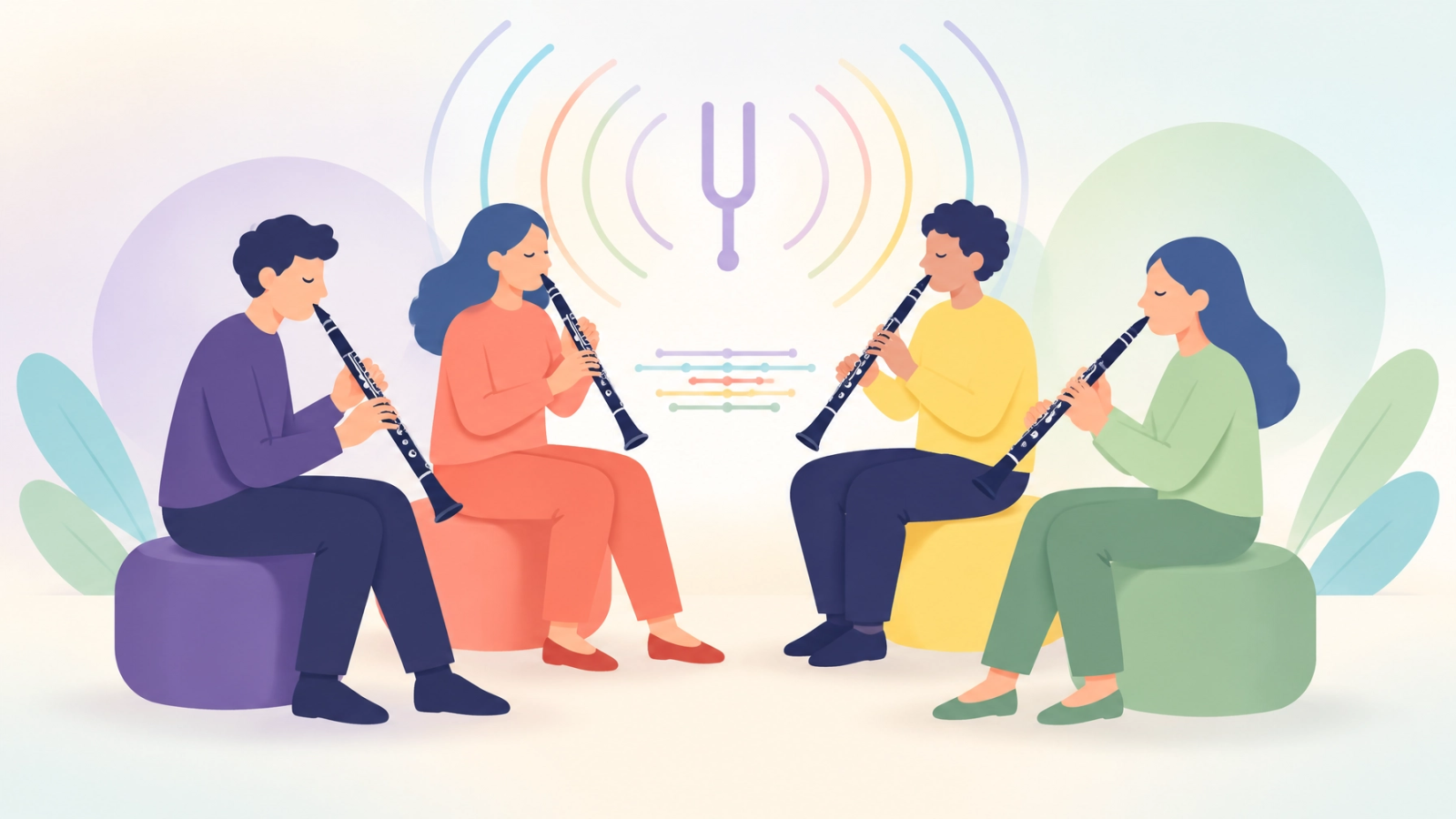
Meta description: Learn how clarinetists build ensemble blend through intonation, synchronized attacks, harmonic listening, latency strategies, and cognitive science.
Ensemble clarinet playing requires more than accurate notes. In advanced music lessons Ottawa, you learn to coordinate pitch, tone, timing, and attention within a changing acoustic field. Your sound must remain identifiable. However, it must also merge with the section.
This balance depends on auditory processing, motor prediction, and harmonic awareness. It also depends on specific physical decisions. You must match the ensemble’s tone spectrum, align note attacks, coordinate releases, and tune according to harmonic function.
Recent research on instrumental blend and musical neurodynamics helps explain these demands. The evidence does not replace careful rehearsal. Instead, it provides a clearer framework for practice.
What Ensemble Blend Actually Means
Blend does not mean that every clarinet sounds identical. It means that the instruments form a coherent perceptual layer.
Listeners evaluate blend through several interacting cues:
- Similarity in spectral envelope and tone colour
- Synchrony of note onsets
- Similarity in dynamic contour
- Alignment of vibrato, when used
- Pitch proximity within the harmonic context
- Parallel motion between musical lines
McAdams, Gianferrara, Korsmit, Goodchild, and Soden found that onset synchrony and parallel pitch motion increase perceived instrumental blend. Their 2025 study examined orchestral excerpts, rather than clarinet sections alone. Therefore, you should apply the findings carefully. Still, the principles transfer well to homogeneous woodwind ensembles.
For clarinets, blend begins with a shared concept of tone. A darker sound does not automatically blend better. A bright sound does not automatically project more effectively. The section must decide which acoustic profile serves the repertoire.
In practice, compare:
- The strength of the fundamental
- The balance of upper partials
- The speed of the attack
- The shape of the crescendo
- The amount of air noise
- The stability of the sustain
You should also listen from outside the section. A sound that feels balanced under your ear may dominate from the audience’s position.

Music Lessons Ottawa: Matching Intonation to the Harmonic Center
A tuner measures frequency. An ensemble listens for function.
This distinction matters because equal-tempered pitch is not always the best acoustic target. In a chord, each note has a role. The third, fifth, seventh, and leading tone may require different adjustments depending on the musical style and harmonic context.
You should therefore tune toward the ensemble’s harmonic center. This center is the perceived pitch structure created by the group. It may shift during a phrase, especially when the bass line changes or when the harmony moves through secondary dominants.
Use this sequence:
- Identify the tonal center before playing the passage.
- Sing or imagine your note in relation to the chord.
- Play with a drone or sustained reference pitch.
- Adjust until the sound stabilizes within the harmony.
- Recheck the note at different dynamics.
- Practise the same pitch without visual tuner feedback.
Avoid making every note “correct” in isolation. A clarinetist can match a tuner and still sound out of tune with the group. The ear detects beating, roughness, and instability between partials. These cues often provide more musical information than a single frequency reading.
Harmonic listening also requires flexibility. A pitch may need a different placement when it functions as a dissonance than when it functions as a stable chord tone. Your clarinet intonation practice should include both tuner-based measurement and contextual listening.
Synchronizing Attacks and Releases
An ensemble attack is a coordination problem. Each player must prepare the same musical event at nearly the same time.
The tongue does not create the entire attack. It releases the reed while the respiratory system supplies pressure and airflow. Therefore, inconsistent attacks often reflect inconsistent preparation rather than poor tonguing alone.
Practise attacks in three stages:
- Prepare the breath and embouchure silently.
- Establish the air pressure before the tongue releases.
- Start the note with the minimum articulation required.
Next, isolate the timing. Have one player sustain a reference pitch. Other players should enter on the same pitch at different dynamic levels. Record the result. Then listen for whether the attack creates one unified event or several separate events.
Releases require equal precision. A clean ensemble release is not simply the absence of sound. It is a coordinated termination of vibration, airflow, and resonance.
For a synchronized release:
- Read the release marking as a shared event.
- Keep the body still until the release point.
- Stop the air and tongue motion together when appropriate.
- Avoid allowing the final pitch to sag.
- Listen for residual sound from other players.
- Practise cutoffs at several dynamic levels.
The goal is not mechanical uniformity. The goal is shared intention expressed through synchronized motor actions.
Listening Across Multiple Voices
A clarinet ensemble can contain several simultaneous tasks. You may need to monitor your pitch, follow the conductor, hear the principal line, count rests, and anticipate your next entrance.
This demands divided attention and working memory. It also requires auditory scene analysis. Your brain must group some sounds together while separating others.
The 2026 study by Bogaard, Mesik, and Oxenham examined how harmonicity affects the ability to hear individual voices in polyphonic music. The study was not specific to clarinetists. However, it supports a useful conclusion: harmonic relationships influence how clearly listeners can separate musical lines.
You can train this skill through selective listening:
- Play your part while silently tracking another section.
- Mark where your line doubles, supports, or contradicts the melody.
- Practise with a recording and reduce the volume of your own part.
- Speak the rhythmic pattern of another voice while fingering your line.
- Identify which notes create dissonance against the harmonic center.
- Rehearse entrances from silence rather than only from the beginning.
This approach strengthens auditory attention. It also reduces dependence on visual cues.

Cognitive Demands of Multi-Voice Coordination
Ensemble performance combines perception and action in real time. You must process what has already happened while predicting what comes next.
Harding, Kim, Demos, Roman, Tichko, Palmer, and Large describe musical performance through neural dynamics, anticipation, resonance, and synchronization. Their 2025 review in Nature Reviews Neuroscience explains how neural oscillations can align with musical structure.
For clarinetists, this means that reliable ensemble timing is not only a matter of counting. You also develop internal temporal models. With practice, your nervous system predicts the likely location of the next beat, entrance, release, or harmonic change.
Scheurich, Bégel, Sahlas, and Palmer also reported that stable neural oscillations support auditory-motor synchronization. Their findings offer a useful practice implication: timing improves when your movement remains linked to a stable internal pulse.
Use cognitive scaffolding:
- First, practise the rhythm with a metronome.
- Next, speak the counts while fingering silently.
- Then, play your part with a reduced tempo.
- Add the surrounding voices through a recording.
- Remove the metronome and retain the internal pulse.
- Finally, perform the passage while monitoring tone and intonation.
This progression reduces cognitive load. It also helps you transfer isolated skills into full ensemble conditions.
Ensemble Playing Under Audio Latency
Online playing introduces a separate constraint. Audio latency delays the information you use to coordinate with another musician. Even a small delay can disrupt attacks, releases, and tempo adjustments.
A synchronous online duet is therefore not equivalent to playing in the same room. You may hear your partner after the physical event has already occurred. If you react to the delayed sound, you can create a second delay.
Use online sessions for tasks that tolerate latency:
- Individual tone and intonation work
- Recorded call-and-response
- Score analysis
- Phrase planning
- Listening comparisons
- Metronome-based preparation
- Teacher feedback on posture and technique
For remote ensemble preparation, record both parts separately. Then evaluate blend, timing, and harmonic alignment in the combined track. You can also rehearse with a fixed reference recording.

Comfort and flexibility remain important advantages of online instruction. You can practise in a familiar room, avoid travel, and maintain a consistent schedule. However, you should distinguish remote coaching from real-time ensemble synchronization.
A Practical Clarinet Ensemble Protocol
Apply this 25-minute routine to a difficult passage.
- Spend five minutes on unison long tones. Match tone, pitch, dynamic level, and release.
- Spend five minutes on attacks. Use repeated eighth notes at a slow tempo.
- Spend five minutes on harmonic tuning. Sustain chord tones against a drone.
- Spend five minutes on selective listening. Track another voice while playing your own.
- Spend five minutes on the complete passage. Record one version with a metronome and one without.
After each repetition, assess only one variable. For example, focus on attack timing first. Then assess pitch. Finally, evaluate blend. This prevents excessive cognitive load.
You can connect this work with music theory lessons online. Harmonic analysis makes pitch decisions more deliberate. It also clarifies which voice requires prominence.
The choice of instrument is not the central issue. Clarinet, flute, piano, and ukulele each provide different technical conditions. However, the priority remains the music and what you want to play. The same principles of listening, coordination, and musical intention can support online flute lessons, theory study, and school-band preparation.
At Allegro Ma Non Troppo, bilingual music lessons are available in English and Spanish. For example, a teacher might explain harmonic center as “centro armónico” and use both languages to clarify rehearsal instructions. This option can make advanced concepts more accessible for Ottawa families.
Lessons are available online and in person. You can select 30-, 45-, or 60-minute sessions through the clarinet lesson plan. A free trial lesson allows you to assess the teaching approach before committing.
Research Citations
- McAdams, Stephen, Pierre G. Gianferrara, Iza R. Korsmit, Meghan Goodchild, and Kit Soden. (2025). “Factors Contributing to Instrumental Blends in Orchestral Excerpts.” Music & Science, 8. https://doi.org/10.1177/20592043251326391
- Harding, Eleanor E., Ji Chul Kim, Alexander P. Demos, Iran R. Roman, Parker Tichko, Caroline Palmer, and Edward W. Large. (2025). “Musical Neurodynamics.” Nature Reviews Neuroscience, 26, 293–307. https://doi.org/10.1038/s41583-025-00915-4
- Scheurich, R., V. Bégel, E. Sahlas, and C. Palmer. (2025). “Stability of Neural Oscillations Supports Auditory-Motor Synchronization.” European Journal of Neuroscience, 61, e70127. https://doi.org/10.1111/ejn.70127
- Bogaard, L. G., J. Mesik, and A. J. Oxenham. (2026). “Role of Harmonicity in Counting and Hearing Out Voices in Polyphonic Music: Effects of Hearing Loss.” Hearing Research, article 109775. https://doi.org/10.1016/j.heares.2026.109775
Ensemble blend develops through repeated coordination between your ear, breath, fingers, and attention. You refine tone by listening across the section. You refine intonation by hearing harmonic function. You refine timing by predicting the group rather than reacting to delayed information.
That process gives each note a clearer role within the larger musical structure.
Leave A Comment