
 Cart is empty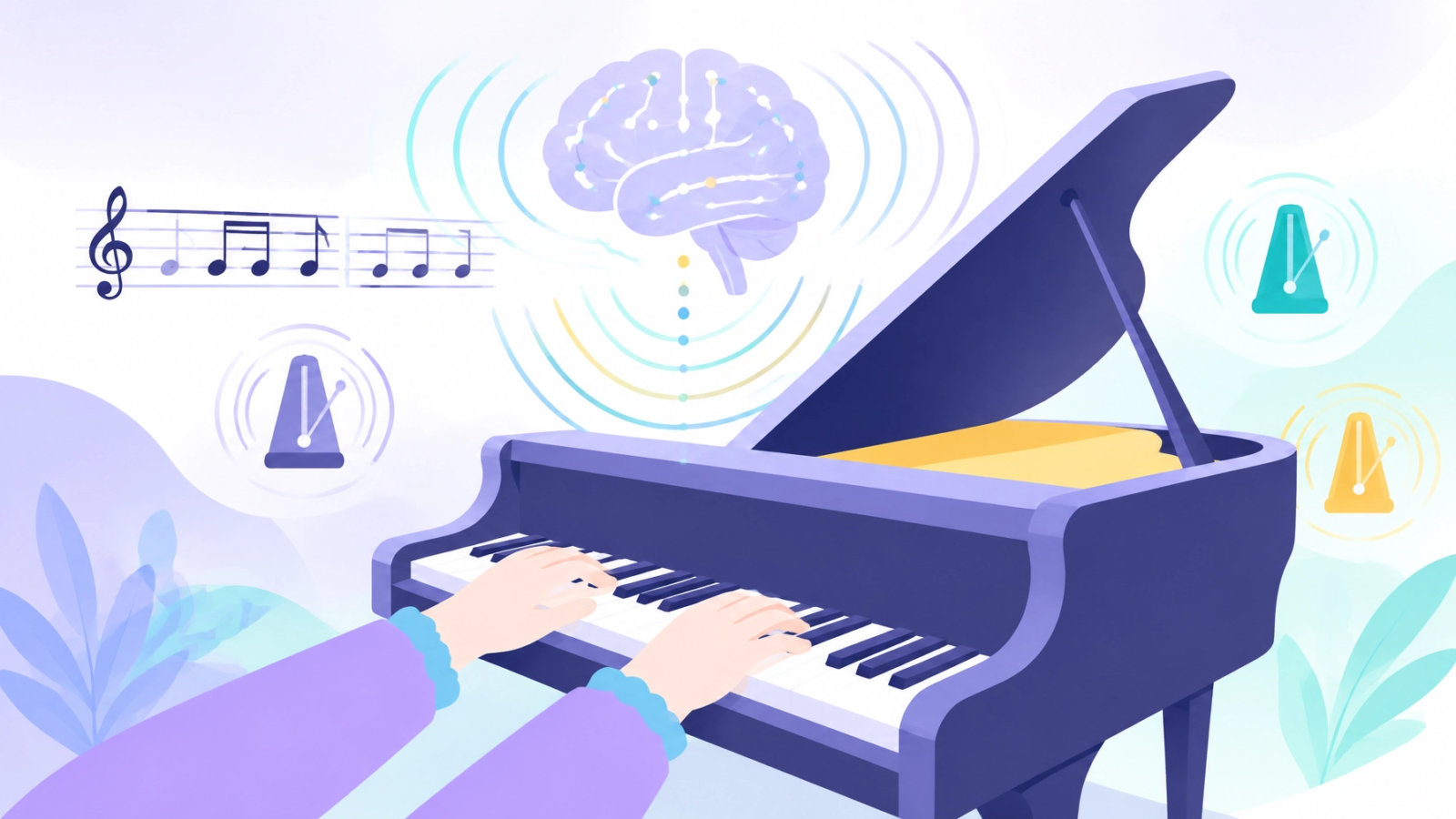
Meta description: Discover music lessons Ottawa piano strategies for rhythmic timing, neural entrainment, and auditory-motor coupling through metronome and ensemble work.
In music lessons Ottawa, piano study can train more than pitch accuracy and finger coordination. It can refine how you predict, produce, and correct timing.
Advanced pianists continuously align auditory information with motor output. You hear a pulse, anticipate the next event, prepare a movement, and evaluate the resulting sound. This loop operates within fractions of a second.
Researchers describe this process as sensorimotor synchronization and auditory-motor coupling. Neural entrainment refers to the alignment of brain activity with a rhythmic signal. Behavioural synchronization refers to the alignment of your keystrokes with the beat.
These processes overlap, but they are not identical. Understanding the difference can improve how you practise rhythm, use a metronome, and prepare for ensemble performance.
How music lessons Ottawa train neural entrainment
Neural entrainment occurs when rhythmic external input influences the timing of internal neural activity. In music, a metronome click or repeated beat can provide a temporal framework for prediction.
Your auditory system extracts regularities from the sound. Then, motor networks use those regularities to prepare an action. At the piano, the action may involve a single finger, a chord, or a coordinated gesture across both hands.
A 2024 scoping review by Pranjić, Braun Janzen, Vukšić, and Thaut mapped the neural mechanisms involved in auditory-motor synchronization. The review identified contributions from several regions:
- The supplementary motor area supports internally generated and beat-based timing.
- The premotor cortex helps transform sound into planned action.
- The basal ganglia contribute to beat detection and rhythmic prediction.
- The cerebellum supports timing precision and error correction.
- The inferior frontal gyrus contributes to perception-action coupling and beat monitoring.
The researchers emphasize that listening alone can activate motor-related networks. However, active synchronization adds a further layer. You must translate the predicted beat into a precisely timed movement.
This explains why piano rhythm work should include both listening and playing. If you only repeat finger movements, you may develop a mechanical pattern without improving auditory prediction. Conversely, if you only listen, you may not strengthen the movement component of the timing loop.

Interval timing and beat-based timing at the piano
Advanced piano rhythm involves at least two related timing systems.
Interval timing concerns the duration between events. For example, you may control the interval between two repeated eighth notes or between a bass note and a right-hand chord.
Beat-based timing concerns the larger pulse structure. You may feel the quarter-note beat while playing subdivisions, syncopations, or polyrhythms.
These systems interact, but they place different demands on attention and motor control. A passage can contain accurate local intervals while still drifting away from the larger beat. It can also preserve the pulse while producing uneven subdivisions.
Research supports this distinction. In a 2025 EEG study, Pranjić and colleagues examined rhythmic timing and auditory-motor synchronization in children with and without developmental coordination disorder. The trained musician group had formal piano experience and showed stronger performance on several timing tasks.
The study also found that rhythmic auditory cues improved motor performance across groups. However, the authors used a small sample and studied children with a specific motor profile. Therefore, the results do not prove that piano lessons produce identical effects for every learner.
They do support a useful pedagogical principle. External rhythmic cues can reduce uncertainty during movement. With practice, you can gradually internalize the timing reference and rely less on continuous external input.
What the metronome should actually train
A metronome is most effective when it develops prediction rather than dependence. If you hear a click on every note, you can react to each event. That approach may not require a strong internal pulse.
Instead, use the metronome as a changing scaffold. Begin with frequent clicks. Then create more space between the external cues.
At intermediate and advanced levels, try the following sequence:
- Play a scale or passage with the metronome on every beat.
- Keep the same tempo while the metronome marks only beats two and four.
- Reduce the clicks to one per bar.
- Subdivide internally while the click marks the beginning of each phrase.
- Stop the metronome and continue for several bars.
- Restart the click and assess whether your pulse has drifted.
This sequence trains synchronization and continuation. It also reveals whether you can maintain an internal representation of the beat.
You can measure your performance through several practical indicators:
- Does the first note after a silent bar arrive at the expected time?
- Do repeated subdivisions remain evenly spaced?
- Does the left hand maintain its interval when the right hand becomes complex?
- Does your tempo change when you add dynamics or articulation?
- Can you recover after a small timing error without stopping?
Avoid treating every deviation as a failure. Musical performance includes expressive timing. The goal is not to eliminate variation. The goal is to distinguish intentional timing from unplanned instability.
For more structured work, connect rhythmic practice with piano lessons that address repertoire, technique, and individualized timing goals.
Perturbation practice and predictive motor control
Your timing system becomes more adaptable when practice includes controlled change. A predictable task trains stability. A carefully graded perturbation trains correction.
For example, your teacher can ask you to:
- Shift accents across a repeating pattern.
- Play a phrase with displaced syncopations.
- Alternate between straight and swung subdivisions.
- Practise a left-hand ostinato while the right hand changes meter.
- Move between two nearby tempos without pausing.
- Continue after the metronome stops unexpectedly.
These tasks create small prediction errors. Your brain compares the expected event with the actual event. Then, it updates the next motor command.
The 2025 study by Ishida and Nittono, cited in recent predictive-coding research, examined how motor engagement affects rhythmic prediction error. Its findings support the idea that active movement changes how the brain processes unexpected rhythmic events.
At the piano, this means that silent counting, tapping, and deliberate movement preparation can influence your auditory predictions. You should therefore practise rhythm away from the keyboard as well as at it.
Clapping a passage can expose metric confusion. Speaking subdivisions can reveal uneven internal timing. Conducting the beat can clarify the difference between pulse and surface rhythm.
Neural entrainment and ensemble coordination
Ensemble playing adds another timing system. You must coordinate with another performer while also making your own actions predictable.
In a duet, you listen for the other player’s attack, sustain, breath, gesture, and phrase direction. You also provide cues through your own preparation. A slight lift, a change in posture, or a clear anacrusis can help another musician anticipate your timing.
Cao and Shi’s 2026 review examined pianist-dancer interaction through predictive coding. The authors argue that performers do not rely only on delayed feedback. Instead, they use visible and audible preparatory cues to predict upcoming actions.
The review also distinguishes direct evidence from related evidence. Much of the research comes from adjacent ensemble and movement paradigms rather than large studies of pianist-dancer pairs. Therefore, the conclusions should remain cautious.
Still, the practical implication is clear. Ensemble timing depends on shared prediction. Each performer must manage personal accuracy while remaining responsive to the group.

You can apply this principle during piano duet work or school band preparation. You can also transfer it to other instruments. For example, ukulele lessons can develop strumming consistency, chord-change timing, and coordination with a shared pulse.
A research-informed piano practice protocol
A focused session can combine neural prediction, auditory processing, and motor control. The following structure works well for intermediate and advanced students:
- Spend two minutes listening to the target excerpt without playing.
- Tap the main pulse while speaking the subdivisions.
- Play each hand separately with a slow metronome.
- Combine the hands at a tempo that allows accurate prediction.
- Record one uninterrupted performance.
- Mark every point where the pulse changes unintentionally.
- Repeat the passage with fewer metronome cues.
- Finish by playing without the metronome and comparing the recording.
Keep the practice environment comfortable. A stable bench height, appropriate lighting, and low auditory distraction reduce unnecessary cognitive load. Online study can offer a quiet home environment and remove travel time. In-person study provides direct acoustic feedback and immediate teacher observation at the Ottawa studio.
At Allegro Ma Non Troppo, Master-level teachers can adapt the scaffold to your current skill. Instruction is available in English and Spanish, including bilingual explanations of rhythm, notation, and technique. Spanish-speaking families can ask about clases de música and English-Spanish instruction.
Flexible music lessons Ottawa scheduling and plans
You can choose 30-, 45-, or 60-minute lessons. Shorter sessions may suit focused technical work. Longer sessions can accommodate repertoire, analysis, ensemble preparation, and recording review.
The published plan snapshot lists the following individual lesson rates:
- 30 minutes: $35
- 45 minutes: $48
- 60 minutes: $63
Published bundle savings include:
- 30-minute lessons: 2 for
$70$65, 3 for$105$100, and 4 for$140$120 - 45-minute lessons: 2 for
$96$94, 3 for$144$140, and 4 for$192$180 - 60-minute lessons: 2 for
$126$124, 3 for$189$185, and 4 for$252$240
Confirm current prices and availability when booking. A Family Plan provides additional savings for households with three or more participating members. You can also begin with a free trial lesson before choosing a recurring schedule.
For students who want to connect performance with analysis, music theory lessons can reinforce meter, harmonic rhythm, phrase structure, and auditory prediction.

What current research suggests
The evidence supports a measured conclusion. Piano practice repeatedly links auditory prediction with precise motor output. This process can strengthen timing skills, but outcomes depend on practice quality, duration, instruction, and individual differences.
Recent research includes:
- Pranjić, M., Leung, J., Tam, K. L., Polatajko, H., Welsh, T., Chau, T., and Thaut, M. (2025). “Brain-behavior correlates of rhythmic timing and auditory-motor synchronization in children with developmental coordination disorder: an EEG study.” DOI: 10.3389/fnhum.2025.1602580
- Serré, H., Harrigian, K., Park, S.-W., and colleagues (2026). “Testing sensorimotor timing across age and music experience in a real-world environment.” DOI: 10.1038/s41598-026-38073-x
- Cao, X., and Shi, X. (2026). “Hearing movement, seeing sound: multimodal predictive coding in pianist-dancer interaction.” DOI: 10.3389/fpsyg.2026.1820643
- Harding, E. E., and colleagues (2025). “Musical neurodynamics.” DOI: 10.1038/s41583-025-00915-4
- Pranjić, M., Braun Janzen, T., Vukšić, N., and Thaut, M. (2024). “From Sound to Movement: Mapping the Neural Mechanisms of Auditory–Motor Entrainment and Synchronization.” DOI: 10.3390/brainsci14111063
When your ear, hands, and internal pulse align, rhythmic accuracy becomes more than a counting exercise. It becomes a coordinated prediction system that can resonate across solo performance and ensemble playing.
Leave A Comment