
 Cart is empty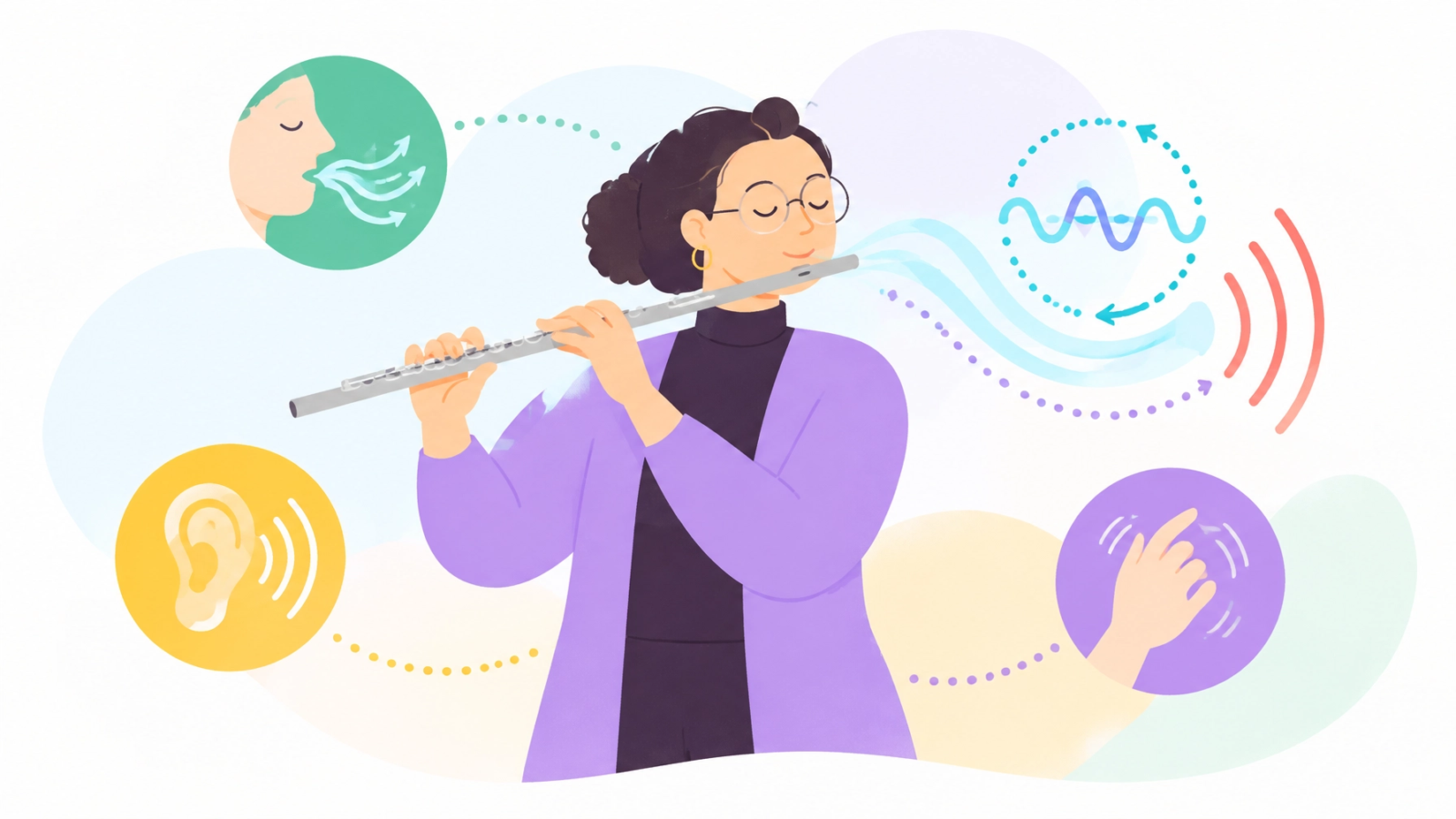
If you pursue advanced music lessons Ottawa, flute vibrato deserves more than a collection of imitation exercises.
Vibrato is a cyclical modulation of pitch, amplitude, and timbre. It requires respiratory control, laryngeal coordination, auditory feedback, and precise motor learning.
Your goal is not to create random fluctuation. Instead, you develop a stable oscillatory pattern. Then, you adjust its rate, width, regularity, and colour for each musical context.
Current research connects vibrato perception with auditory expertise. It also connects skilled flute performance with breathing, anticipation, and overtone control. Sleep research adds another important factor. Your nervous system consolidates newly learned motor patterns after practice.
Music lessons Ottawa: the science of flute vibrato and motor control
A controlled flute vibrato begins with the respiratory system. However, the diaphragm does not work in isolation. The abdominal wall, rib cage, intercostal muscles, airway, larynx, and oropharyngeal space coordinate the result.
During playing, you regulate air pressure and airflow. Small changes can influence pitch, loudness, and timbre. A well-organized vibrato allows these changes to cycle without disrupting the tone core.
This process involves two interacting systems:
- A feedforward system predicts the intended rate, width, and musical effect.
- A feedback system compares the produced sound with your auditory target.
- Respiratory muscles regulate the pressure pulses that shape the oscillation.
- The laryngeal and oropharyngeal structures influence resistance and resonance.
- The auditory cortex evaluates pitch movement, amplitude change, and spectral colour.
- The motor system adjusts the next cycle through sensorimotor integration.
For advanced players, vibrato should remain connected to musical structure. The rate may change with tempo, register, articulation, and phrase direction. The width may also change with dynamics and stylistic requirements.
A 2025 study by Noam Amira, Eitan Globerson, and Yael Zaltz examined auditory learning through vibrato perception. The researchers compared musicians with vibrato experience, musicians without regular vibrato experience, and non-musicians.
Both musician groups showed stronger pure-tone frequency discrimination. However, only vibrato-trained musicians showed a specific advantage for vibrato-related tasks. This finding supports a central pedagogical principle. General musicianship does not automatically create vibrato expertise. Relevant auditory exposure matters.
The study appears in Applied Acoustics. You can read the article, “Unraveling the specificity of auditory learning through vibrato perception,” through ScienceDirect. Its DOI is 10.1016/j.apacoust.2025.110707.

Respiratory and laryngeal coordination
Flute vibrato often receives simplified instructions. For example, teachers may describe it as “pulsing the air.” That phrase can help initially. Yet, advanced development requires more anatomical precision.
The diaphragm contributes to inhalation and respiratory regulation. The abdominal wall and intercostal muscles help manage pressure during exhalation. Meanwhile, the larynx and vocal tract can shape the airflow pathway and resonance.
You should avoid treating one body part as the sole source of vibrato. A forced abdominal pulse may create excessive amplitude. A constricted throat may produce unstable pitch and unwanted noise. Jaw movement may also create a mechanical effect that lacks flexibility.
Instead, work toward coordinated modulation. The breath remains continuous. The oscillation sits inside the air stream rather than interrupting it.
The 2024 study by Michel A. Cara and Divna Mitrovic provides useful evidence about this coordination. The researchers studied 27 flutists. They measured eye movements, breathing patterns, pupil dilation, and audio during performances of unfamiliar music.
Expert musicians showed stronger anticipation. They also adapted breathing more effectively to musical structure. Practice improved the eye-hand span, which reflects how far a performer reads ahead of the note being played.
This result matters for vibrato. You should not add vibrato after the phrase has already begun mentally. Instead, anticipate the phrase, prepare the breath, and select the vibrato profile before the note arrives.
Cara and Mitrovic’s article, “Coupling of anticipation and breathing in expert flute performance: the influence of musical structure and practice,” appears in Frontiers in Cognition. Read it at Frontiers. The DOI is 10.3389/fcogn.2024.1425005.
Auditory feedback and articulatory precision
Vibrato depends on listening. You need to monitor pitch movement, amplitude modulation, regularity, and timbre. Therefore, practice without real-time auditory attention can reinforce inaccurate motor patterns.
This principle also applies to articulation. Your tongue tip and oral cavity must coordinate with the flute’s air stream. The tongue initiates notes, but it also affects transitions between notes. A change in tongue position can influence perceived clarity and tone colour.
A 2026 study by Matthew Masapollo, Susan Nittrouer, Rosalie Gendron, Nathan Maxfield, and David J. Ostry examined task-relevant tongue control. Participants showed reduced articulatory precision when they lacked real-time auditory feedback.
The study did not examine flute players directly. Therefore, you should not transfer its findings without qualification. Still, the result supports a broader sensorimotor principle. Auditory feedback helps the brain calibrate precise articulatory movements.
The article, “Precision of Tongue Control for Task-Relevant Articulatory Goals Diminishes Without Real-Time Auditory Feedback,” appears in the Journal of Speech, Language, and Hearing Research. Access it through PubMed or the DOI. The DOI is 10.1044/2025_JSLHR-25-00514.
In practice, use short feedback loops:
- Play one sustained note with a neutral tone.
- Add a narrow vibrato at a slow rate.
- Listen for pitch-centre stability.
- Repeat with a slightly wider modulation.
- Record both versions from a consistent distance.
- Compare the sound after a short pause.
- Apply the preferred result to a phrase.
This method creates scaffolding. First, you isolate one variable. Next, you connect the variable to a musical phrase. Finally, you transfer it to repertoire.
Timbre, overtones, and vibrato perception
Vibrato does not change only pitch. It can also change amplitude and timbre. As the air stream varies, the balance among overtones may shift.
Kai Hiraiwa and Masanobu Miura studied this process in professional and advanced flute performance. Their 2025 research analysed overtone components up to the fifth overtone. The researchers found that timbre depended on overall overtone strength and the balance among specific overtones.
Listeners distinguished contrasting timbres. They also showed greater consistency with some players and registers. The middle register offered particularly strong expressive variation.
This finding has direct implications for advanced vibrato work. Your vibrato should not operate as a separate decoration. It should interact with tone colour and phrase direction.
For example, you can compare:
- A narrow vibrato with a stable, focused tone.
- A wider vibrato with greater amplitude variation.
- A slower vibrato in a sustained lyrical phrase.
- A restrained vibrato during a transparent passage.
- A vibrato change across a crescendo.
- A vibrato transition between middle and high registers.
Read Hiraiwa and Miura’s article, “Unconscious overtone manipulation and transmission in flute performance: insights into musical expression and perception,” at Frontiers in Psychology. The DOI is 10.3389/fpsyg.2025.1393689.

Practice scheduling and sleep-dependent consolidation
Motor learning does not end when you stop playing. After practice, your brain continues processing the new motor pattern. This process is called consolidation.
Sleep appears especially relevant. During non-rapid eye movement sleep, sleep spindles interact with slow oscillations. These rhythms may support synaptic plasticity and the stabilization of motor memories.
A 2026 study by Adrien Conessa, Damien Léger, and Arnaud Boutin examined sleep spindle clustering and slow-oscillation coupling. The study used a finger-sequence task rather than flute performance. Therefore, it does not prove that sleep consolidates flute vibrato specifically.
However, the findings support a useful practice inference. Distributed practice may help your nervous system stabilize fine motor patterns. Sleep can then support the retention and generalization of those patterns.
The study found that grouped spindles related to motor memory consolidation. Isolated spindles showed different relationships with skill generalization. Read the article in Communications Biology. The DOI is 10.1038/s42003-025-09425-6.
Benjamin Pelletier’s 2025 study also examined sleep and musical performance skills. Its DOI is 10.1177/20592043251385420. You can access “Effects of Sleep Extension on Musical Performance Skills” through Music & Science.
For advanced vibrato practice, consider this schedule:
- Practise one technical variable for 10 to 15 focused minutes.
- Stop before respiratory or laryngeal fatigue changes the result.
- Record a short sample at the end of the session.
- Sleep normally rather than extending practice into exhaustion.
- Re-test the same exercise the next day.
- Vary the musical context after the motor pattern stabilizes.
- Use spaced sessions across several days.
This schedule supports neural plasticity without relying on massed repetition. It also gives your teacher clearer information about retention.

Applying the research in flute lessons Ottawa
Advanced instruction should connect physiology, acoustics, and perception. In flute lessons Ottawa, you can examine vibrato rate, width, articulation, breath timing, and tone colour as related variables.
You can also choose online flute lessons. Online instruction offers comfort, reduced travel, and practice in your own acoustic environment. In-person sessions at the Ottawa studio provide direct observation of posture, embouchure, and breathing coordination.
Instruction is available in English and Spanish. Bilingual explanations can make anatomical and acoustic terminology more precise for English- and Spanish-speaking learners.
A free trial lesson allows you to evaluate the instructional approach before committing. Sessions are available in 30-, 45-, and 60-minute formats.
Current plan pricing includes:
- 30 minutes: $35 for one lesson.
- 30-minute bundle:
$70$65 for two lessons. - 30-minute bundle:
$105$100 for three lessons. - 30-minute bundle:
$140$120 for four lessons. - 45 minutes: $48 for one lesson.
- 45-minute bundle:
$192$180 for four lessons. - 60 minutes: $63 for one lesson.
- 60-minute bundle:
$252$240 for four lessons. - Family Plan: 10% savings for three or more members.
These options support consistent scheduling. They also allow you to select a lesson duration that matches your concentration, respiratory demands, and weekly availability.
For complementary study, music theory instruction can strengthen phrase analysis, harmonic expectation, and breath planning.
Practical conclusions
Flute vibrato is a coordinated motor skill. It depends on respiratory regulation, laryngeal and oropharyngeal shaping, auditory feedback, and precise timing.
The current evidence supports several conclusions:
- Vibrato training develops task-specific auditory perception.
- Respiratory control should regulate, rather than force, the oscillation.
- Real-time listening improves sensorimotor calibration.
- Tongue-tip precision depends on accurate auditory feedback.
- Vibrato can influence amplitude, pitch, and overtone balance.
- Musical anticipation helps organize breathing before the phrase begins.
- Distributed practice may improve consolidation.
- Sleep supports broader motor-memory processes, although flute-specific evidence remains limited.
- Comfortable environments and flexible scheduling can improve practice consistency.
With structured feedback, you can make vibrato more stable, intentional, and musically responsive. Each cycle should serve the phrase. Each breath should prepare the next gesture. Over time, your auditory and motor systems can work in harmony.
Selected peer-reviewed sources
- Noam Amira, Eitan Globerson, and Yael Zaltz. “Unraveling the specificity of auditory learning through vibrato perception.” Applied Acoustics (2025). DOI: 10.1016/j.apacoust.2025.110707
- Matthew Masapollo, Susan Nittrouer, Rosalie Gendron, Nathan Maxfield, and David J. Ostry. “Precision of Tongue Control for Task-Relevant Articulatory Goals Diminishes Without Real-Time Auditory Feedback.” Journal of Speech, Language, and Hearing Research (2026). DOI: 10.1044/2025_JSLHR-25-00514
- Kai Hiraiwa and Masanobu Miura. “Unconscious overtone manipulation and transmission in flute performance: insights into musical expression and perception.” Frontiers in Psychology (2025). DOI: 10.3389/fpsyg.2025.1393689
- Adrien Conessa, Damien Léger, and Arnaud Boutin. “Temporal sleep spindle clustering and slow-oscillation coupling in motor memory consolidation and generalization.” Communications Biology (2026). DOI: 10.1038/s42003-025-09425-6
- Benjamin Pelletier. “Effects of Sleep Extension on Musical Performance Skills.” Music & Science (2025). DOI: 10.1177/20592043251385420
- Michel A. Cara and Divna Mitrovic. “Coupling of anticipation and breathing in expert flute performance: the influence of musical structure and practice.” Frontiers in Cognition (2024). DOI: 10.3389/fcogn.2024.1425005
Leave A Comment