
 Cart is empty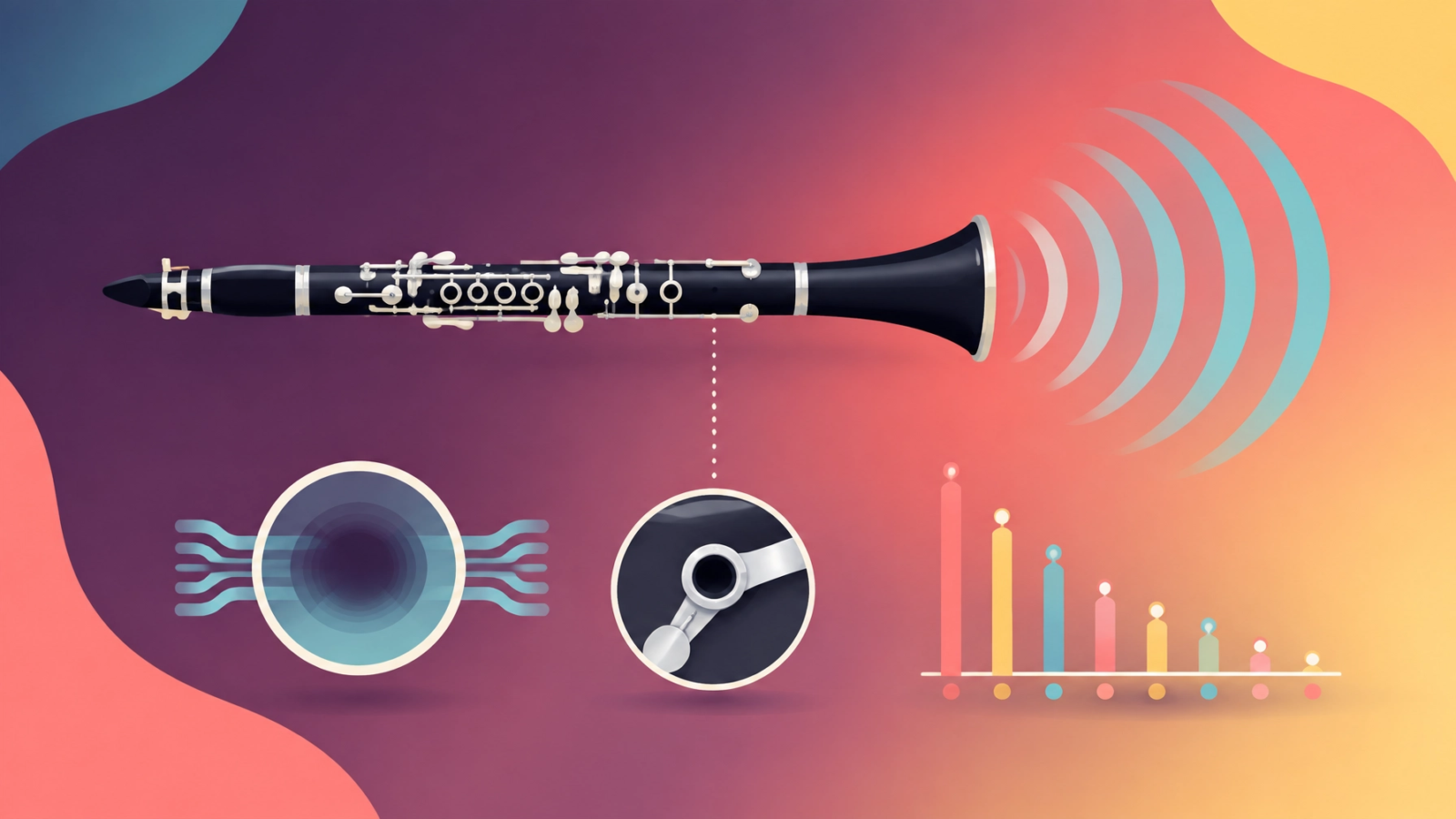
Meta description: Explore clarinet tone color and resonance science, from cylindrical bores and register holes to voicing, timbre, and auditory-motor prediction in Ottawa lessons.
Tone color is not an abstract artistic label. It is the audible result of pressure, airflow, vibration, resonance, and perception. In advanced clarinet playing, a darker or brighter sound reflects measurable changes in the instrument’s spectrum and in your coordination.
This article explains the acoustic and physiological principles behind tone production. It also shows how structured tone-color work can strengthen auditory-motor prediction. These concepts form part of the approach used in clarinet lessons Ottawa at Allegro Ma Non Troppo.
Why the Clarinet Produces a Distinctive Tone Color
The clarinet has a predominantly cylindrical bore. Its mouthpiece and reed form an acoustically closed end, while the bell or an open tone hole functions as the approximate open end.
This closed-open configuration supports resonances near the odd harmonics of the fundamental frequency:
- The first resonance occurs near the fundamental.
- The next major resonance occurs near the third harmonic.
- The following resonance occurs near the fifth harmonic.
- Even harmonics remain possible, but the bore does not reinforce them as efficiently.
As a result, the lower register often has a spectrum with strong odd partials and comparatively weaker even partials. This balance contributes to the clarinet’s characteristic dark, hollow, or rounded tone color.
The description remains an approximation. A real clarinet includes tone holes, a bell, a mouthpiece, a reed, and frequency-dependent losses. The radiated sound also contains even harmonics because reed motion is nonlinear. However, the cylindrical bore establishes the primary acoustic bias.
Tone color therefore depends on more than pitch. Two performances of the same note can differ because they contain different proportions of fundamental energy, upper partials, transient energy, and noise.

How the Register Hole Changes the Harmonic Structure
The register hole is often called a speaker hole. Its function differs from the octave vents found on many conical instruments.
When you open the register hole, you introduce a small opening near the upper part of the bore. This opening disrupts the pressure pattern that supports the fundamental resonance. The reed then couples more effectively with a higher resonance.
For the clarinet, this higher resonance lies near the third harmonic. Consequently, the instrument overblows at approximately a twelfth rather than at an octave.
The register hole also changes the spectrum:
- The fundamental loses stability or becomes less strongly reinforced.
- The third harmonic becomes more influential.
- The spectral balance becomes less dominated by the low-register odd-harmonic pattern.
- The resulting sound often becomes clearer, brighter, and more penetrating.
Recent clarinet research demonstrates that nonlinear losses around the register hole play a decisive role in register production. These losses do not simply remove energy. They alter the impedance conditions that determine whether the reed can sustain a particular oscillation.
Szwarcberg, Colinot, Vergez, and Jousserand describe this mechanism in their peer-reviewed study of second-register production. Their findings are relevant to register transitions, tone stability, and instrument design.
In practical terms, a register change requires more than pressing a key. You must coordinate:
- Air pressure below the reed.
- Embouchure resistance.
- Tongue and oral-cavity shape.
- Finger timing.
- The expected resonance of the new note.
That coordination explains why register exercises can reveal differences in tone quality before they reveal obvious pitch errors.
The Reed-Mouthpiece System Is a Coupled Oscillator
The reed does not vibrate independently. It interacts with the mouthpiece chamber, the player’s oral cavity, and the bore.
Your air pressure causes the reed to open and close. The reed then modulates airflow into the mouthpiece. In return, the bore sends acoustic pressure back toward the reed. This feedback loop can reinforce or destabilize vibration.
The system depends on acoustic impedance. Impedance describes how strongly the instrument resists airflow at different frequencies. When the reed’s oscillation aligns with a strong bore resonance, energy transfer becomes more efficient.
That alignment affects several audible variables:
- Attack clarity.
- Pitch stability.
- Dynamic range.
- Upper-partial strength.
- Response during register changes.
- Perceived resistance.
The reed also behaves nonlinearly. Its opening does not increase in a perfectly proportional way as pressure changes. Therefore, the waveform includes additional partials that the bore may reinforce or suppress.
A useful analogy is a conversation between the reed and the air column. The reed initiates the sound, but the bore determines which frequencies receive emphasis. Your technique influences how efficiently those two systems communicate.
Voicing: How the Vocal Tract Shapes Timbre
Voicing refers to the configuration of the vocal tract during playing. It includes the position of the tongue, the shape of the oral cavity, the openness of the throat, and the pressure conditions behind the reed.
The vocal tract creates resonances of its own. These resonances can interact with the mouthpiece and reed system. They may not function exactly like speech formants, but they can produce formant-like spectral shaping.
A higher, more forward tongue position generally reduces the volume of the oral cavity and raises some tract resonances. A lower or more retracted tongue position increases the cavity volume and lowers those resonances.
These changes can influence:
- The airflow spectrum entering the mouthpiece.
- The ease of initiating a note.
- The strength of upper partials.
- The stability of high-register notes.
- The transition between vowel-like articulatory shapes.
- The perceived brightness or focus of the sound.
The effect is not identical for every player. Anatomy, mouthpiece design, reed strength, dynamic level, and register all matter. For that reason, teachers should treat syllables such as “ee,” “ah,” and “oh” as coordination prompts rather than universal physical instructions.

A 2015 review by Wolfe, Fletcher, and Smith explains how wind players adjust vocal-tract resonances to interact with instrument resonances. This player-instrument interaction remains central to advanced clarinet pedagogy.
For example, you may use a slightly higher tongue position to stabilize an upper-register note. You may also reduce unnecessary jaw pressure. The goal is not to force brightness. Instead, you shape the internal acoustic environment so the reed can vibrate with less interference.
Tone-Color Training and Auditory-Motor Prediction
Tone-color practice also develops a predictive system.
Before you play, your brain forms an expectation about the sound. That expectation includes pitch, loudness, attack, resonance, and spectral balance. Your motor system then organizes the actions required to produce it.
Those actions include:
- Breath pressure.
- Lip and jaw position.
- Tongue placement.
- Finger movement.
- Reed contact.
- Timing of articulation.
- Adjustment after the note begins.
The sound provides immediate sensory feedback. If the result differs from your expectation, the brain registers a prediction error. You then modify the next attempt.
This process resembles a feedback loop:
- You hear or imagine a target tone.
- You select a motor strategy.
- The reed and bore generate a sound.
- Your auditory system evaluates the spectrum.
- You update the motor strategy.
Recent neuroscience research supports the broader role of auditory-motor prediction in music. Keitel and colleagues found that rhythmic tracking depends on pitch predictability, expertise, and cortical timing processes. Pranjić and colleagues identified behavioral and EEG correlates of auditory-motor synchronization in children. Liu and colleagues also linked musicianship with auditory working memory and auditory stream segregation.
These studies do not prove that every clarinet exercise produces a specific neural change. They do, however, support a useful pedagogical principle: precise listening and repeated movement-sound associations can improve prediction, attention, and coordination.
A Practical Tone-Color Protocol
You can apply these principles during practice without specialized laboratory equipment.
Begin with a sustained low-register note. Record it if possible. Then repeat the note while changing only one variable at a time.
- Keep the fingers stable.
- Compare a lower and higher tongue position.
- Maintain similar loudness.
- Observe the attack and steady-state spectrum.
- Listen for changes in brightness, core, and resistance.
- Repeat the exercise in the clarion register.
- Compare the register transition without increasing jaw pressure.
Next, practice slow register pairs. Play the lower note, rest, and then play the corresponding upper note. Focus on resonance rather than volume.
Use descriptive listening questions:
- Does the note begin immediately?
- Does the sound contain a stable central pitch?
- Does the upper register feel focused or spread?
- Does the tone become brighter because of resonance or because of excessive pressure?
- Can you reproduce the same colour at three dynamic levels?
This approach resembles scaffolding in pedagogy. You isolate one variable, establish a reliable result, and then add complexity. Over time, your auditory target becomes more precise.
You can also integrate music theory lessons online. Harmonic analysis helps you identify why a sound changes. Ear training helps you detect the change. Instrumental technique gives you control over its cause.
What This Means for Clarinet Learners in Ottawa
Advanced study does not require a particular age or previous identity as a musician. It requires a clear goal and a method that matches your current coordination.
At Allegro Ma Non Troppo, music lessons Ottawa can take place online or at the Ottawa studio. The environment matters because comfort, reliable acoustics, and scheduling flexibility affect practice quality.
Students can choose 30-, 45-, or 60-minute lessons. School band students can receive specialized support. Instruction is available in English or Spanish through bilingual music lessons.
The instrument choice is also not the central issue. Clarinet, flute, piano, ukulele, or music theory can all provide a route into the same broader processes: auditory attention, motor planning, memory, timing, and creative decision-making. What matters most is music and what you want to play.
The academy also offers Family Plan savings for households with three or more members. Families can therefore coordinate study while preserving individual goals and lesson plans.
References
-
Szwarcberg N, Colinot T, Vergez C, Jousserand M. “Second register production on the clarinet: Nonlinear losses in the register hole as a decisive physical phenomenon.” Journal of the Acoustical Society of America. 2024;156(2):726–739. https://doi.org/10.1121/10.0028118
-
Domingues RB, Domingues LA, Procaci VR, Pedroso JL. “The neuroscience of music perception: a narrative review.” Arquivos de Neuro-Psiquiatria. 2025;83(9). https://doi.org/10.1055/s-0045-1811233
-
Keitel A, Pelofi C, Guan X, Watson E, Wight L, Allen S, Mencke I, Keitel C, Rimmele J. “Cortical and behavioral tracking of rhythm in music: Effects of pitch predictability, enjoyment, and expertise.” Annals of the New York Academy of Sciences. 2025;1546(1):120–135. https://doi.org/10.1111/nyas.15315
-
Liu M, Arseneau-Bruneau I, Farrés Franch M, Latorre M-E, Samuels J, Issa E, Payumo A, Rahman N, Loureiro N, Leung TCM, Nave KM, von Handorf KM, Hoddinott JD, Coffey EBJ, Grahn J, Zatorre RJ. “Auditory working memory mechanisms mediating the relationship between musicianship and auditory stream segregation.” Frontiers in Psychology. 2025;16:1538511. https://doi.org/10.3389/fpsyg.2025.1538511
-
Pranjić M, Leung J, Tam KL, Polatajko H, Welsh T, Chau T, Thaut MH. “Brain-behavior correlates of rhythmic timing and auditory-motor synchronization in children with developmental coordination disorder: an EEG study.” Frontiers in Human Neuroscience. 2025;19. https://doi.org/10.3389/fnhum.2025.1602580
-
Wolfe J, Fletcher NH, Smith J. “The Interactions Between Wind Instruments and their Players.” Acta Acustica united with Acustica. 2015;101(2):211–223. https://doi.org/10.3813/AAA.918820

If you want to investigate tone colour, resonance, voicing, and register control with an expert teacher, Book Your Free Trial Lesson Now. Study in person at our Ottawa studio or online, with bilingual English/Spanish instruction and flexible 30-, 45-, or 60-minute scheduling.
Leave A Comment