
 Cart is empty
SEO title: Piano Lessons Ottawa: Motor Chunking Practice Science
Meta description: Learn why piano chunk transitions trigger errors and use practical, evidence-informed strategies to strengthen them with music lessons Ottawa.
Author: Karen Erazo
When you learn a piano piece, you may divide it into short sections. That approach can make notes and rhythms easier to manage. Yet learners often stumble where one section ends and the next begins. Research on motor sequences helps explain why these joins can be vulnerable, and how focused practice may help.
For families considering music lessons Ottawa, this offers a useful practice principle: do not only repeat the sections. Also learn to connect them. The research is promising, but it has limits. Some studies examine expert pianists performing laboratory tasks, not children learning a first piece. So the practice ideas below are evidence-informed applications, not guaranteed outcomes.
What chunking does when you learn a piece
Motor chunking means organizing a long sequence of actions into smaller, familiar units. In piano, a chunk might be a phrase, a measure, or a short fingering pattern. With practice, you may retrieve that unit as a coordinated sequence instead of planning each note separately.
This can reduce the mental load of playing a long passage. However, the connection between two well-practiced units may receive less attention. You might know both sections but still hesitate on the last note of the first, the first note of the next, or the movement that links them.

Why transitions can be error-prone
A 2026 iScience study tested how pianists performed sequences organized into chunks. Researchers introduced auditory perturbations either within chunks or at the junction between them. In that specific task, the junctions were more vulnerable to disruption than the passages inside chunks. The researchers also found larger pupil responses at junctions, a measure associated with greater attentional demand.
In a second experiment, pianists practiced either the connections between chunks or the chunks themselves. Junction-focused training improved stability under perturbation. It also reduced related frontal theta activity, which can track cognitive effort. These measures do not prove a single cause for transition errors. Still, they suggest that a transition can demand attention and benefit from direct practice.
This does not mean chunking always creates errors, or that every learner makes most mistakes at joins. Rather, the study identifies a specific vulnerability in a trained sequence task. For your own practice, the practical lesson is to check whether the transition is less secure than either section alone.
A practical routine for bridging a piano transition
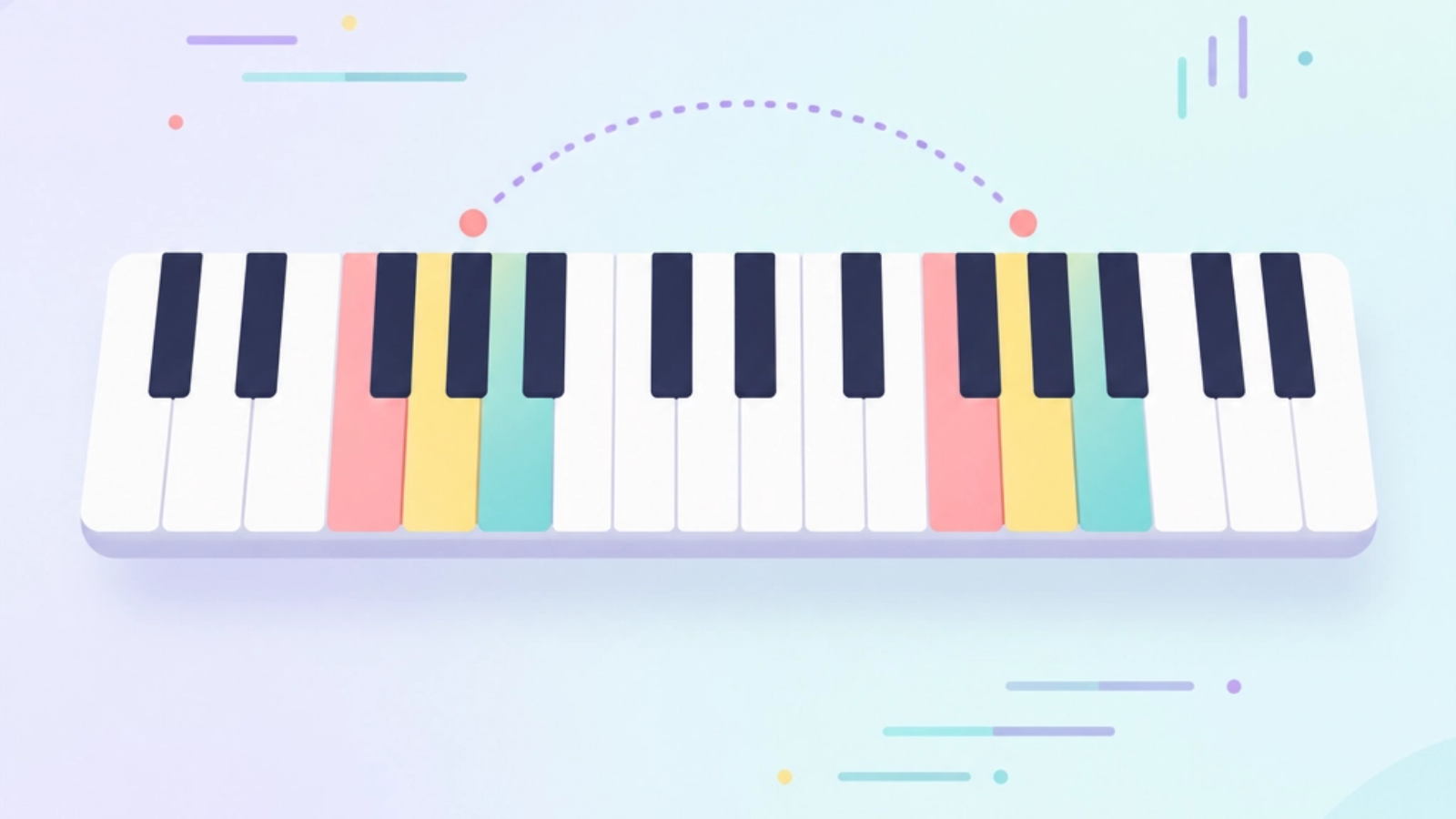
Choose a short passage where you can play the sections separately but lose continuity between them. Then practice the join as its own unit.
- Mark the boundary. Identify the final one or two notes before the join and the first one or two notes after it.
- Set a comfortable tempo. Use a speed at which you can play the notes accurately without rushing or tensing.
- Play across the boundary. Start just before the join and continue just after it. Repeat this small bridge several times.
- Pause and diagnose. Notice whether the difficulty is timing, fingering, note reading, hand movement, or remembering what comes next.
- Reconnect the phrase. Add more notes on either side. Once the join feels reliable, play the full section and check whether the improvement carries over.

Use a metronome when it helps you notice an uneven pulse. However, do not raise the tempo simply because you can complete one repetition. First, check whether the transition stays consistent across several attempts. If it breaks down, reduce the tempo or shorten the bridge again.
You can also use a brief pause before the transition. Play the first chunk, stop, then prepare the first movement of the next chunk. Gradually shorten the pause until you can continue in time. This is a practice scaffold: it makes the hard part manageable, then reduces the support as your coordination and recall improve.
Why feedback matters when you break a passage down
A 2025 Communications Biology study examined a different question: whether pianists could improve a demanding finger sequence by practicing its component movements separately. Skilled pianists improved in the decomposition condition when they received precise visual feedback about timing errors. Repetition alone did not produce the same improvement, and the result did not extend to the non-skilled group in the same way.
This was a specialized, laboratory task with expert pianists. It did not test chunk transitions directly. Therefore, it does not show that a beginner should use the same intensive method. But it does reinforce a useful principle: breaking a task into parts works best when you can identify what needs adjustment.
In everyday practice, feedback can be simple. Listen for an extra gap, check whether the rhythm changes at the join, or observe whether your hand arrives comfortably at the next position. If you are unsure what is causing the error, a teacher can help identify it. For stronger notation and phrase awareness, you can also explore music theory lessons.

What the PIANO-Cog pilot can and cannot tell us
A 2026 PIANO-Cog report followed a small group of older adults who completed an eight-week, self-guided piano course. The report explored cognition, including working-memory measures, alongside brain imaging. Some findings were preliminary signals rather than firm evidence of improvement.
Importantly, PIANO-Cog is a preprint, not a peer-reviewed journal article. It was a feasibility pilot, with a small sample and a passive control group. It cannot establish that piano lessons improve working memory, nor can it explain why transitions in a piece cause errors. It does, however, point to areas that future, larger controlled studies can investigate.
Overall, these three studies address different questions. The chunking study directly tested transitions. The decomposition study focused on precise feedback during component practice. The pilot examined a broader piano-training program. Together, they support careful experimentation with practice methods, not sweeping claims about guaranteed cognitive or academic benefits.
Music Lessons Ottawa: Put the Research Into Your Practice
At Allegro Ma Non Troppo, instruction can help you find the right bridge size for your level and repertoire. Our piano lessons are available for beginners and developing players, with online or in-person options in Ottawa. Lessons can be conducted in English or Spanish.
You can choose flexible 30-, 45-, or 60-minute scheduling. The right lesson length depends on your goals and availability. Families with three or more members can also ask about the Family Plan, which offers a 10% discount.
A focused practice plan should leave room for comfort and flexibility. You can work at home between lessons, then bring a difficult passage to your teacher for feedback. If you are exploring other instruments or lesson options, visit the lessons overview.
When a passage repeatedly breaks at the same point, do not assume you need to start from the beginning each time. Identify the join, slow it down, listen closely, and practice the transition as a small musical unit. Then reconnect it to the phrase. Over time, that bridge can become as familiar as the notes on either side.
Research Sources
- Shih, P.-C., Hirano, M., & Furuya, S. “Bridging chunks during complex movement sequence execution.” iScience, 29(2), 114562 (2026). https://doi.org/10.1016/j.isci.2025.114562
- Kimoto, Y., Hirano, M., & Furuya, S. “Decomposition of a complex motor skill with precise error feedback and intensive training breaks expertise ceiling.” Communications Biology, 8, 118 (2025). https://doi.org/10.1038/s42003-025-07562-6
- Rogers, F., McNabb, C. B., Erdem, E., & Metzler-Baddeley, C. “Feasibility of PIANO-Cog for older adults: A randomised controlled pilot trial exploring changes in cognition and brain microstructure.” bioRxiv preprint (2026; not peer reviewed). https://doi.org/10.64898/2026.01.28.702269
Leave A Comment