
 Cart is empty
By Karen Erazo
Clarinet lessons Ottawa families can use to build clear portato and staccato timing, with a practical exercise and careful context from 2025 research.
When you play a phrase, each note depends on more than its start. The transition from one note to the next also shapes clarity, rhythm, and musical character. In music lessons Ottawa students can practice this detail by listening closely, slowing down, and making one adjustment at a time.
Clarinet lessons Ottawa: hearing the space between notes
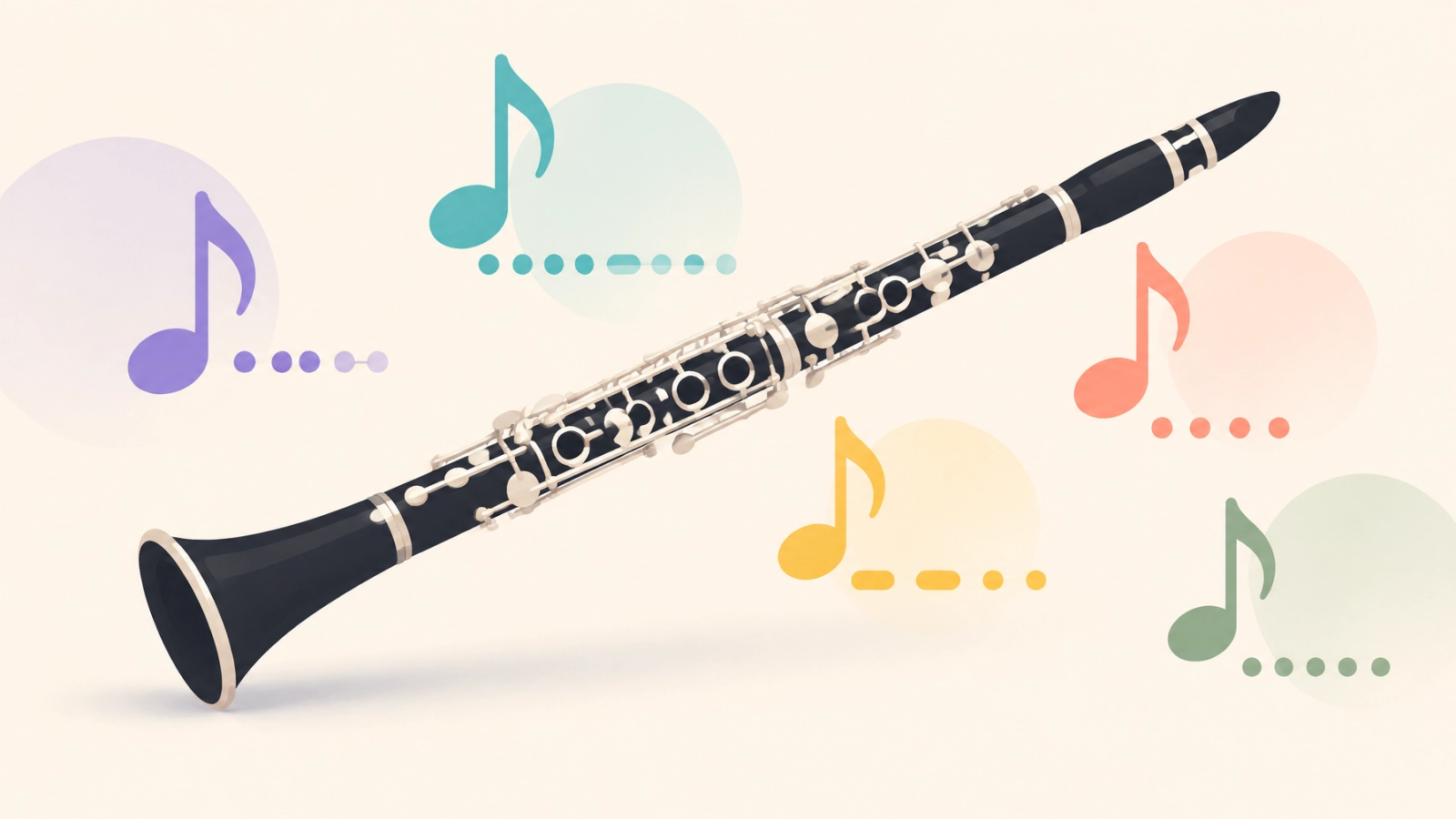
Articulation describes how you begin, connect, separate, and release notes. A clean transition is not simply a matter of moving your tongue faster. It involves coordinated timing among your tongue, airflow, fingers, and the reed.
In portato, notes sound gently separated while retaining a connected quality. In staccato, notes sound shorter and more detached. Neither term specifies one fixed duration for every tempo or musical style. Instead, the score, pulse, phrasing, and performance context guide your choices.
For practice, listen for the relationship between the notes:
- Does the second note begin on the intended beat?
- Is there an unintended gap, accent, or delay?
- Do your fingers and tongue coordinate, or does one seem to lead?
- Does the phrase keep its pulse when you shorten the notes?
These questions help you hear the transition as part of the musical phrase, not just as a mechanical tongue action.
What a 2025 clarinet study measured
A peer-reviewed acoustics paper offers one way to study note-to-note transitions. Griffin, Coyle, and Kellison’s 2025 study describes a computational measure called ΔT. It uses the curvature of mouthpiece-pressure changes to estimate the duration of an articulation transition.
The researchers compared this estimate with threshold-based timing and tongue–reed contact measurements. Their analysis included recorded conditions from 11 clarinetists. However, one key comparison requires careful context: the portato comparison against threshold timing used 81 filtered transitions from one performer, not a representative sample of every player or playing situation.
In a separate, regression-corrected comparison against tongue–reed contact, the reported agreement had an RMSE of 5.91 milliseconds and an R² of 0.41. These results suggest a useful research approach, but they do not establish universal precision. Nor do they mean that ΔT is a routine measurement tool in ordinary clarinet lessons.
The study helps clarify what researchers can measure under specified conditions. It does not show that a device can replace listening, practice, or instructor feedback. For students, its practical value is a reminder that transitions have timing features worth noticing and refining.
A practical portato and staccato exercise
Try this short exercise with a comfortable note pair in the middle register. Use a metronome at 60 beats per minute and begin at a moderate, even dynamic.
- Play the first note for two beats, then move to the second note for two beats. Repeat four times, aiming for a smooth, steady connection.
- Play the same pair as portato. Keep the pulse and airflow steady, and make each note gently distinct.
- Play the pair as staccato. Keep the beat unchanged while shortening each note. Avoid rushing the second attack.
- Record one repetition of each version. Listen for the beat, the clarity of the transition, and any unwanted accent or delay.
- Change only one variable at a time. For example, adjust the separation slightly while keeping tempo and volume consistent.
If the transition feels uneven, slow down further. Check whether your fingers move together and whether your tongue releases the reed cleanly. Keep the jaw relaxed. A teacher can help you identify whether the issue comes from timing, finger coordination, or articulation approach.
This exercise is a practical learning strategy, not a guaranteed scientific intervention. Its purpose is to make a small musical detail easier to hear and repeat.
From careful listening to guided feedback
Slow practice can make short timing differences easier to notice. It also reduces the number of demands you manage at once. First focus on an even pulse. Then add the articulation style. Finally, return to the phrase and listen for how the notes connect in context.
A recording can help you compare repetitions, but it has limits. Room acoustics, microphone placement, and playback quality affect what you hear. Therefore, use recordings as a supplement rather than a definitive measurement.
In a lesson, an instructor can observe your playing and offer feedback tailored to your sound, goals, and current technique. Clarinet lessons in Ottawa can include focused work on articulation and transitions. You can also explore music theory lessons to connect articulation markings with rhythm, phrasing, and musical structure.
Music lessons Ottawa students can fit around their lives
Allegro Ma Non Troppo offers music lessons Ottawa students and families can take online or in person at the Ottawa studio. Instruction is available in English and Spanish, and lessons are tailored to different ages, levels, and goals.
You can choose 30-, 45-, or 60-minute lesson options. Bundle discounts are available, and the Family Plan provides 10% savings for three or more members. To learn more about lesson options, visit the lessons page.
A comfortable practice space and flexible lesson format can make it easier to fit music study into your routine. Whether you are beginning clarinet or refining school-band skills, you can work on articulation at a pace that supports careful listening and steady progress.
Research sources
- Griffin, M., Coyle, W. L., & Kellison, M. S. (2025). “Computational detection of articulation transients in clarinet performance.” Proceedings of Meetings on Acoustics, 58, 035007. https://doi.org/10.1121/2.0002074
- Pàmies-Vilà, M., Hofmann, A., & Chatziioannou, V. (2018). “Analysis of tonguing and blowing actions during clarinet performance.” Frontiers in Psychology, 9, 617. https://doi.org/10.3389/fpsyg.2018.00617 (the sensor-equipped mouthpiece dataset used in the 2025 study)
Leave A Comment