
 Cart is empty
SEO title: Music Theory Lessons Online: How Cadences Resolve
Meta description: Learn how musical cadences shape harmonic expectation, what recent research says, and practical listening exercises from Allegro Ma Non Troppo in Ottawa.
Author: Karen Erazo
Editorial status: Draft for Karen Erazo’s review
When you hear a dominant chord, you may expect it to resolve to the tonic. That expectation is not simply a rule you consciously recite. It reflects your experience with musical patterns, the context you have heard, and the way a piece directs attention. In this article, we explore how recent research can inform music theory lessons online, and how you can practise hearing cadences with greater precision.
What listeners expect from a cadence
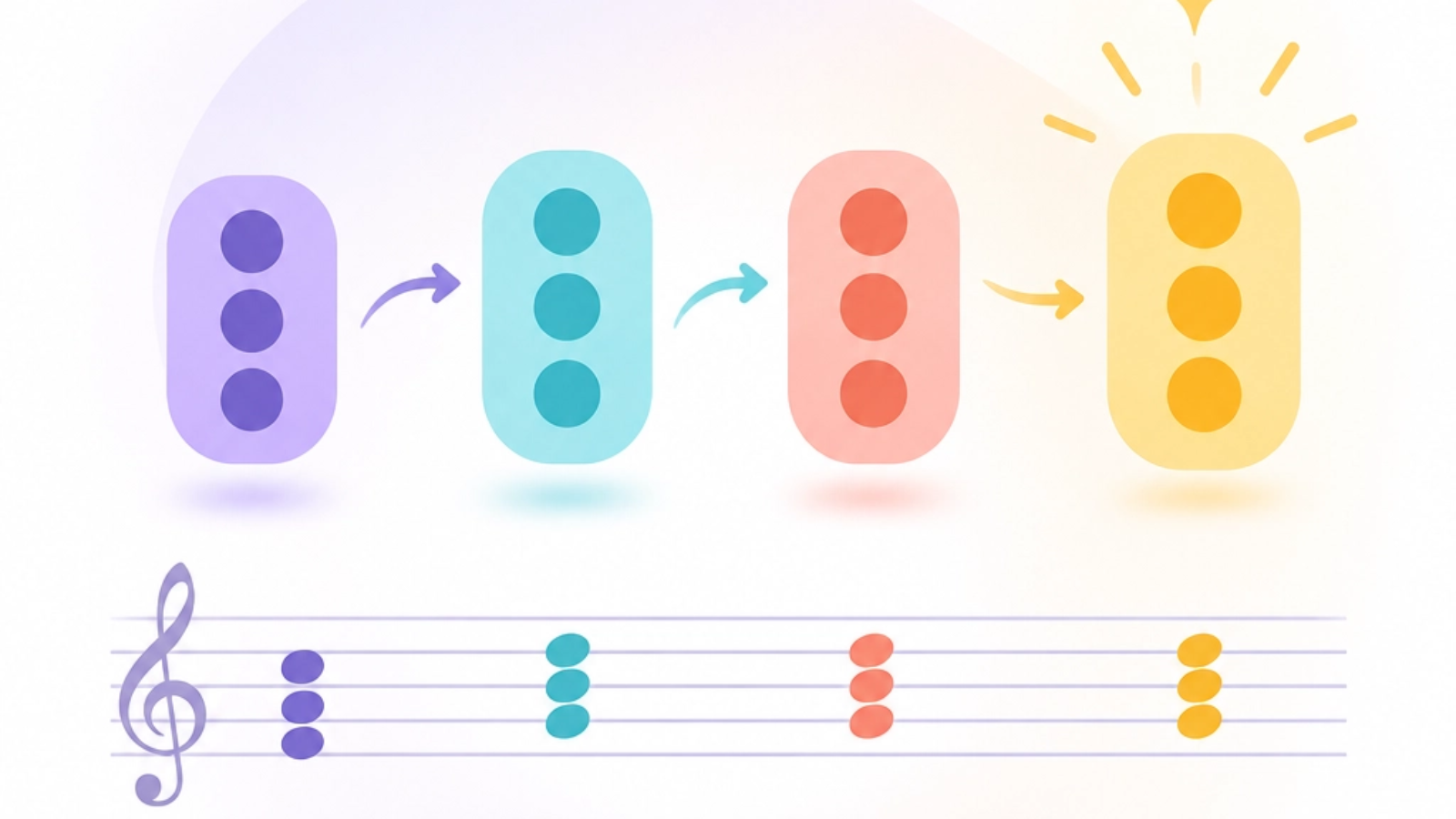
A cadence is a harmonic event that helps shape a phrase’s ending. In tonal music, a dominant-to-tonic progression often creates a strong sense of arrival. A deceptive cadence, by contrast, redirects the expected resolution. The phrase may continue, but the listener has already formed an expectation that the music will settle.
This is one way to understand harmonic prediction: your brain uses the music so far to anticipate what may come next. The expectation need not be conscious. Nor does it guarantee that you will prefer, or even notice, a particular ending. Instead, it offers a useful framework for understanding why the same chord can sound settled in one context and surprising in another.
Cadence perception also involves more than identifying the final chord. The preceding harmony establishes a tonal context. The final chord’s stability within that context, along with its mode and musical function, can shape whether the ending feels complete.

What recent cadence research tells us
A 2025 study by Hannah Lee Choi and Takako Fujioka examined how adults perceived different cadences in major- and minor-mode settings. The 61 participants had varying levels of musical training. They rated arousal, valence, and degree of completion for authentic, parallel-mode tonic, deceptive, and Neapolitan cadences.
The researchers found that listeners’ valence ratings depended mainly on the mode of the preceding context: major contexts generally received higher ratings. Perceived completion, meanwhile, was associated with how stable the final chord was in its tonal context. Parallel-mode tonic cadences stood out. In those cases, the mode of the ending chord mattered more for both completion and valence. The study also found that training influenced participants’ ratings, most noticeably their completion judgments.
These findings suggest that listeners do not judge a cadence by its last chord alone. Instead, they interpret the ending in relation to what came before. However, ratings of completion and valence are not direct measurements of a listener’s full, real-time musical experience. The study provides evidence about responses to specific musical examples, not a universal formula for how every listener hears a cadence.
A separate 2025 EEG study by Andrew Goldman and colleagues investigated harmonic expectation in the context of musical syntax. Listeners who knew that further musical context would follow an unexpected harmony showed larger ERP responses to improbable chords. The authors interpret this pattern as consistent with predictive coding: top-down expectations about musical structure can interact with acoustic information and the surprising chord itself.
This result adds a complementary perspective. The Choi and Fujioka study concerns how listeners evaluate cadence endings. Goldman and colleagues examine neural responses to unexpected harmonies under different structural expectations. Together, they suggest that musical context can shape both the experience of completion and responses to harmonic surprise. They do not establish that cadence practice itself changes the brain.
Music theory lessons online: practising harmonic expectation
You can train your listening by comparing resolutions rather than memorizing labels alone. Start with a short progression in a familiar key. Play or listen to a dominant-to-tonic ending, then compare it with a deceptive resolution. Notice whether the second ending feels unfinished, redirected, or simply different. Describe what you hear before naming the chords.

Next, listen for how the mode of the surrounding music affects the ending. A change in the final chord’s mode can alter its character, even when it occupies a tonic role. For example, a Picardy third ends a minor-mode passage with a major tonic chord. Listen for both the shift in mode and the feeling of resolution. Avoid treating “major” as automatically happy or “minor” as automatically sad; musical perception depends on context, and individual responses vary.
Use this sequence as a practical exercise:
- Choose a short phrase in a piece you know. Identify where you expect it to end.
- Compare an authentic cadence with a deceptive one. Listen for what the second chord does to your expectation.
- Replay the phrase and focus on the pre-cadential mode, then the mode and stability of the final chord.
- Apply the same listening questions to a different piece. Ask what the music led you to expect and what it actually delivered.
- If you play an instrument, perform each ending slowly. Listen to the bass motion as well as the upper voices.
These steps develop analytical listening, but they are not a brain-training guarantee. They give you a repeatable way to connect tonal function, expectation, and what you hear. A teacher can help you test those interpretations against the score and the style of the repertoire.
What rhythm research can, and cannot, add
Research on rhythm can help explain why music learning may involve more than symbolic analysis. However, rhythm studies do not directly test cadence perception. They should not be used as proof that studying harmony changes cognition.
For example, a 2025 randomized controlled trial studied music-based rhythmic auditory stimulation for walking in people with Parkinson’s disease. Across eight weeks, the music-based group showed gains in walking activity and improvements in stride-time variability compared with an active walking control. This work concerns movement and rhythmic entrainment, not harmonic syntax or cadence listening.
A second 2025 trial examined a rhythm-based game for children with reading disorders. It found no group difference on its primary measure of nonword decoding. In a per-protocol analysis, children who completed the intervention showed improvements in word-reading accuracy and speed. Because these findings appeared in the per-protocol analysis rather than the primary outcome, they call for careful interpretation. They do not show that cadence study improves reading.
These studies illustrate why evidence must match the claim. Music can be studied in relation to movement, reading, perception, and learning, but results in one domain cannot be assumed to apply to another. For cadence practice, the most direct evidence comes from research that tests how listeners respond to musical endings and harmonic expectations.

Learn cadence analysis with Allegro Ma Non Troppo
At Allegro Ma Non Troppo, music theory instruction can connect chord function, score reading, and listening to the repertoire you want to understand. Our music theory lessons are available online and in person at our Ottawa studio. Instruction is available in English and Spanish, for learners of different ages and skill levels.
You can choose 30-, 45-, or 60-minute lesson options. Bundle discounts are available, and the Family Plan offers a 10% discount when three or more members enrol. For current plan details, visit music lesson plans.
Online lessons let you study from a comfortable space at home, while in-person lessons offer the Ottawa studio setting. In either format, you can bring a score, a recording, or a specific question about a cadence. Your teacher can then help you compare the notation with what you hear.
Research Sources
- Choi, H. L., & Fujioka, T. (2025). “The Perception of a Musical Cadence Is Driven by Local Versus Global Mode Depending on the Tonal Structure of Its Terminal Chord.” Music Perception. DOI: 10.1525/mp.2025.2347984. The study was read via its PsyArXiv preprint: https://osf.io/preprints/psyarxiv/xwqub.
- Goldman, A., Nozari, N., Lim, Y., & Kibler, M. (2025). “‘Hearing as’: Knowledge of Syntactic Structure Affects Event-related Potential Components for Musical Expectation.” Journal of Cognitive Neuroscience. DOI: 10.1162/jocn.a.2404. This source was reviewed at the abstract level.
- Porciuncula, F., Cavanaugh, J. T., Zajac, J., Wendel, N., Baker, T., Arumukhom Revi, D., Eklund, N., Holmes, M. B., Awad, L. N., & Ellis, T. D. (2025). “Amplifying walking activity in Parkinson’s disease through autonomous music-based rhythmic auditory stimulation: randomized controlled trial.” npj Parkinson’s Disease, 11, 100. DOI: 10.1038/s41531-025-00952-x.
- Descamps, M., Grossard, C., Pellerin, H., et al. (2025). “Rhythm training improves word-reading in children with dyslexia.” Scientific Reports, 15, 17631. DOI: 10.1038/s41598-025-02485-y.
Leave A Comment