
 Cart is empty
Author: Karen Erazo
If you are exploring flute lessons Ottawa offers for your family, tone can seem like a mystery. A small change in how you direct your air can alter the sound’s character. In 2026, researchers described one mechanism behind that change: jet angle can shift the balance between the second and third harmonics.
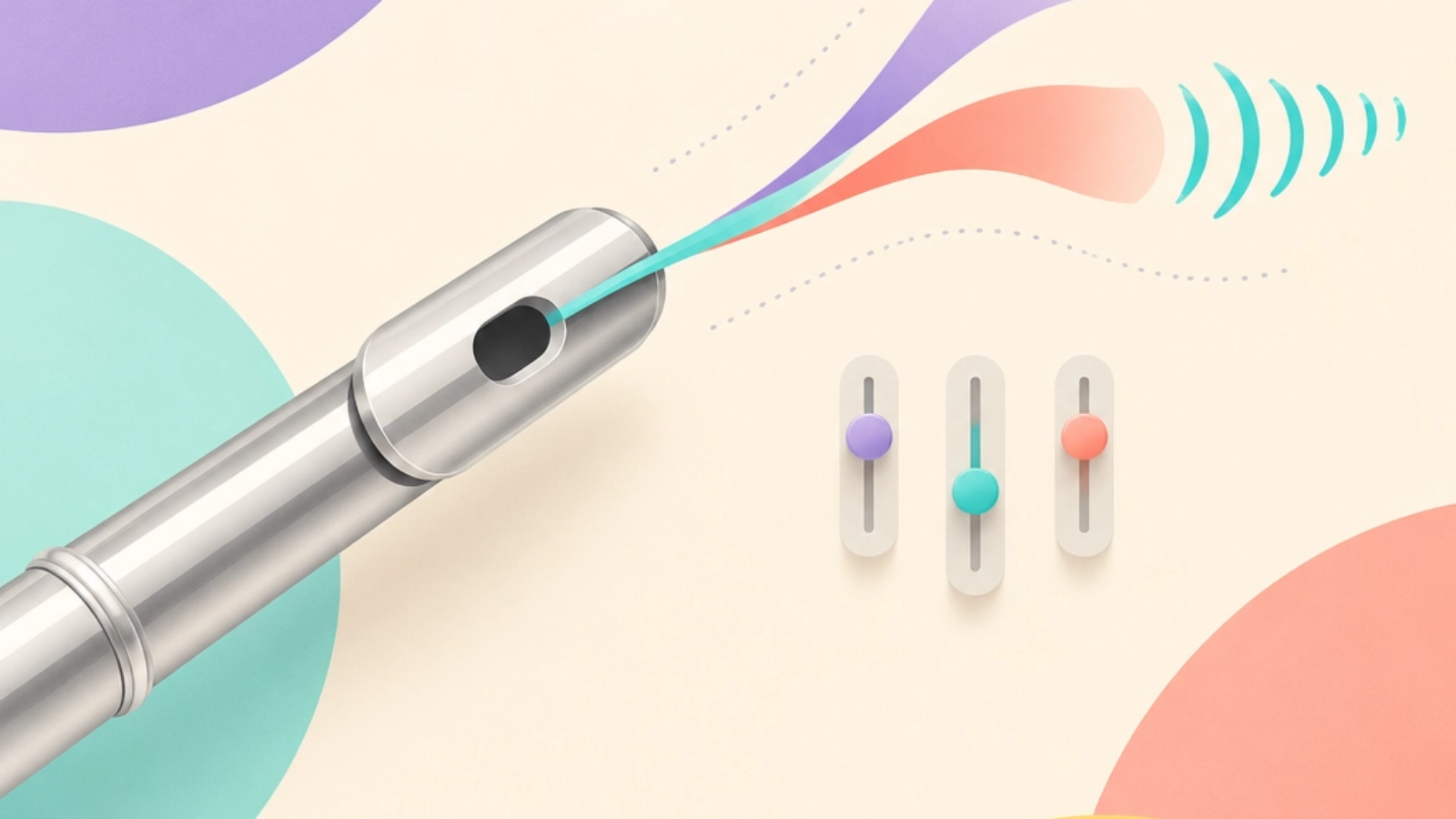
The mixing-board metaphor helps explain the idea. However, your embouchure does not have separate, independent controls. Changing your air angle also changes how the air jet interacts with the flute’s edge. Here is what the research says, what it does not establish, and how you can explore the idea carefully.
What the 2026 flute study examined
Onogi and colleagues used direct aeroacoustic simulations for two flute headjoints. They studied how the angle between the air jet and the mouth opening affects harmonic structure. The researchers did not study full flutes played by students.
The abstract reports that increasing the jet angle, directing the jet more perpendicular to the mouth opening, intensified the second harmonic more than the third. In practical terms, the balance of partials can change even when the player is not simply aiming for more volume.

A harmonic is a frequency component within a musical tone. The fundamental is the main perceived pitch. Higher harmonics add detail to its sound. The 2026 finding does not mean that one angle is best for every player or musical passage. It describes a relationship observed in simulations of two headjoints.
The researchers connected this shift to jet deflection. As the jet angle increased, the air stream deflected toward the inside of the pipe. This increased the actual jet offset: the jet’s effective position relative to the edge.
The pressure difference across the opening helps explain why. With a greater angle, the jet was directed horizontally at the inner edge wall, decreasing pressure inside the pipe. At the same time, the angle between the jet and the outer edge wall increased, raising pressure outside. These pressure changes contributed to the inward deflection.
The study also reports that the inclination of the inner edge wall matters. When that wall was changed to be more perpendicular to the jet, pressure around the wall increased and the jet deflected farther outward. So the angle of the air and the shape of the edge work together.
Why “mixing board” is a useful, limited metaphor
You can picture harmonics as tone-colour sliders. A small adjustment to your air direction may shift the relative strength of different harmonics. That makes the mixing-board image useful for listening and teaching.
Still, a physical mixing board has independent faders. The flute does not. Jet angle affects jet deflection and actual offset, while other playing conditions can also influence the result. The 2026 study identifies the edge-wall angle as another factor in that interaction.
An earlier study by some of the same research group helps put the effect in context. In 2021, the researchers used an isolated flute headjoint and an artificial blowing device. They varied jet angle, jet offset, lip-to-edge distance, and flow rate independently. They also measured airflow with a hot-wire anemometer.
The 2021 abstract reports that jet angle changed the difference between the second and third harmonic sound-pressure levels. Its effect was smaller than the effect of jet offset, comparable to flow rate, and larger than the effect of lip-to-edge distance. The authors suggested that the angle’s effect mainly came from its shift in actual jet offset.

Together, these studies suggest that jet angle is one influence on harmonic balance, not a standalone tone solution. The 2021 work points to jet offset as an important variable too. Therefore, an exercise should help you notice and compare changes, not force you toward a supposedly ideal setting.
Three careful tone experiments for students
These short experiments are practice ideas inspired by the research. They are not exercises tested in the studies. A teacher can help you keep your posture and playing comfortable while you listen.
- Choose a comfortable note. Play it several times with your usual setup. Keep the note, instrument position, and dynamic as consistent as you can. Record a short baseline if that helps you compare.
- Make a small air-direction adjustment. Play the same note again without forcing your lips or increasing breath pressure. Notice changes in tone colour, stability, and response. Return to your usual setup between attempts.
- Compare recordings. Listen for differences rather than deciding immediately that one version is better. If you use a spectrum display, treat it as a listening aid, not a score. A phone recording or display cannot reproduce the controlled conditions of a lab study.

Stop if you feel strain, dizziness, or discomfort. Avoid making large changes to your embouchure based on a single attempt. Instead, use short, repeatable comparisons and ask your teacher to help you isolate variables.
For young players, the goal is careful listening, not copying a particular mouth shape. Children and beginners were not tested in either study. A teacher can adapt the exploration to your experience, instrument, and musical goals.
What the research cannot tell you
Both papers were read at abstract level. The full text of the 2026 paper is paywalled, so this summary does not claim to review its complete methods or results. The 2021 paper’s abstract was also the basis for the description here.
The 2026 work used simulations of two headjoints. The 2021 work used an isolated headjoint and an artificial blowing device. Neither study tested full flutes played by real students, children, or beginners. They also do not establish that a particular jet angle improves performance or suits every player.
That distinction matters. The studies clarify physical mechanisms under controlled conditions. They do not replace individual instruction, and they do not prescribe a universal embouchure. A flute teacher can help you connect careful listening to comfortable, consistent technique.
Flute lessons and music lessons Ottawa families can access
At Allegro Ma Non Troppo, students can explore these ideas through individual instruction shaped around their level and musical goals. Our flute lessons are available in person in Ottawa at 90 Genest Street or online. Instruction is available in English and Spanish, including clases de flauta en español.
Lesson options are 30 minutes for $35, 45 minutes for $48, and 60 minutes for $63. Bundles are available at these prices:
- 30-minute lessons: 2 for
$70$65; 3 for$105$100; 4 for$140$120. - 45-minute lessons: 2 for
$96$94; 3 for$144$140; 4 for$192$180. - 60-minute lessons: 2 for
$126$124; 3 for$189$185; 4 for$252$240.
Families with three or more members can receive a 10% Family Plan discount. You can review current options on the lesson plans and pricing page. A free trial lesson lets you try a lesson before committing. In-person study offers the comfort of a dedicated studio; online lessons offer flexibility when travel or schedules make an in-person visit difficult.
Research sources
- Onogi, K., Yokoyama, H., Yoshinaga, T., & Iida, A. (2026). “Mechanism of harmonic structure change with jet angle in flute playing.” The Journal of the Acoustical Society of America, 159(1), 862–873. Published January 28, 2026. https://doi.org/10.1121/10.0042263. PMID: 41603625. Read at abstract level only; the full text is paywalled. The study used simulations for two flute headjoints, not full flutes played by students.
- Onogi, K., Yokoyama, H., & Iida, A. (2021). “Effects of jet angle on harmonic structure of sound radiating from the flute.” Acta Acustica, 5, 11. https://doi.org/10.1051/aacus/2021003. Read at abstract level only. The study used an isolated headjoint and an artificial blowing device, not student performances.
Leave A Comment