
 Cart is empty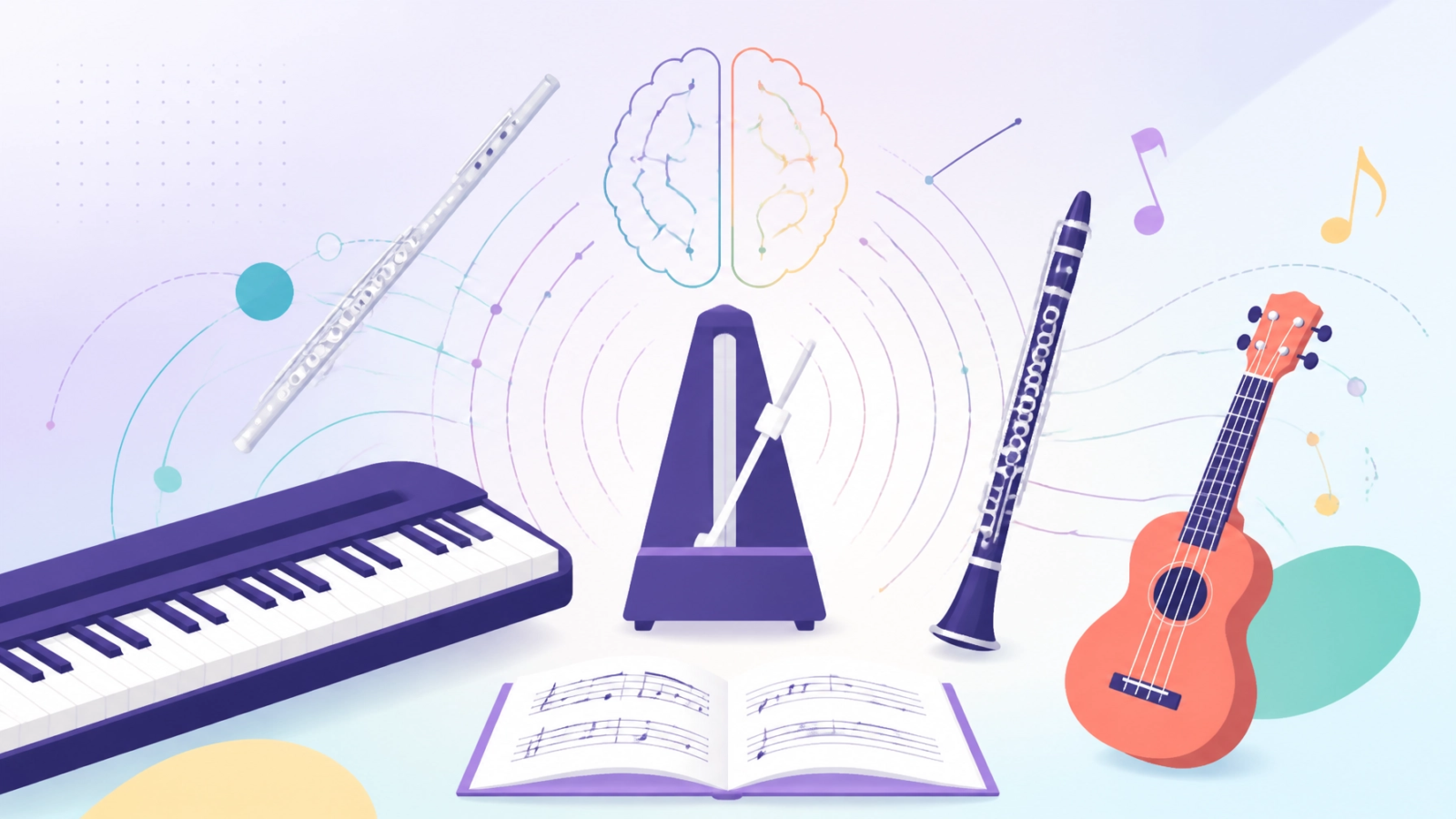
Ensemble musicianship is a demanding form of cognitive-motor coordination. You must monitor your part, predict upcoming sounds, remember musical information, and adjust to other performers. These processes engage executive function, auditory processing, and neural plasticity.
This is one reason music lessons Ottawa can provide structured cognitive training. However, music should not be reduced to a brain exercise. The central purpose remains musical: learning the repertoire, styles, and sounds you want to play.
The instrument is secondary to that purpose. Piano, flute, clarinet, ukulele, and music theory each provide different routes into musicianship. Each can develop timing, attention, memory, and motor control when instruction uses precise goals and deliberate practice.
How music lessons Ottawa engage executive function
Executive function describes mental processes that organize purposeful action. The core domains include inhibitory control, working memory, and cognitive flexibility.
In an ensemble, these domains operate together.
- Inhibitory control helps you suppress an early entrance, excess volume, or automatic response.
- Working memory helps you retain a cue, harmonic pattern, rhythm, or upcoming transition.
- Cognitive flexibility helps you shift between your part, the conductor, the score, and the group sound.
- Auditory prediction helps you anticipate when and how the next musical event should occur.
- Synchronization helps you align movement and sound with a shared pulse.
- Deliberate practice helps you improve each process through specific, feedback-based repetition.
A 2025 systematic review by J. Riikka Ahokas, Suvi Saarikallio, Graham Welch, Usha Goswami, and Tiina Parviainen examined rhythm training and executive function. The review connects rhythm skills with inhibition, working memory, and shifting. Its findings support the value of structured timing tasks, while also emphasizing the need for careful interpretation.
A three-level meta-analysis by Yumeng Cai, Dan Kang, and Xiwu Xu examined 46 studies involving 3,530 children. Musical training showed a positive overall association with executive function. The result was meaningful, but it did not establish that every lesson produces the same cognitive outcome.
This distinction matters. Music training can exercise executive processes. It does not guarantee higher grades or generalized intelligence. Outcomes depend on the learner, instruction, practice quality, and comparison activity.

Auditory prediction and synchronization in ensemble playing
Your brain does not wait for every beat before preparing a response. It creates predictions from meter, tempo, phrasing, harmony, and previous events.
Suppose a clarinet section approaches a shared entrance. Each player predicts the timing and character of the attack. Each player also listens for evidence that confirms or challenges the prediction. The group then adjusts through visual, auditory, and motor feedback.
This process involves the auditory system, premotor regions, supplementary motor areas, basal ganglia, and cerebellum. These systems help coordinate timing and correct deviations.
Emily E. Harding, Joonyeol C. Kim, Alexander P. Demos, Isabela R. Roman, Phil Tichko, Caroline Palmer, and Edward W. Large reviewed these mechanisms in “Musical neurodynamics.” The 2025 article in Nature Reviews Neuroscience describes rhythm, prediction, neural oscillations, and motor engagement in music.
Joint performance also requires self-other distinction. You must identify the sound produced by your own action while tracking the actions of others. Natalie Kohler, Anna M. Czepiel, Örjan de Manzano, Giacomo Novembre, Peter E. Keller, Arno Villringer, and Daniela Sammler studied this process in joint piano performance. Their 2025 findings describe distinct neural representations for self-produced and other-produced actions.
You can develop these abilities through a staged exercise:
- Play a passage with a metronome.
- Remove the metronome while maintaining the internal pulse.
- Record yourself and compare the recording with the click.
- Listen to a partner’s part without playing.
- Play your part while shifting attention between your sound and the ensemble.
- Rehearse entrances with a visible breath or preparatory movement.
These tasks increase cognitive demand gradually. That progression is pedagogical scaffolding. You first establish one skill. Then, you add complexity after the earlier skill becomes stable.
Advanced exercises for piano, flute, clarinet, and ukulele
Each instrument places different demands on the auditory-motor system. Your musical goals should determine the instrument and repertoire.
Piano: layered inhibition and working memory
Piano performance requires bilateral coordination and simultaneous attention to several musical layers. You may voice a melody, control an accompaniment, and anticipate a harmonic change.
Try this advanced exercise:
- Play a melody in the right hand.
- Reduce the accompaniment to blocked chords in the left hand.
- Keep the melody prominent at a quiet dynamic.
- Remove the written score after one repetition.
- Restart from the beginning of each phrase.
- Change the accompaniment rhythm while preserving the melody.
This exercise targets working memory and cognitive flexibility. It also trains inhibitory control because you must prevent the accompaniment from dominating the texture.
You can connect this work to piano lessons in Ottawa, where technical coordination can be linked to repertoire, analysis, and performance goals.
Flute: respiratory prediction and phrase control
Flute performance adds respiratory planning to synchronization. You must predict phrase length, dynamic direction, register, and recovery time before you begin.
Try this sequence:
- Mark the structural peak of each phrase.
- Choose a breath point before the phrase becomes urgent.
- Play the passage at a moderate tempo.
- Repeat it while maintaining the same phrase direction at a lower dynamic.
- Record the tone and listen for pitch instability near the end of the breath.
- Repeat with one altered breath point.
This exercise trains prediction, interoceptive awareness, and motor flexibility. It also helps you evaluate whether a breath serves musical syntax.
The respiratory system must remain adaptable. There is no single visual breathing pattern that every advanced flutist must reproduce. Function matters more than appearance. Explore flute lessons in Ottawa for individualized work on breath control, tone, and phrasing.
Clarinet: inhibition and ensemble timing
Clarinetists must coordinate finger movement, articulation, breath pressure, and pitch. Ensemble playing adds the need to blend timing and tone with other instruments.
Use this exercise:
- Select a difficult entrance.
- Practise the inhalation and first note without continuing the phrase.
- Delay the entrance deliberately by one subdivision.
- Return to the correct entrance after hearing the internal count.
- Practise with a metronome on beats two and four.
- Finish by playing the passage with a partner or recording.
The delayed entrance develops inhibitory control. The reduced metronome develops internal timing. Listening to another part develops auditory scene analysis.
Current research on ensemble synchronization often uses tapping or piano rather than clarinet. Apply these findings as mechanisms, not as instrument-specific guarantees. You can develop the practical skills through clarinet lessons in Ottawa.
Ukulele: harmonic prediction and cognitive flexibility
Ukulele study offers direct access to harmonic patterns. Chord changes require motor preparation, auditory recognition, and temporal continuity.
Try this exercise:
- Choose a four-chord progression.
- Name each chord and its harmonic function.
- Hear the next chord before changing shape.
- Practise the transition without strumming.
- Add a steady strum at a slow tempo.
- Transpose the progression to a new key.
- Maintain the rhythmic pattern during the transposition.
This task strengthens chord retrieval and cognitive flexibility. It also reduces dependence on visual chord charts.
The goal is not to memorize isolated hand shapes. The goal is to connect shape, sound, function, and timing. See ukulele lessons in Ottawa for a broader explanation of chord memory.

Music theory makes ensemble decisions more predictable
Music theory supports executive function by organizing musical information. Harmony, meter, form, and phrase structure reduce the need to process every note as an isolated event.
For advanced learners, try the following theory routine:
- Analyze the harmonic function of each phrase.
- Mark cadences and points of structural tension.
- Identify rhythmic hierarchy within the meter.
- Write the entrance cues for each instrument.
- Reduce the passage to a bass line or rhythmic skeleton.
- Sing your part while conducting the meter.
- Reconstruct the full texture from memory.
This exercise combines working memory, auditory prediction, and cognitive flexibility. It also clarifies your role in the ensemble. You can determine whether your part leads, supports, imitates, or answers another line.
Music theory lessons in Ottawa can connect notation with aural skills and repertoire. Theory is not separate from performance. It is a map for making accurate musical decisions.
Deliberate practice and neural plasticity
Deliberate practice is not simply extended practice time. It includes a defined target, an appropriate level of difficulty, feedback, and reflection.
Daniel Mateos-Moreno, Jorge García-Perals, and T. W. Maxwell examined conscious practice in one-to-one instrumental teaching in 2025. Their action-research study reported improvements in focus, productivity, memory for learning processes, and body awareness.
A deliberate practice cycle may look like this:
- Identify one measurable problem.
- Select a task that isolates that problem.
- Practise slowly enough to detect errors.
- Receive auditory, visual, or teacher feedback.
- Change one variable at a time.
- Test the skill in the complete musical context.
- Record the result and plan the next session.
Neural plasticity responds to repeated, relevant experience. However, repetition must preserve accuracy. Repeating an error strengthens an inefficient motor pattern.
A recent 2026 dataset by Francesca Talamini, Massimo Grassi, Gianmarco Altoè, Elvira Brattico, Anne Caclin, Barbara Carretti, Véronique Drai, and colleagues provides a large resource for studying musicianship, cognition, personality, and memory. It may help researchers examine how musical background relates to executive processes. It does not prove that ensemble participation alone causes cognitive improvement.
Choosing music lessons Ottawa students can sustain
The best instrument is the one that supports your musical intentions. You may want to accompany songs, perform in a school band, study classical repertoire, improvise, or understand harmony. Your goals should guide the choice.
Allegro Ma Non Troppo offers private instruction in piano, flute, clarinet, ukulele, and music theory. Lessons are available in English and Spanish, including clases bilingües en inglés y español when that format best supports comprehension, auditory processing, and clear pedagogical scaffolding. You can study in person at the Ottawa studio or online from a comfortable home environment.
Online learning can reduce travel demands and provide scheduling flexibility. In-person study allows direct observation of posture, movement, and acoustic response. Both formats can support serious progress when your environment is quiet, comfortable, and technically reliable.
You can choose 30-, 45-, or 60-minute sessions. Lesson bundles provide savings:
- 30 minutes: 4 lessons are
$140$120. - 45 minutes: 4 lessons are
$192$180. - 60 minutes: 4 lessons are
$252$240. - A free trial lesson is available before commitment.
Family Plan savings are also available for three or more members. Specialized support can address school band preparation, ensemble excerpts, theory, sight-reading, and structured practice.
For high-level learners, the purpose is not to select the instrument with the largest theoretical cognitive benefit. Research does not support that simplistic ranking. The purpose is to build a reliable relationship among sound, movement, attention, and musical meaning.
Recent evidence includes:
- Ahokas, J. Riikka, Suvi Saarikallio, Graham Welch, Usha Goswami, and Tiina Parviainen. “The Training of Rhythm Skills and Executive Function: A Systematic Review.” Music & Science, 2025. DOI: 10.1177/20592043241305922
- Cai, Yumeng, Dan Kang, and Xiwu Xu. “Boosting Executive Function in Children Aged 3–12 Through Musical Training: A Three-Level Meta-Analysis.” Frontiers in Psychology, 2025. DOI: 10.3389/fpsyg.2025.1659927
- Harding, Emily E., Joonyeol C. Kim, Alexander P. Demos, Isabela R. Roman, Phil Tichko, Caroline Palmer, and Edward W. Large. “Musical Neurodynamics.” Nature Reviews Neuroscience, 2025. DOI: 10.1038/s41583-025-00915-4
- Kohler, Natalie, Anna M. Czepiel, Örjan de Manzano, Giacomo Novembre, Peter E. Keller, Arno Villringer, and Daniela Sammler. “Distinct and Content-Specific Neural Representations of Self- and Other-Produced Actions in Joint Piano Performance.” Frontiers in Human Neuroscience, 2025. DOI: 10.3389/fnhum.2025.1543131
- Mateos-Moreno, Daniel, Jorge García-Perals, and T. W. Maxwell. “Teaching to Practice Productively and Consciously: An Action-Research Study in One-to-One Instrumental Music Teaching.” Music Education Research, 2025. DOI: 10.1080/14613808.2025.2465248
- Talamini, Francesca, Massimo Grassi, Gianmarco Altoè, Elvira Brattico, Anne Caclin, Barbara Carretti, Véronique Drai, and colleagues. “Music Ensemble: A Large Dataset on Musicianship, Cognition, and Personality in Musicians and Nonmusicians.” Scientific Data, 2026. DOI: 10.1038/s41597-026-06654-0
Leave A Comment