
 Cart is empty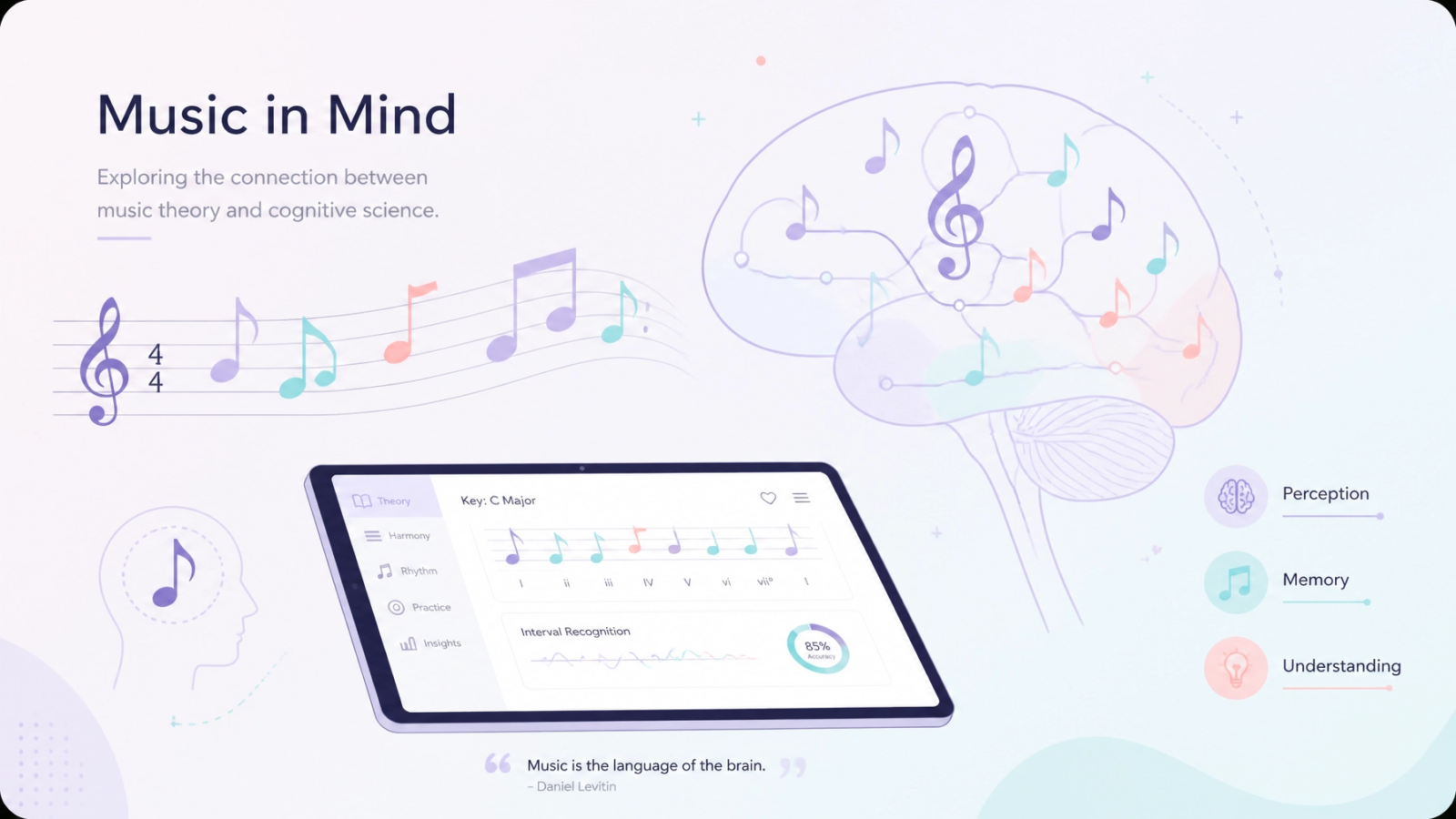
The study of music theory is often perceived as a collection of archaic rules and abstract symbols. However, when viewed through the lens of cognitive science and pedagogy, music theory serves as the structural framework for auditory processing and neural plasticity. It is the grammar of sound that allows the brain to decode complex temporal patterns into meaningful artistic expression. Despite its importance, many students encounter systemic errors in their theoretical training that hinder their overall musical development. By identifying these common mistakes and utilizing the technological advantages of online learning, you can accelerate your mastery of this vital discipline.
The Cognitive Science of Music Theory
Music theory is not merely an academic exercise; it is a catalyst for cognitive development. Engaging with harmonic structures and rhythmic notation stimulates the executive functions of the brain, including working memory, attention, and planning. Research in neuroscience suggests that the systematic study of music theory enhances neural plasticity, the brain’s ability to reorganize itself by forming new neural connections.
When you study music theory at Allegro Ma Non Troppo, you are not just learning where to place notes on a staff. You are training your brain to perform high-level auditory discrimination. This process involves the ability to differentiate between subtle variations in pitch, timbre, and duration. For students in flute lessons in Ottawa or those engaged in clarinet lessons Ottawa, theory provides the cognitive scaffolding necessary to translate complex sheet music into precise motor movements.
Common Notation and Structural Mistakes
One of the most frequent errors encountered in early music theory education is the improper execution of visual notation. While these may seem like minor aesthetic issues, they represent a failure in the accurate encoding of musical information.
- Incorrect stem directions and notehead placement: Many students fail to follow the standard rules of notation, such as directing stems downward for notes above the middle line of the staff.
- Misplaced or omitted clefs: The clef is the primary reference point for pitch. An incorrect or missing clef renders the entire staff unintelligible, leading to systemic errors in note reading.
- Faulty key signature application: Forgetting to apply accidentals consistently across a measure is a common breakdown in temporal monitoring.

These errors often stem from a lack of focus on the precision required in musical literacy. In our music theory lessons, expert teachers emphasize the importance of correct notation as a foundation for advanced analysis. Whether you are learning in English or seeking bilingual instruction in Spanish, the technical requirements of notation remain a universal standard for musical communication.
The Disconnect Between Theory and Audition
A significant pedagogical mistake is the separation of written theory from the actual sound it represents. This creates a cognitive gap where symbols are manipulated on paper without any corresponding auditory internalisation. This phenomenon is often referred to as "paper theory."
To achieve true musical proficiency, theory must resonate with the sounds you produce. If you can write a perfect authentic cadence but cannot identify its sound when listening, you have not fully integrated the concept. This lack of auditory discrimination can limit your success in practical settings, such as performing in school bands or practicing piano lessons in Ottawa.

By bridging this gap, you enhance your brain’s ability to predict and interpret musical structures. This is a form of advanced pattern recognition that is essential for sight-reading and improvisation. Integrating ear training with theoretical study ensures that every note you write is supported by a clear mental representation of its sound.
Temporal Processing and Rhythmic Precision
Rhythm is the temporal foundation of all music, yet it is often the area where the most fundamental mistakes occur. Errors in rhythmic theory typically manifest as:
- Inconsistent bar lengths: Creating measures that do not adhere to the specified time signature.
- Improper grouping of beats: Failing to visualize the underlying pulse within complex rhythmic patterns.
- Neglecting the hierarchy of beats: Not understanding the difference between strong and weak beats, which affects phrasing and expression.
These mistakes indicate a struggle with temporal processing, a cognitive function responsible for the perception and timing of events. For students of the ukulele lessons, understanding rhythmic theory is crucial for maintaining a steady tempo and coordinating with other musicians. Advanced music theory helps you internalize these temporal structures, leading to greater rhythmic stability and technical precision.
How Online Lessons Accelerate Cognitive Integration
The transition to online lessons has revolutionized how music theory is taught and absorbed. Digital platforms offer unique advantages that can correct common mistakes more efficiently than traditional methods.
- Real-time notation software: Online instructors can use digital notation tools to demonstrate concepts instantly. This provides immediate visual feedback, helping you correct errors in stem direction or rhythmic grouping in real time.
- Interactive visual aids: Concepts like the circle of fifths or harmonic analysis can be presented through dynamic, high-contrast digital interfaces that enhance visual encoding.
- Screen sharing and document annotation: During an online theory session, your teacher can annotate your work directly on the screen, providing a clear and precise correction of your notation.
- Recording capabilities: Online lessons can be recorded, allowing you to revisit complex explanations of concepts like voice-leading or counterpoint, reinforcing the information through repetition.

These technological interventions reduce the cognitive load on the student, allowing you to focus on high-level conceptual understanding rather than the mechanics of the medium. The flexibility of online learning also means that families in the Ottawa area can integrate theory into their schedules without the logistical challenges of travel, ensuring consistent progress.
Expert Instruction in Ottawa and Online
At Allegro Ma Non Troppo, we provide a structured and scientific approach to music education. Our Master-level teachers are experts in guiding students through the complexities of music theory, whether in-person at our Ottawa studio or through our comprehensive online platform. Our bilingual instruction in English and Spanish ensures that our community has access to high-quality music education in the language they are most comfortable with.
We believe in transparency and accessibility for all families. To support your musical journey, we offer a variety of flexible scheduling and pricing options designed to accommodate your needs.
- Free Trial Lesson: Experience our teaching methodology with a no-obligation introductory session.
- Single 30-minute lesson: $35.00
- Single 45-minute lesson: $52.50
- Single 60-minute lesson: $70.00
- Lesson Bundle (5 lessons): $166.25 (strikethrough $175.00)
- Lesson Bundle (10 lessons): $315.00 (strikethrough $350.00)
- Family Plan: Savings for three or more family members.
Our curriculum is personalized to your specific goals, providing specialized support for school band students and adult learners alike. By focusing on evidence-based pedagogical strategies, we help you avoid common pitfalls and achieve a higher level of musical literacy.
Music theory is the key to unlocking your full potential as a musician. By correcting notation errors, integrating audition with theory, and utilizing the tools of online learning, you can develop the cognitive skills necessary for a lifetime of musical achievement. Join us in Ottawa or online to begin your journey toward musical mastery.
Leave A Comment