
 Cart is empty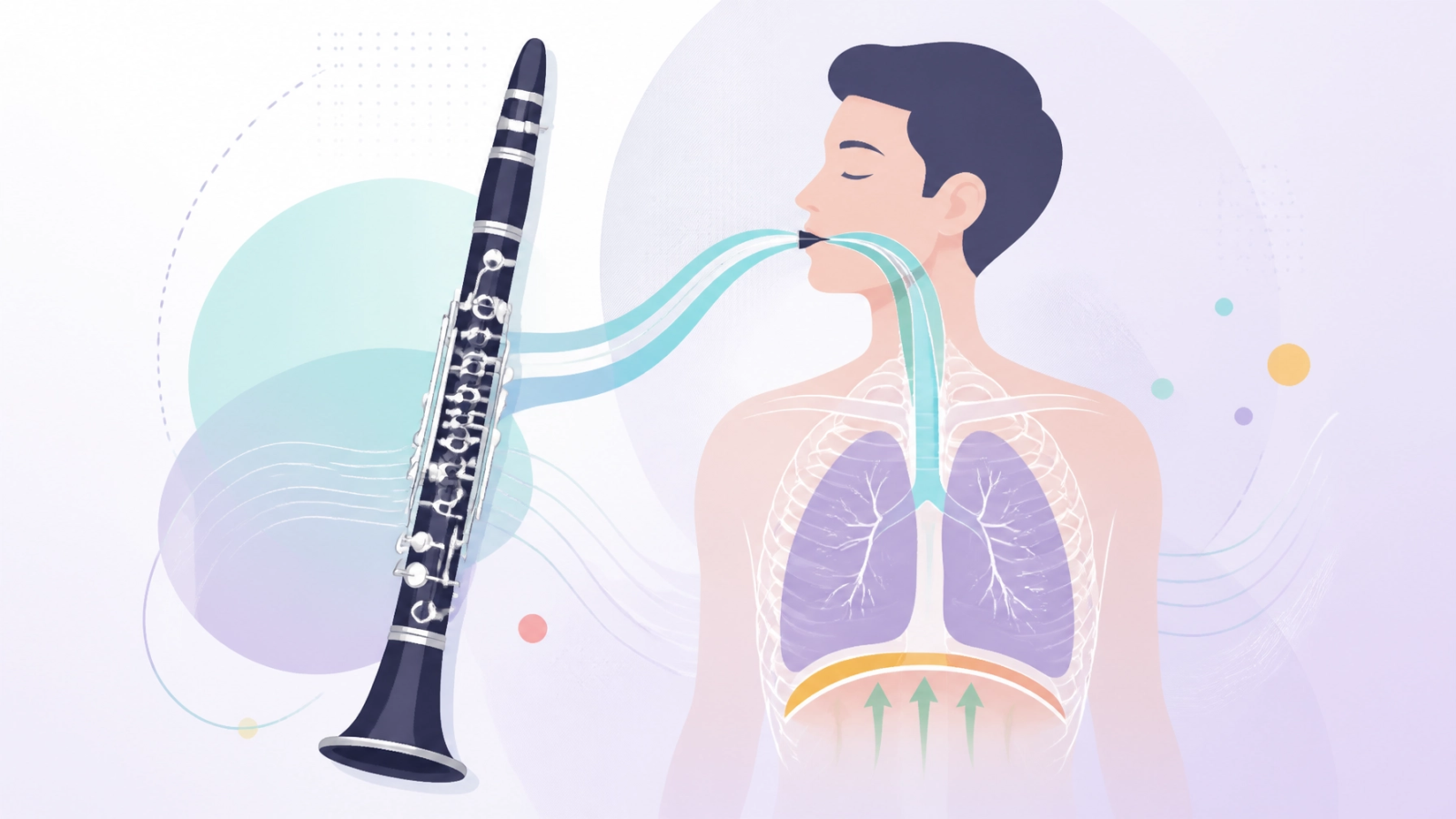
Clarinet breath control involves more than taking a large breath. It requires precise coordination between respiratory muscles, oral pressure, reed vibration, posture, attention, and musical phrasing. Therefore, advanced players need a model that connects physiology with acoustics and motor learning.
In serious music lessons Ottawa, you learn to regulate air rather than simply increase it. You also learn to match pressure and airflow to the clarinet’s acoustic resistance. This approach can improve tone stability, intonation, endurance, articulation, and ensemble reliability.
The evidence base is developing. Recent peer-reviewed studies examine respiratory training in wind players, the acoustics of clarinet impedance peaks, and the relationship between breathing, anxiety, and attentional control. Although not every study focuses directly on clarinetists, the findings offer useful principles for intermediate and advanced players.
Respiratory Physiology and Clarinet Breath Control
During inhalation, your thoracic cavity expands. The diaphragm descends, while the external intercostal muscles help expand the ribcage. As a result, air enters the lungs through a pressure gradient.
During playing, exhalation becomes controlled rather than passive. Your respiratory muscles regulate pressure inside the mouth and behind the reed. The goal is not maximal force. Instead, you need stable pressure that matches the musical demand.
Several structures contribute to this process:
- The diaphragm supports efficient changes in thoracic volume.
- The intercostal muscles help control ribcage movement.
- The abdominal muscles regulate exhalation pressure.
- The oral cavity stores and directs pressure toward the reed.
- The embouchure controls the reed without restricting its vibration.
- The tongue coordinates articulation and oral shaping.
The term “breath support” can therefore mislead you if you interpret it as abdominal tension alone. Efficient support involves muscular coordination. It also requires a responsive embouchure and a clear auditory target.
A useful inhalation should feel quiet and efficient. Your shoulders should remain relatively free. Your ribs and abdomen should expand without unnecessary facial or neck tension. However, you should not force a single breathing pattern. Anatomy, repertoire, dynamics, and instrument setup all affect the most efficient solution.

Monteiro, Alvarelhão, Marques, and Lopes studied inspiratory muscle training in wind players. Their 2025 randomized study reported that five weeks of training improved maximum inspiratory pressure and reduced perceived exertion.
This finding has practical value. Stronger inspiratory capacity may reduce the effort required to refill between phrases. Nevertheless, respiratory strength does not automatically produce better musical control. You still need to transfer the capacity into long tones, dynamic shaping, scales, excerpts, and repertoire.
Treat supplemental respiratory training as an adjunct. It should not replace clarinet-specific practice. If you experience dizziness, chest discomfort, unusual shortness of breath, or persistent fatigue, stop the exercise and consult a qualified health professional.
Clarinet Acoustics: Pressure, Flow, and Impedance
The clarinet does not respond to air in the same way as an open-blown instrument. The reed acts as a pressure-sensitive valve. Your oral pressure moves the reed, while the bore determines much of the instrument’s resonance and pitch behaviour.
This relationship explains why “blow more” often fails as technical advice. More airflow can destabilize the reed. Excessive embouchure pressure can restrict vibration. In contrast, controlled pressure can produce a centred tone with efficient projection.
Acoustic impedance describes how strongly the instrument resists a particular frequency. The clarinet’s impedance peaks reflect resonant conditions within the mouthpiece and bore. These peaks influence response, pitch stability, tone colour, and the sensation of resistance.
Talaski and Smyth’s 2025 study examined the effect of overblowing clarinet impedance peaks on sound production, playability, and intonation. Their work is especially relevant when you move across registers or increase dynamic intensity. The study reinforces a central principle: your breath must interact with the instrument’s resonant structure.

You can apply this principle through controlled experiments:
- Sustain one comfortable note at mezzo-piano.
- Increase the dynamic level without biting.
- Observe changes in pitch, tone colour, and resistance.
- Repeat the exercise in the chalumeau and clarion registers.
- Record the sound and compare each version.
- Identify the point where additional pressure stops improving resonance.
Your target is not the largest sound. Your target is efficient acoustic coupling. The reed should vibrate freely, while your respiratory system supplies enough pressure to maintain the intended dynamic and pitch.
This process also explains why reed strength and mouthpiece design matter. A reed that feels too resistant may require greater oral pressure. A reed that feels too soft may respond quickly but lose tonal stability. Your teacher can help you distinguish equipment limitations from breath-control problems.
For further context, review our article on the physics of woodwind instruments.
Breathing, Attention, and Performance Cognition
Clarinet playing demands divided attention. You monitor fingering, articulation, intonation, tone, phrasing, score information, and ensemble timing. Breath control must therefore become increasingly automatic.
This is where motor learning and neural plasticity become relevant. Repeated practice strengthens the neural networks involved in movement, timing, and auditory prediction. However, repetition can also reinforce inefficient patterns. Your practice must provide accurate feedback.
Yang, Chen, and Yang studied 118 bassoon players in a 2026 cross-sectional investigation. Dysfunctional breathing correlated positively with performance anxiety, at r = 0.52. It also correlated negatively with attentional control, at r = -0.39. Performance anxiety mediated 59.4% of the relationship between breathing patterns and attentional control.
The study focused on bassoonists, not clarinetists. Therefore, you should not treat the findings as direct proof of a clarinet-specific effect. However, both instruments require sustained pressure regulation and precise respiratory timing. The results support a cautious hypothesis: inefficient breathing may consume attentional resources that you need for musical decisions.
The authors also found that professional players showed better respiratory patterns and stronger attentional control. Anxiety levels did not differ significantly between professionals and amateurs. This distinction matters. Expertise may not eliminate anxiety. Instead, it may improve processing efficiency under pressure.
You can develop this efficiency through pedagogical scaffolding:
- First, stabilize posture and inhalation.
- Next, sustain a single note with consistent pressure.
- Then, add dynamic changes.
- After that, coordinate articulation and register changes.
- Finally, transfer the skill to excerpts and ensemble repertoire.
This sequence reduces cognitive load. It also allows you to isolate one variable at a time.

A Research-Informed Clarinet Breath Routine
Use the following routine for 10 to 15 minutes. Adjust the duration according to your level and physical response.
Begin with two or three silent breaths. Keep your shoulders relaxed. Allow your ribs and abdomen to expand without forcing the inhale.
Next, play a comfortable middle-register note for eight beats. Maintain a stable sound. Avoid squeezing the jaw or collapsing the torso.
Then, repeat the note with a gradual crescendo and diminuendo. Listen for pitch movement. If the pitch rises during the crescendo, check for excessive embouchure pressure.
Afterward, practise a five-note scale pattern. Take one planned breath before the pattern. Then, repeat it with a different dynamic. This connects respiration with motor planning.
Finally, mark breathing points in an excerpt. Prefer phrase boundaries, rests, and natural cadences. Avoid reactive breaths before technically difficult passages. Instead, prepare the breath before the phrase begins.
Track these practical measures:
- Long-tone duration at a consistent dynamic.
- Pitch stability during crescendo and diminuendo.
- Ease of response across register changes.
- Number of planned breaths completed accurately.
- Perceived exertion after a full exercise.
- Consistency across repeated attempts.
Use a tuner, recording device, or teacher feedback. A tuner can show frequency changes. However, it cannot fully evaluate resonance, articulation, or tone colour. Auditory analysis remains essential.
Music theory also supports breath planning. Phrase structure, harmonic direction, cadences, and rhythmic hierarchy help you decide where a musical line needs space. You can connect physical technique with interpretation through music theory services.
Clarinet Lessons Ottawa for Advanced and School Band Players
Individual instruction gives you a structured way to apply this science. During clarinet lessons Ottawa, you can examine breath timing, embouchure efficiency, tone production, intonation, and repertoire-specific demands.
Allegro Ma Non Troppo offers private lessons at its Ottawa studio and online. You can choose 30-, 45-, or 60-minute sessions. The online format may reduce travel demands. It also lets you practise in a familiar and comfortable environment.
In-person lessons provide direct observation of posture, inhalation, embouchure, and instrument angle. Online lessons can still support detailed listening, score analysis, recording review, and practice planning. Your teacher can recommend the most suitable format for your goals.
Instruction is available in English and Spanish, including clases de clarinete en inglés y español. Specialized guidance is also available for school band excerpts, auditions, ensemble preparation, and intermediate-to-advanced repertoire.
Lesson bundles may reduce the overall cost. A Family Plan can provide savings when three or more members study with the academy. Current lesson totals and scheduling options are shown during booking. A free trial lesson lets you assess the instructional approach before making a longer commitment.
You can also review the Clarinet Lesson Plan for available lesson formats and theory options.
Research Citations
-
Yang G, Chen H, Yang S. (2026). Breath, brain, and performance: investigating the effects of respiratory patterns on anxiety and cognition in bassoon players. Frontiers in Psychiatry, 17:1786605. https://doi.org/10.3389/fpsyt.2026.1786605
-
Talaski G, Smyth T. (2025). The effect of overblowing clarinet impedance peaks on sound production, playability, and intonation. The Journal of the Acoustical Society of America. https://doi.org/10.1121/10.0040301
-
Monteiro C, Alvarelhão J, Marques A, Lopes M. (2025). Effect of inspiratory muscle training on wind players: a randomized study. Minerva Respiratory Medicine. https://doi.org/10.23736/S2784-8477.25.02199-0
Clarinet breath control emerges from a coordinated system. Your respiratory muscles create pressure. Your oral cavity directs it. The reed converts it into vibration. Your auditory system evaluates the result. Finally, your brain adjusts the next attempt.
When you practise these elements progressively, your technique becomes more efficient. The result is greater control across tone, intonation, phrasing, and performance conditions.
Leave A Comment