
 Cart is empty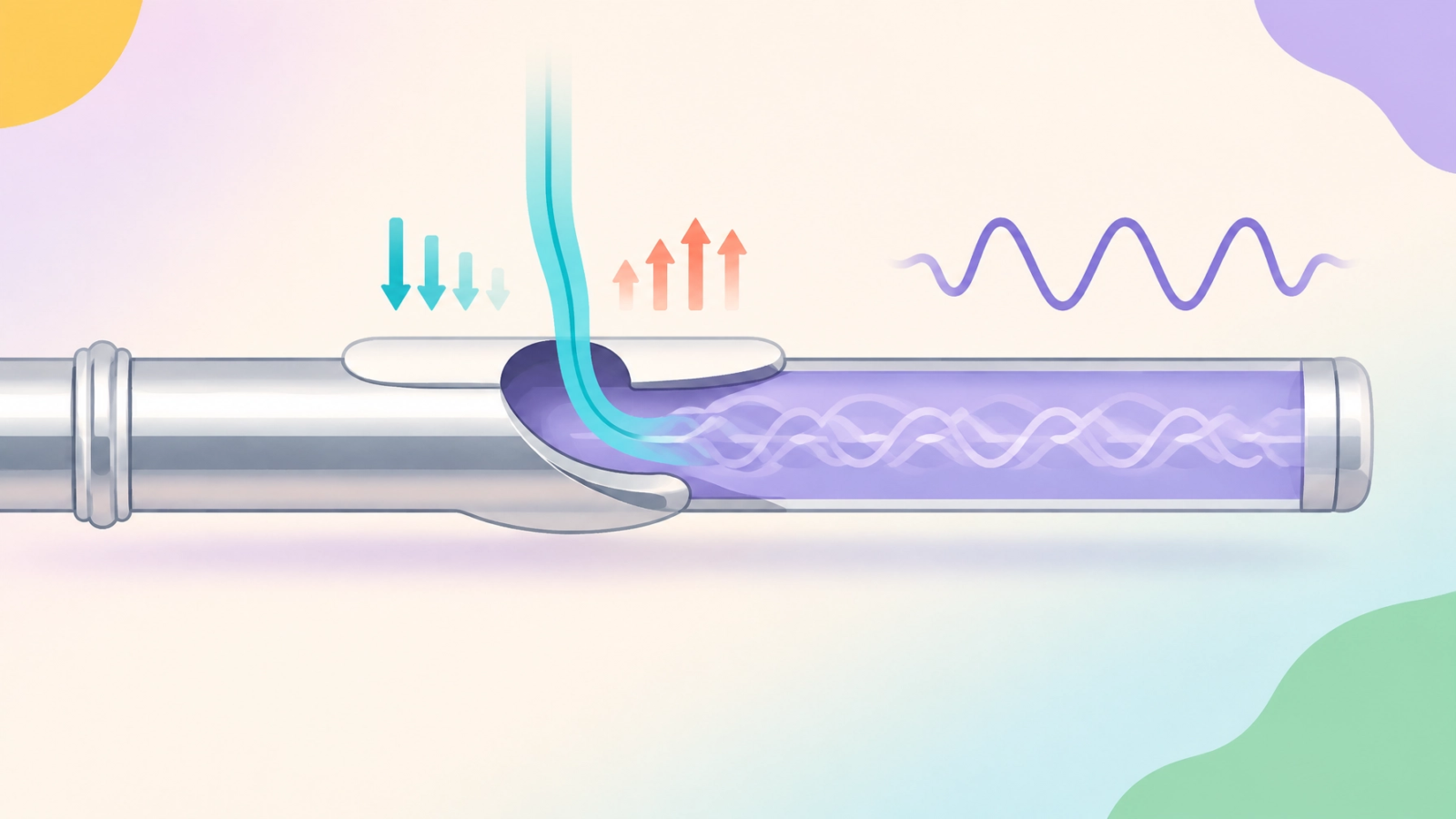
Meta description: Explore music lessons Ottawa through flute airstream physics, jet velocity, embouchure efficiency, air-column coupling, and targeted practice for stable tone.
The flute produces sound through a precise interaction between airflow, the embouchure hole, the labium, and the instrument’s resonant air column. Therefore, advanced tone production requires more than increased breath volume. It requires efficient control of jet velocity, jet angle, pressure, and timing.
In this Daily Science Series article, you will examine how the flute airstream becomes sound. You will also see how targeted practice develops stable tone production through neural plasticity, auditory feedback, and motor learning. This approach can strengthen your work in music lessons Ottawa, whether you study in person or through online flute lessons.
Music lessons Ottawa: how the flute jet produces sound
The flute uses a free air jet rather than a reed. When you blow across the embouchure hole, a narrow stream of air travels toward the labium, or sharp edge. The jet alternately moves into and away from the instrument’s bore. This oscillation transfers energy to the air column.
Three linked processes determine the result:
- Your respiratory system generates a pressure difference.
- Your lips shape and direct the air jet.
- The air column selects and reinforces specific frequencies.
The system behaves as a coupled aeroacoustic oscillator. The hydrodynamic motion of the jet interacts with the acoustic pressure inside the tube. In other words, the jet and the air column continuously influence one another.
The University of New South Wales flute acoustics resource provides an accessible technical overview of this process. It also explains why the flute’s open pipe has complex resonance patterns rather than behaving like a simple closed tube.

Jet velocity is not the same as blowing force
Jet velocity describes how quickly the air stream travels through the embouchure opening. It depends on the pressure difference and the effective size of the aperture. A smaller aperture can produce a faster jet without requiring a large increase in total airflow.
This distinction matters. If you respond to a high register by simply blowing harder, you may increase turbulence and noise. You may also destabilize the pitch. Instead, efficient playing often requires a narrower and faster jet with carefully controlled direction.
A useful simplified relationship is:
Jet velocity increases as pressure difference increases and aperture size decreases.
However, the flute does not reward maximum velocity in every situation. Each register requires a suitable balance among:
- Jet speed
- Jet angle
- Jet offset from the labium
- Lip-to-edge distance
- Embouchure aperture
- Acoustic impedance
- Respiratory pressure
The optimal combination changes with register, dynamic level, articulation, and tone colour.
In their 2025 study, Seiji Adachi and Zhiwen Qian developed a flute-like sound-production model based on measured jet response. Their model describes the interaction between hydrodynamic jet modes and acoustic resonator modes. The findings support a central principle for advanced flute lessons Ottawa: stable sound depends on coupling efficiency, not on breath quantity alone.
Air-column coupling and harmonic structure
The air column acts as a frequency-selective system. When the jet oscillates near one of the instrument’s resonant frequencies, the acoustic pressure reinforces the oscillation. This feedback makes the tone more stable.
The embouchure also influences harmonic structure. Harmonics are frequency components above the fundamental. Their relative strength affects brightness, focus, projection, and colour.
Kimie Onogi, Hiroshi Yokoyama, Tsukasa Yoshinaga, and Akiyoshi Iida examined this mechanism in a 2026 study published in the Journal of the Acoustical Society of America. Their simulations showed that increasing jet angle changed the harmonic balance. In particular, the second harmonic became stronger relative to the third.
The researchers linked this change to jet deflection and actual jet offset. Even when the geometric position remains constant, pressure differences around the inner and outer edge walls can move the jet inward. Consequently, a small embouchure adjustment can produce a measurable change in tone colour.
For your practice, this means that tone colour is not an abstract artistic effect. It reflects physical variables that you can observe and refine.
Try this controlled experiment:
- Sustain a middle-register note at a moderate dynamic.
- Record the sound with a consistent microphone distance.
- Change the lip angle slightly while maintaining pitch.
- Compare the second and third harmonic balance through a tuner or spectrum analyser.
- Repeat at a softer dynamic.
- Note which adjustment produces a focused tone without excessive air noise.
Use small movements. Large changes make it difficult to identify the active variable.
Embouchure efficiency and respiratory physiology
Flute playing requires coordination among the lungs, rib cage, abdominal wall, intercostal muscles, lips, jaw, and vocal tract. The diaphragm contributes to inhalation, but it does not operate as an isolated “support” mechanism.
A stable airstream begins with an efficient pressure gradient. Your respiratory system must maintain enough pressure to energize the jet. At the same time, your lips must avoid unnecessary constriction. Excessive tension narrows the system’s range of adjustment.
Research on professional flute playing shows that performers can use different respiratory strategies for similar musical results. Therefore, there is no single anatomical pattern that applies to every player. The goal is coordinated pressure regulation, not a rigid breathing formula.
Michel A. Cara and Divna Mitrovic studied 27 flutists using respiratory sensors, eye tracking, and audio recordings. Their results showed that musical structure influenced breathing patterns. Practice also improved the eye-hand span, which reflects anticipatory reading.
This has direct implications for tone production. Before a sustained entrance, you should anticipate:
- The required breath volume
- The phrase length
- The dynamic level
- The register
- The desired harmonic profile
- The next recovery point
Anticipatory planning reduces last-second pressure changes. It also supports more consistent coupling between the jet and air column.

How targeted practice stabilizes tone
Motor learning depends on repeated, accurately monitored actions. Yet repetition alone does not guarantee improvement. Your nervous system needs a clear goal, relevant feedback, and manageable variation.
This is where scaffolding becomes useful. You begin with a simple task. Next, you add one controlled variable. Finally, you transfer the skill to repertoire.
Use the following progression:
- Sustain five notes in the middle register at one comfortable dynamic.
- Monitor pitch stability and the beginning of the sound.
- Repeat with a slightly narrower aperture.
- Repeat with a small change in jet angle.
- Compare recordings rather than relying only on immediate sensation.
- Apply the most efficient setup to a short phrase.
- Revisit the phrase the next day to test retention.
A 2025 motor-learning study by T. Loria, A. Fraga, J. Teich, M. Tan, A. Huang, and M. H. Thaut examined stabilization of joint-angle velocity in percussion learning. The study did not investigate flute players directly. However, it offers a relevant motor-learning principle: stable movement parameters can contribute to skill acquisition.
For flute, the comparable variables may include lip aperture, jaw position, finger timing, and the coordination of pressure with jet direction. You should not freeze these movements. Instead, you should stabilize the useful relationship among them.
Auditory feedback remains essential. A 2025 study by S. Lavigne, J. Burdette, M. Bahrami, P. Laurien, R. Lyday, and M. H. Thaut examined neural network topology associated with auditory-motor synchronization. The research does not establish a flute-specific effect. Still, it supports the broader role of auditory-motor integration in timing and movement control.
Your ear therefore functions as a measurement system. It detects pitch drift, noise, delayed response, unstable harmonics, and changes in projection. Your teacher can then help you connect that sound information to a precise physical adjustment.

A practical protocol for jet and tone control
Use this 12-minute protocol during focused practice:
- Spend two minutes on relaxed inhalation and silent exhalation.
- Spend three minutes on long tones at a moderate dynamic.
- Spend two minutes changing only the jet angle.
- Spend two minutes changing only the aperture.
- Spend two minutes transferring the best result to a scale.
- Spend one minute recording a short phrase.
Keep the room comfortable and acoustically predictable. A stable environment makes auditory comparisons more reliable. Online flute lessons can also help because you practise in your own space. In-person lessons provide direct observation of posture, embouchure, and breathing coordination.
Avoid practising until fatigue changes your embouchure. Fatigue introduces new variables and can reinforce inefficient movements. Instead, use shorter sessions with clear technical targets.
Applying the physics in flute lessons Ottawa
In flute lessons Ottawa, advanced students can study jet angle, harmonic balance, breath timing, articulation, and register transitions as connected systems.
Instruction is available in English and Spanish. Bilingual explanations can make technical terms such as pressure gradient, acoustic impedance, aperture, and respiratory coordination more precise. You can also choose online flute lessons when travel, scheduling, or home comfort affects consistency.
A free trial lesson allows you to evaluate the instructional approach before committing. Lesson options include 30-, 45-, and 60-minute formats. Bundle discounts reduce the cost of ongoing study. The Family Plan also provides savings when three or more members of the same family study.
For complementary development, music theory lessons can strengthen your understanding of harmonic expectation, phrase structure, and tonal direction. These skills help you anticipate breath points and select appropriate tone colours.
Key conclusions
The flute airstream is a coupled physical and neural process. Your breath creates the pressure difference. Your embouchure shapes the jet. The labium redirects the jet. The air column selects resonant frequencies. Your auditory system evaluates the result.
The most important principles are:
- Faster airflow does not automatically produce better tone.
- Jet angle and offset influence harmonic structure.
- Embouchure efficiency depends on coordination rather than force.
- Respiratory planning should follow musical structure.
- Stable motor parameters support repeatable tone production.
- Auditory feedback helps calibrate small physical adjustments.
- Short, distributed practice can support retention and neural plasticity.
- Comfortable environments and flexible scheduling can improve practice consistency.
Through structured music lessons Ottawa, you can study these variables systematically. Each adjustment becomes a measurable note in the larger harmony between physiology, acoustics, and musical intention.
Selected peer-reviewed sources
- Adachi, Seiji, and Zhiwen Qian. “Sound Production Model for Flute-Like Instruments Based on Measured Jet Response.” Journal of the Acoustical Society of America, 158(1), 515–528, 2025. DOI: 10.1121/10.0037194.
- Onogi, Kimie, Hiroshi Yokoyama, Tsukasa Yoshinaga, and Akiyoshi Iida. “Mechanism of Harmonic Structure Change with Jet Angle in Flute Playing.” Journal of the Acoustical Society of America, 159(1), 862–873, 2026. DOI: 10.1121/10.0042263.
- Loria, T., A. Fraga, J. Teich, M. Tan, A. Huang, and M. H. Thaut. “Stabilizing Joint Angle Velocity Contributes to Motor Learning in Percussion.” Music & Science, 2025. DOI: 10.1177/20592043251379671.
- Lavigne, S., J. Burdette, M. Bahrami, P. Laurien, R. Lyday, and M. H. Thaut. “Altered Basal Ganglia Networks Topology Associated with Auditory-Motor Synchronization.” Brain & Behavior, 2025. DOI: 10.1002/brb3.70695.
- Cara, Michel A., and Divna Mitrovic. “Coupling of Anticipation and Breathing in Expert Flute Performance: The Influence of Musical Structure and Practice.” Frontiers in Cognition, 3, 2024. DOI: 10.3389/fcogn.2024.1425005.
- Cossette, I., B. Fabre, V. Fréour, N. Montgermont, and P. Monaco. “From Breath to Sound: Linking Respiratory Mechanics to Aeroacoustic Sound Production in Flutes.” Acta Acustica United with Acustica, 96, 654–667, 2010. DOI: 10.3813/AAA.918320.
Leave A Comment