
 Cart is empty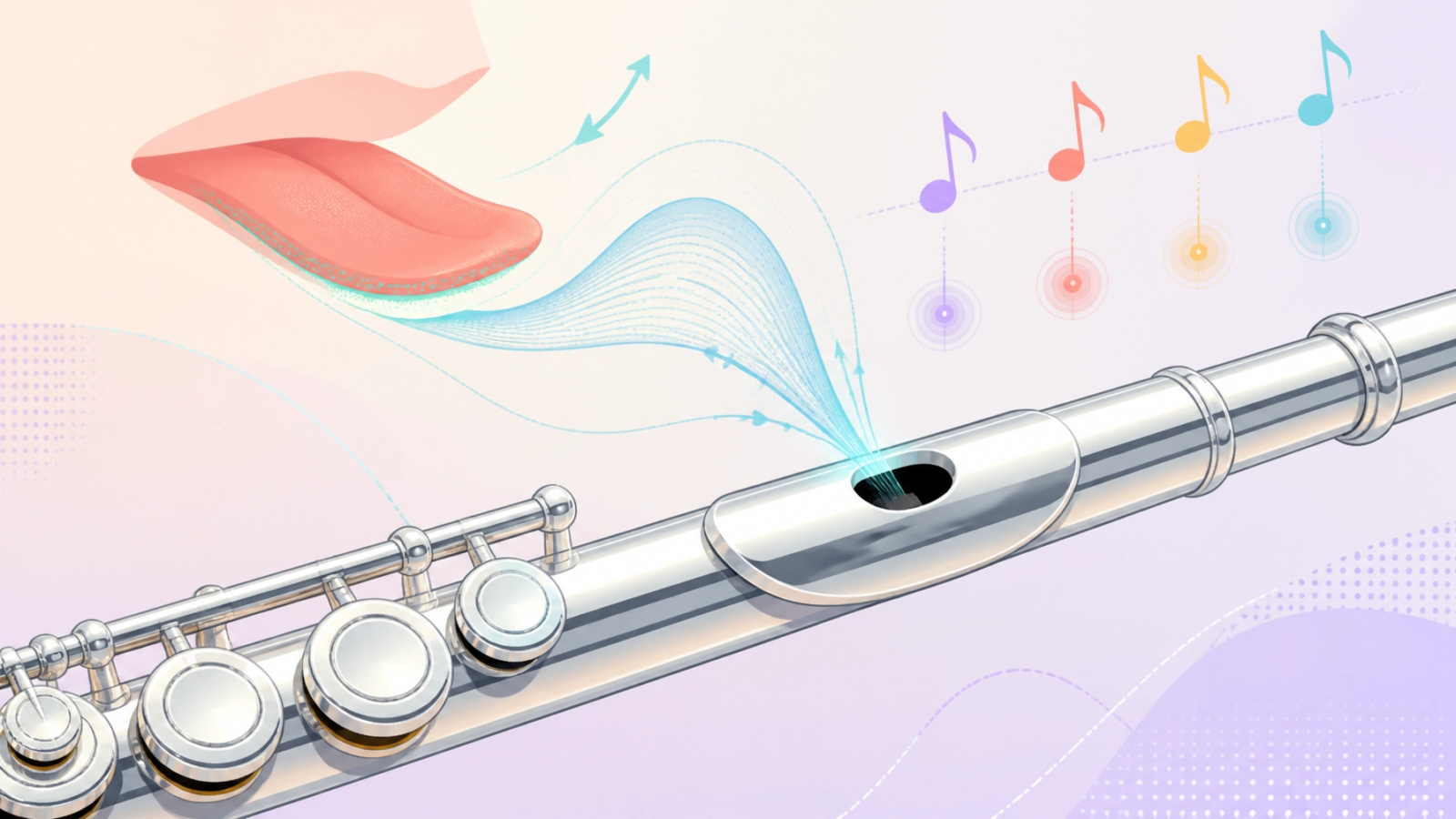
If you are pursuing advanced music lessons Ottawa, articulation deserves the same analytical attention as pitch, breathing, and finger technique. Tonguing is not merely a repeated syllable. It is a precisely timed sensorimotor action that coordinates the tongue, airflow, embouchure, fingers, and auditory system.
Single, double, and triple tonguing place increasing demands on motor planning. They also require continuous auditory evaluation. With structured practice, your nervous system can refine these actions through experience-dependent neural plasticity.
However, current research has an important limitation. Few recent studies examine flute articulation directly. Therefore, the most responsible approach combines flute-specific phonetic research with recent studies of auditory-motor learning, tongue control, and motor-sequence consolidation.
Music Lessons Ottawa: What Flute Tonguing Actually Does
In a tongued flute attack, the tongue briefly interrupts or redirects the air stream. The lips and oral cavity then shape the air jet that enters the embouchure hole. The tongue does not create the flute’s pitch. Instead, it helps define the onset, separation, and rhythmic identity of each note.
The movement includes several coordinated stages:
- A motor plan selects the articulation pattern and timing.
- The tongue moves toward a chosen contact or near-contact point.
- The air stream is briefly interrupted or narrowed.
- The tongue releases while the embouchure and fingers maintain their roles.
- Auditory feedback confirms whether the attack was clean, stable, and appropriately weighted.
- The cerebellum and other motor networks help adjust timing and consistency through repetition.
Many teachers describe these actions with syllables such as “tu,” “du,” “ku,” or “gu.” These syllables are useful teaching tools. However, they should not be treated as universal physical instructions. Your native language, oral anatomy, tongue length, jaw position, and desired tone can all influence the result.
Eduardo Yáñez’s flute-specific research uses the International Phonetic Alphabet to describe articulation more precisely. The study explains how tongue position, contact location, and oral-cavity configuration can alter the character of a flute attack. It also challenges the idea that one language, such as French, produces the best articulation for every player.
Yáñez, E. (2024). “Articulation on the Transverse Flute: An Exploration from Artistic Practice Using Tools from the International Phonetic Alphabet.” Resonancias, 28(54), 193–216. https://doi.org/10.7764/res.2024.54.9
Single Tonguing and Motor Planning
Single tonguing is usually the first articulation pattern you develop. It may appear simple because one repeated tongue gesture produces each attack. Yet accurate single tonguing requires several independent variables to remain coordinated.
You must control:
- The interval between attacks.
- The consistency of the tongue release.
- The relationship between tongue movement and air pressure.
- The balance between articulation clarity and tone resonance.
- The synchronization of the tongue with changing finger patterns.
- The dynamic level and stylistic character of the passage.
At slower tempos, conscious control can guide each event. At faster tempos, however, the nervous system begins to organize the movements into a sequence. This process reduces cognitive load. Rather than planning every attack independently, you begin to anticipate a rhythmic-motor pattern.
This is an example of motor chunking. The brain groups individual actions into a larger unit. As a result, the movement becomes more efficient and less dependent on conscious supervision.
For practice, begin with a single comfortable note. Use a moderate dynamic and a relaxed syllable such as “tu” or “du.” Then change only one variable at a time:
- Increase the metronome marking gradually.
- Move from one note to a five-note pattern.
- Add finger changes.
- Change the dynamic.
- Transfer the pattern to scales and school-band excerpts.
Do not increase speed while the tone becomes unstable. Speed without acoustic control trains the wrong motor map.

Double and Triple Tonguing Increase Sequencing Demands
Double tonguing alternates a forward articulation with a posterior articulation. Common teaching patterns include “tu-ku” or “du-gu.” The second syllable uses the back region of the tongue near the velum. This allows rapid attacks when repeating the forward gesture alone becomes inefficient.
Triple tonguing extends the principle across three attacks. Depending on the musical pattern, you may practise “tu-tu-ku,” “tu-ku-tu,” or another sequence that reflects the meter and accent structure.
These patterns create a coordination problem. The two or three tongue gestures do not initially feel identical. The forward syllable may sound clearer, while the posterior syllable may produce a softer, delayed, or less focused attack.
Your practice goal is not to force the “ku” syllable to imitate “tu” immediately. Instead, you should gradually align several dimensions:
- Attack timing.
- Airflow continuity.
- Tone colour.
- Dynamic weight.
- Tongue travel distance.
- Finger synchronization.
- Rhythmic accent.
The sequence therefore engages motor planning at two levels. First, the brain must select the appropriate articulation pattern. Second, it must organize the order and timing of individual gestures within the pattern.
This resembles other learned motor sequences. A 2025 study by Ploettner and colleagues examined how different types of pitch feedback influenced an 11-item finger-tapping sequence. Congruent auditory feedback improved performance during the immediate training period. However, unpredictable feedback produced greater offline improvement after a delay.
The study did not examine flute playing. Still, it supports an important teaching principle: feedback that improves immediate performance does not always produce the strongest long-term motor memory. Therefore, your practice should include both supported repetition and occasional testing without external assistance.
Ploettner, P., Muehlberg, C., Psurek, F., Fricke, C., & Rumpf, J.-J. (2025). “Divergent effects of pitch feedback on online and offline motor sequence learning.” Frontiers in Behavioral Neuroscience, 19, 1680277. https://doi.org/10.3389/fnbeh.2025.1680277
Auditory Feedback Refines Tongue Precision
Auditory feedback tells you whether an articulation produced the intended result. You hear differences in onset sharpness, noise, rhythmic placement, and tone continuity. This information then modifies the next motor command.
Recent tongue-control research provides relevant evidence, although it focuses on speech rather than flute. Masapollo and colleagues examined tongue-tip and jaw movements while participants produced speech sequences with and without real-time auditory feedback. When feedback was masked, tongue-tip movement became more variable during the formation of the target constriction.
The researchers did not observe the same reduction in precision for the jaw. This distinction matters because the tongue has many degrees of freedom. It can change position, shape, speed, and contact area within a very small time window.
Flute tonguing is not speech. The acoustic goals differ, and the tongue does not create a consonant in the same way. Nevertheless, the study supports a cautious inference: precise tongue actions benefit from clear sensory information during learning.
For this reason, avoid extended practice that produces little or no sound. Silent articulation can help you reduce unnecessary movement. However, it cannot fully replace playing with an audible tone.
Masapollo, M., Nittrouer, S., Gendron, R., Maxfield, N., & Ostry, D. J. (2026). “Precision of Tongue Control for Task-Relevant Articulatory Goals Diminishes Without Real-Time Auditory Feedback.” Journal of Speech, Language, and Hearing Research. DOI: 10.1044/2025_JSLHR-25-00514
Neural Plasticity and the Developing Flutist
Neural plasticity refers to the nervous system’s capacity to modify its connections and activity through experience. In instrumental learning, repeated practice can strengthen associations between a physical action and its expected sound.
For articulation, this association includes:
- A visual rhythm or notation pattern.
- A planned tongue sequence.
- A specific airflow response.
- A predicted acoustic onset.
- A corrective response when the sound differs from the target.
As your skill increases, control can shift from deliberate planning toward more automated execution. This does not mean that attention becomes irrelevant. Instead, attention can move toward higher-level goals such as phrasing, balance, intonation, and ensemble coordination.
A 2025 study by Chang, Ullén, and de Manzano investigated common brain representations of action and perception after participants learned new melodies. Its findings support the broader concept that musical actions and their auditory outcomes can become linked within shared neural representations.
Chang, Y., Ullén, F., & de Manzano, Ö. (2025). “Common brain representations of action and perception investigated with cross-modal classification of newly learned melodies.” Scientific Reports, 15, 16492. https://doi.org/10.1038/s41598-025-00208-x
The evidence does not prove that double tonguing creates a specific anatomical change in a flutist’s brain. It does show why consistent, goal-directed practice matters. Repetition becomes useful when it repeatedly connects the intended movement with accurate auditory and rhythmic outcomes.

A Research-Informed Articulation Practice Sequence
Use the following sequence for an intermediate or advanced flute session.
1. Establish the acoustic target
Listen to a high-quality recording or create your own reference. Identify the desired attack, tone colour, rhythmic placement, and dynamic profile.
2. Practise one articulation
Play a single pitch with repeated “tu” attacks. Record five to ten seconds. Listen for inconsistent onset noise, pitch movement, or changes in tone density.
3. Add the second syllable
Practise “tu-ku” at a slow tempo. Keep the air stream continuous. The syllables should not create two unrelated tone qualities.
4. Use variable practice
Change register, dynamic, rhythm, and direction. Variable practice challenges the motor system to adapt rather than memorize one narrow gesture.
5. Remove assistance briefly
After supported repetition, play the pattern without a metronome. Then restore the metronome and compare your timing. This tests whether the sequence has become internally represented.
6. Apply the pattern to repertoire
Transfer the pattern to a school-band excerpt, étude, scale, or orchestral passage. Your teacher can determine whether the chosen syllable supports the style and register.
Applying This Work in Music Lessons Ottawa
At Allegro Ma Non Troppo, flute lessons in Ottawa can address single tonguing, double tonguing, triple tonguing, breath coordination, tone production, and school-band repertoire. Lessons are available in person at the Ottawa studio or through online lessons.
The learning environment also affects practice quality. In-person lessons provide direct observation of tongue, jaw, posture, and airflow coordination. Online lessons offer comfort, flexible scheduling, and the ability to practise in your own acoustic environment.
Instruction is available in English and Spanish. For families seeking Clases de flauta en Ottawa, bilingual explanations can make technical concepts more accessible and precise.
You may choose 30-, 45-, or 60-minute lessons. A free trial allows you to evaluate the instructional approach before committing. Students can also connect flute study with music theory lessons to understand meter, phrasing, articulation markings, and formal structure.
The current research supports a balanced approach. Use clear auditory feedback during acquisition. Introduce variation as your control improves. Finally, test articulation in musical contexts where timing, tone, and expression must work together.
Research Boundaries and Key Takeaways
Recent studies provide useful principles, but they do not yet offer a complete neuroscience of flute tonguing. Flute-specific research remains limited. Much of the strongest experimental evidence comes from speech, piano, finger-tapping, or general musical learning.
The most defensible conclusions are:
- Single, double, and triple tonguing are learned motor sequences.
- Motor planning coordinates tongue gestures with breath, fingers, meter, and musical goals.
- Auditory feedback helps you detect and correct inconsistent attacks.
- Experienced players gradually rely more on internal prediction and auditory imagery.
- Variable practice may support durable motor representations.
- Neural plasticity is a plausible mechanism for long-term refinement, but flute-specific neuroimaging evidence remains limited.
- Efficient articulation depends on minimal movement, stable airflow, and a clear acoustic target.
When you practise articulation with these principles in mind, each note becomes part of a larger auditory-motor map. Your tongue does not work in isolation. It participates in the timing, harmony, resonance, and rhythmic architecture of the phrase.
Leave A Comment