
 Cart is empty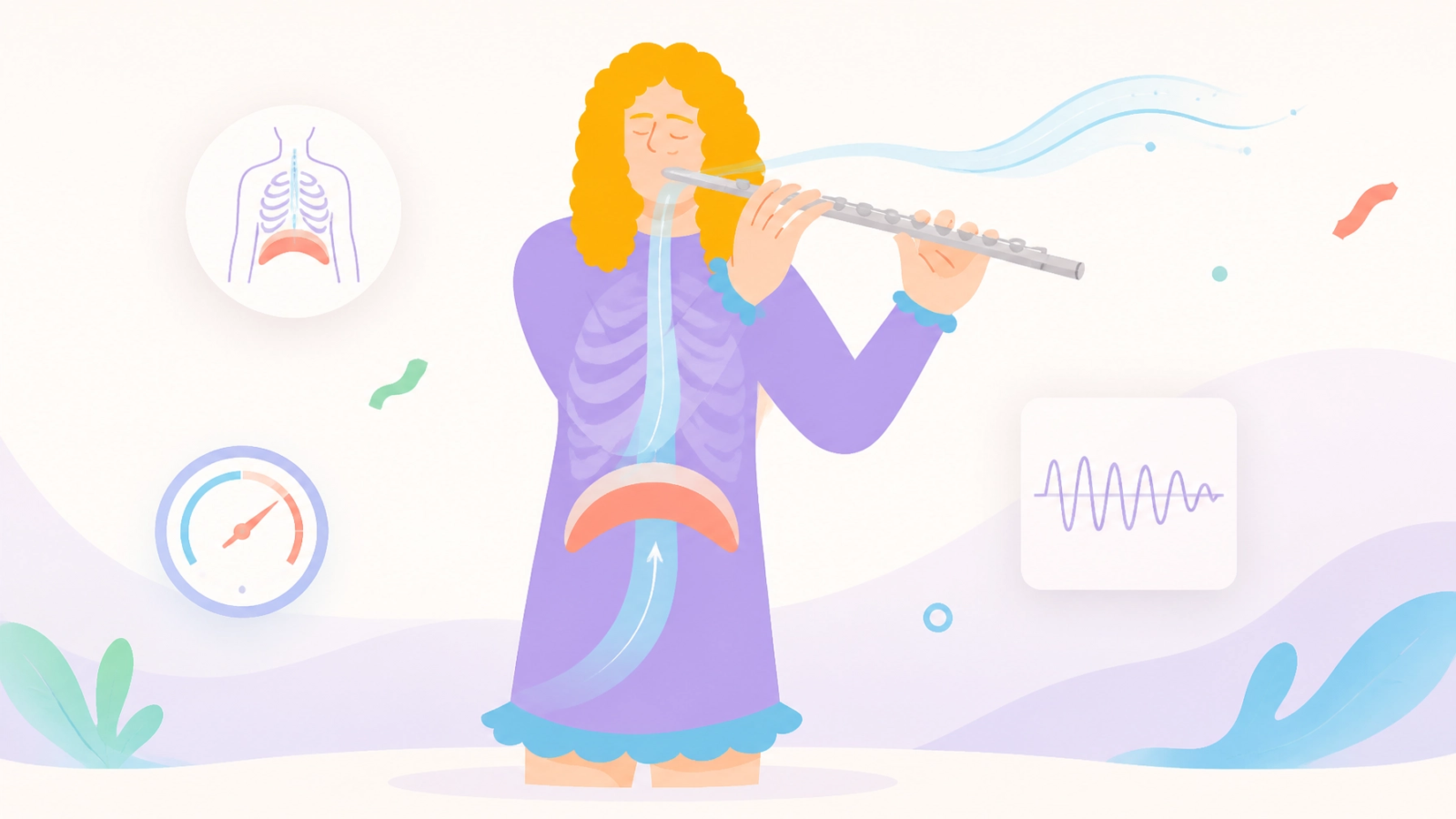
If you are searching for music lessons Ottawa, you may want more than repertoire and finger technique. Advanced flute playing depends on respiratory coordination. Your breathing system must regulate airflow, oral pressure, posture, and musical phrasing at the same time.
This process is often called breath support. However, the term can sound vague. Physiologically, flute breath support involves the coordinated action of the diaphragm, rib cage, abdominal muscles, airway, and embouchure. It is not simply a matter of inhaling more air or pushing harder.
Recent research helps clarify how this system works. It also offers practical principles for improving low-register stability, tone quality, endurance, and expressive control.
Why Breath Control Matters in Flute Performance
The flute produces sound when a focused air jet interacts with the instrument’s embouchure hole. Therefore, small changes in air pressure, airflow velocity, and angle can alter the sound.
Your respiratory system influences several performance variables:
- Air pressure affects dynamic intensity and register response.
- Airflow helps sustain the vibration and shape tone colour.
- Air velocity influences articulation and pitch behaviour.
- Rib-cage stability supports consistent phrase production.
- Abdominal coordination helps regulate pressure as lung volume decreases.
- Embouchure adjustments refine the final relationship between air and sound.
These variables interact. For example, increasing pressure without adjusting the embouchure may raise pitch. Increasing airflow without maintaining resistance may produce an unfocused tone. Consequently, effective technique requires regulation rather than force.
A 2000 clinical trial involving professional flautists found that players could control airflow and air velocity through different combinations of mouth pressure and embouchure aperture. The researchers also observed substantial lung-volume variation while mean mouth pressure remained relatively stable. This finding suggests that expert playing relies on coordination and braking mechanisms, not only on large lung capacity.
See the study record in PubMed for the physiological details.

Music Lessons Ottawa: The Physiology of Flute Breath Support
During inhalation, the diaphragm contracts and moves downward. This action increases the volume of the thoracic cavity. As pressure inside the lungs falls, air flows inward.
The external intercostal muscles also help expand the rib cage. Efficient flute inhalation usually involves expansion around the lower ribs and abdominal wall. This pattern is sometimes described as 360-degree breathing. It does not mean that the lungs fill separately in every direction. Instead, it describes a balanced expansion of the available chest-wall structures.
During performance, exhalation becomes active. The abdominal muscles and internal intercostal muscles contribute to pressure regulation. Yet efficient support does not mean rigid abdominal tension. Excessive contraction can restrict movement and create unnecessary resistance.
Advanced players often coordinate inspiratory and expiratory activity in opposition. This antagonistic coordination can slow the collapse of the rib cage during exhalation. As a result, the player gains more time and precision for controlling airflow.
The goal is a stable pressure relationship. You should not feel as though you are forcing air through the instrument. Instead, you should sense controlled release. The respiratory system acts like a regulated valve that distributes air across the phrase.
What Recent Flute Research Shows
Three recent publications are especially relevant to advanced flute breath control.
Fang’s 2026 Study of Low-Register Breath Support
Mingyue Fang compared professional performers and amateur learners while examining respiratory muscle activity, oral-cavity air pressure, and acoustic parameters. The study focused on low-register flute performance.
The findings emphasize three factors:
- Deep diaphragmatic inhalation formed the primary breathing strategy.
- Expert performers showed approximately 78% contribution from deep diaphragmatic inhalation.
- Sustained antagonistic abdominal contraction helped regulate the outgoing airflow.
- Expert airflow fluctuation remained below 15%.
- Supporting air pressure between 0.8 and 1.2 kPa reduced pitch deviation by approximately 40%.
- Stable pressure also enriched the harmonic structure of the tone.
These results challenge the instruction to “take more air” without further explanation. More air is not automatically more effective. The relevant skill is controlling pressure and airflow continuously.
The complete citation is:
Fang, Mingyue. “Research on the Application of Breath Support in Low Register Performance of the Flute.” Art and Performance Letters, vol. 7, no. 1, 2026, pp. 114–121. https://doi.org/10.23977/artpl.2026.070118.
Monteiro’s 2025 Randomized Study
Monteiro and colleagues studied inspiratory muscle training in wind players. Following a five-week training period, participants improved maximal inspiratory pressure, or MIP. They also reported lower perceived exertion during performance.
MIP measures the pressure generated during a forceful inhalation. It does not measure musical quality by itself. Still, improved inspiratory strength may help players manage demanding phrases with less respiratory effort.
This distinction matters. Conditioning can improve capacity. However, capacity must still be integrated with posture, embouchure, articulation, and musical timing.
The full citation is:
Monteiro, Catarina, Joaquim Alvarelhão, Alda Marques, and Mário Lopes. “Effect of Inspiratory Muscle Training on Wind Players: A Randomized Study.” Minerva Respiratory Medicine, 2025. https://doi.org/10.23736/S2784-8477.25.02199-0.
Ces-Lafuente and Colleagues’ 2026 Review
A systematic review and meta-analysis by Ces-Lafuente and colleagues examined respiratory training among wind instrumentalists and vocalists.
This type of research combines results from multiple studies. Therefore, it can identify broader patterns than a single experiment. At the same time, the populations and training protocols may differ. You should not assume that every finding applies equally to every flute player.
The value of this review is its wider perspective. Respiratory training may influence pressure generation, endurance, respiratory muscle performance, and perceived exertion. Yet the best outcomes likely occur when physical training is paired with instrument-specific instruction.
The full citation is:
Ces-Lafuente, Pablo, Clara Rodríguez-Gude, Adrián Martín-Palomo, and Eva Lantarón-Caeiro. “Impact of Respiratory Training on Wind Instrumentalists and Vocalists: A Systematic Review and Meta-Analysis.” Journal of Voice, 2026. https://doi.org/10.1016/j.jvoice.2026.04.017.

How to Practise Flute Breath Control Safely
Research becomes useful when it changes your practice decisions. The following sequence translates respiratory principles into flute-specific work.
1. Observe the inhalation
Stand or sit with a lengthened spine. Keep your shoulders quiet. Inhale silently and notice expansion around your lower ribs, sides, and back.
Do not chase maximum volume. A forced inhalation can create neck tension and delay the first note. Instead, aim for a quick and efficient preparation.
2. Practise controlled exhalation
Without the flute, inhale comfortably. Then release the air through a narrow opening. Keep the airflow even for six to eight seconds.
The objective is not to create strong resistance. You are developing awareness of pressure regulation. If your abdomen locks or your throat tightens, reduce the effort.
3. Add long tones
Choose a comfortable middle-register note. Sustain it at a moderate dynamic. Listen for changes in pitch, tone density, and airflow noise.
Next, add a gradual crescendo and diminuendo. Keep the pitch centred while changing intensity. This exercise develops the ability to control sound variables independently.
4. Transfer the process to the low register
Low notes require a different balance of air speed, pressure, and embouchure aperture. Begin softly. Maintain a stable, open sound rather than forcing volume.
Fang’s findings suggest that low-register work benefits from stable pressure and limited airflow fluctuation. You can monitor this without laboratory equipment. Listen for wavering pitch, sudden tone collapse, and excess air noise.
5. Mark breaths in the score
Breathing is also a planning task. Mark breath points at phrase boundaries, cadences, or natural rests. Then test whether each breath provides enough capacity for the musical line.
For long phrases, plan the release of air before the final note. Do not wait until the lungs feel empty. Early preparation usually produces more stable phrasing.

What a Science-Based Flute Lesson Should Include
Effective instruction should connect sensory feedback with measurable musical outcomes. In a private lesson, your teacher can help you identify whether a problem comes from breathing, embouchure, posture, articulation, or finger coordination.
A structured lesson may include:
- Respiratory awareness without unnecessary muscular tension.
- Long-tone exercises for pitch and harmonic stability.
- Low-register studies with controlled dynamics.
- Phrase planning and written breath marks.
- Recordings that reveal airflow noise or pitch deviation.
- Gradual increases in phrase length and performance duration.
- Repertoire chosen according to your current respiratory coordination.
At Allegro Ma Non Troppo, flute lessons in Ottawa are personalized for beginners, intermediate students, advanced musicians, and school-band players. Lessons are available at the Ottawa studio or through online lessons.
Instruction can take place in English or Spanish. This bilingual option can make technical explanations more precise for families and learners in Ottawa. You may also combine instrumental study with music theory lessons to strengthen score analysis and phrase planning.
The studio offers 30-, 45-, and 60-minute formats. You can select the environment that best supports concentration. In-person study provides direct acoustic feedback and teacher observation. Online flute lessons can reduce travel time and offer a comfortable home setting.
A free trial lesson also allows you to evaluate the teaching approach before committing. Flexible scheduling, lesson bundles, and the Family Plan can help families organize consistent practice across multiple members.
Key Takeaways for Advanced Learners
The current evidence supports several practical conclusions:
- Breath support is a coordination skill, not a simple increase in air volume.
- The diaphragm, rib cage, abdominal muscles, and embouchure work as an integrated system.
- Antagonistic muscle activity can help regulate exhalation and maintain pressure.
- Stable airflow is especially important in low-register performance.
- Inspiratory muscle training may improve MIP and reduce perceived exertion.
- Instrument-specific practice remains necessary after physical conditioning.
- Efficient breathing should feel controlled, not forced.
- A qualified teacher can connect respiratory sensations with pitch, tone, and phrasing.
Respiratory science gives you a clearer framework for developing flute technique. With consistent practice, each breath can become a deliberate part of the musical architecture. Your phrasing then has a more stable foundation, and your sound can resonate with greater control.
Leave A Comment