
 Cart is empty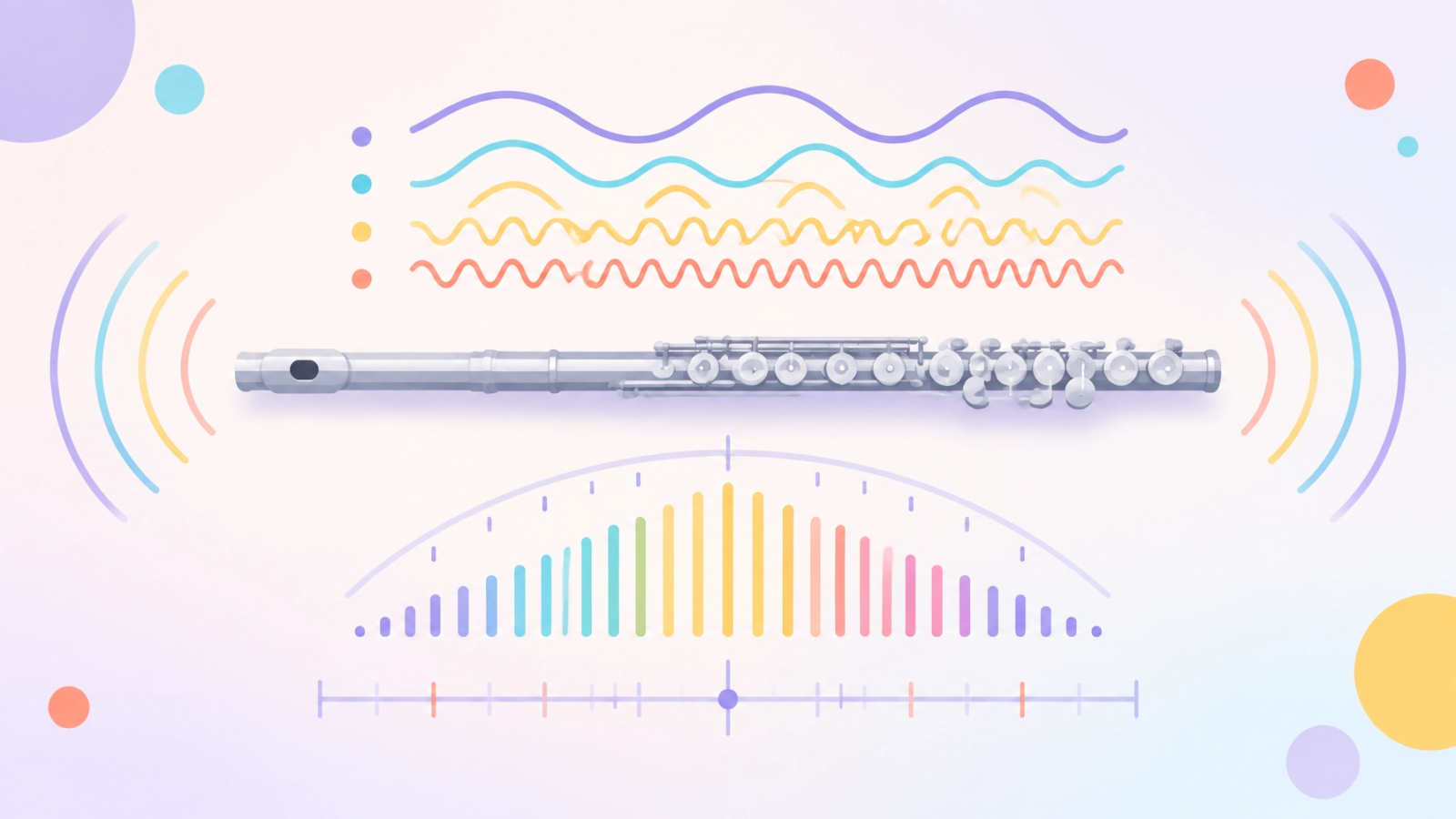
For serious learners, accurate flute pitch requires more than matching a tuner. You must coordinate the instrument’s resonant air column with your airstream, embouchure, voicing, and fingering choices. This coordination develops through auditory feedback and deliberate motor practice.
In advanced music lessons Ottawa students can study why one register tends to rise, why a harmonic fingering changes tone colour, and how spectral analysis can reveal details that your ear may miss. The goal is not mechanical pitch correction. Instead, you learn to create stable resonance while preserving a flexible, efficient sound.
The flute’s overtone series and resonant air column
The modern concert flute behaves approximately as an open-open cylindrical tube. Its air column supports a harmonic series that includes both odd and even multiples of the fundamental frequency. The first resonance produces the fundamental. Higher resonances occur near two, three, four, and five times that frequency.
The model is useful, but the real instrument is more complex. Tone holes interrupt the bore. The embouchure hole couples the player’s air jet to the tube. The headjoint introduces end corrections and additional acoustic effects. Therefore, a fingering does not produce perfectly ideal harmonic relationships.
A flute’s register system reflects this acoustic structure:
- The first register generally uses the fundamental resonance of each fingering.
- The second register often approaches the second harmonic, approximately one octave higher.
- The third register uses higher resonances, often near the third or fourth harmonic.
- The extreme upper register depends heavily on venting, air-jet control, and specialized fingerings.
The harmonic series also explains why harmonic fingerings can sound different from standard fingerings. A low-note fingering may produce several higher notes when you increase air speed and adjust the air angle. These notes are related acoustically, but they may not align perfectly with equal-tempered piano pitches.
For example, the third harmonic is approximately 702 cents above the fundamental. An equal-tempered perfect fifth measures 700 cents. The difference is small, but it becomes audible in sustained intervals and ensemble playing. Similarly, the fifth harmonic produces a major third near 386 cents, while equal temperament places the major third at 400 cents.
This distinction matters. A harmonic fingering may produce a resonant, focused tone while placing the pitch slightly away from the tempered note required by your ensemble. You must therefore control both resonance and pitch.
For a technical reference, the UNSW Music Acoustics flute resource provides measured information about flute modes, impedance, and alternate fingerings.

Why flute intonation changes by register
Pitch tendencies vary because each register uses a different relationship between the air jet and the instrument’s resonances. The player must change air speed, aperture, direction, and voicing. These changes influence both the fundamental frequency and the balance of partials.
The low register often becomes flat during soft playing. A low dynamic requires controlled air energy, but insufficient air speed can weaken the resonance and lower the pitch. Excessive embouchure relaxation can create the same result.
The middle register usually offers the greatest stability. It sits within a practical range for the flute’s air column and allows substantial variation in tone colour. Hiraiwa and Miura found that the middle register also provided the greatest expressive variation in their 2025 study.
The upper register often rises sharp. Faster air and a smaller aperture help excite higher modes. However, these adjustments can increase frequency more than you intend. Rolling the flute inward, lowering the air angle, and moderating air speed can help you descend without collapsing the resonance.
These tendencies are not absolute. Instrument design, headjoint position, temperature, dynamics, and individual technique all contribute. The same note may respond differently in a warm studio, a cold rehearsal hall, or an online lesson environment with different microphone placement.
The Acoustical Society of America and the UNSW flute acoustics research pages offer reliable background on bore resonances, impedance, and tone-hole effects.
Harmonic fingerings as an intonation laboratory
Harmonic fingerings are valuable because they separate pitch production from ordinary notation. You keep one fingering while changing the excited resonance through air and voicing. This process reveals how the flute selects among competing acoustic modes.
Begin with a low D, C, or B fingering. Play the fundamental with a relaxed, stable airstream. Then increase air speed gradually. Do not force the note upward. Instead, allow the resonance to shift while keeping the aperture controlled.
Listen for the following changes:
- The sound may move from a fundamental to an octave.
- The upper note may speak with a different spectral balance.
- The pitch may settle above or below the equal-tempered target.
- The tone may become unstable if the air jet no longer aligns with the resonance.
- A small change in voicing may favour one partial over another.
A harmonic fingering is not simply an alternative way to play a note. It is a diagnostic tool. It shows whether you are controlling the resonance or merely pressing the sound upward with excess air pressure.
Use a drone or sustained reference pitch. First match the harmonic by ear. Then compare it with the tempered target. This sequence builds auditory discrimination. It also prevents overreliance on a tuner display.
Harmonic fingerings can support several advanced goals:
- Stabilizing high notes before returning to standard fingerings.
- Comparing the tone colour of standard and alternate fingerings.
- Developing smooth register transitions.
- Identifying pitch tendencies within exposed orchestral passages.
- Refining the relationship between voicing and air speed.
In flute lessons Ottawa, this work can be adapted to your instrument, repertoire, and current technical range. Instruction can also connect these exercises with music theory lessons online, especially when studying just intonation, equal temperament, and interval acoustics.
Evidence-based practice for pitch accuracy
A reliable practice protocol should combine motor learning, auditory perception, and objective feedback. Use short repetitions. Change only one variable at a time. This approach creates clearer cause-and-effect information for your nervous system.
Start with a pitch baseline. Warm up at a comfortable dynamic. Tune a stable middle-register note to your ensemble reference. Then record several notes in the low, middle, and upper registers.
Next, use controlled contrasts:
- Play a note at piano, mezzo-forte, and forte.
- Keep the fingering constant while changing air speed.
- Keep air speed stable while adjusting air angle.
- Compare a standard fingering with a harmonic or alternate fingering.
- Sustain each note long enough to observe the attack, centre, and release.
- Repeat the exercise after a short rest to test consistency.
Embouchure flexibility is central. Your lips should adjust the air-jet angle without excessive jaw tension. A small inward movement can lower upper-register pitch. A controlled outward adjustment can help raise a low note. Avoid treating these movements as fixed positions. They are dynamic corrections.
Voicing also matters. A higher internal vowel shape can support faster air and upper-register resonance. A more open oral cavity can help maintain low-register stability. These descriptions are useful cues, but your sound and pitch response should guide the final adjustment.
Do not confuse breath pressure with air speed. Increased pressure can create resistance without producing an efficient jet. Efficient playing uses coordinated abdominal support, a focused aperture, and an air stream that reaches the embouchure edge at the correct angle.
Using tuner apps and spectral analysis
A standard tuner measures the perceived fundamental. It does not fully describe the overtone balance. In some cases, a strong partial can influence the tuner’s reading or make the pitch feel more stable than it is.
A tuner app with a spectrum or FFT display can provide additional information. Record a sustained note and examine:
- The fundamental frequency.
- The strength of the second through fifth partials.
- Changes in spectral balance between registers.
- Pitch movement during the attack and release.
- Differences between standard and harmonic fingerings.
- The effect of piano and forte dynamics.
Hiraiwa and Miura’s 2025 research is particularly relevant. In Frontiers in Psychology, they analysed flute tones from the fundamental through the fifth partial. Their principal component analysis showed that players changed both overall overtone strength and the balance between specific partials. Listeners could distinguish these changes, even when the pitch remained constant.
The article is available through Hiraiwa and Miura, “Unconscious overtone manipulation and transmission in flute performance,” Frontiers in Psychology. Its DOI is 10.3389/fpsyg.2025.1393689.
Use spectral analysis as feedback rather than as a new performance target. A brighter spectrum is not automatically better. A stronger second partial is not automatically more resonant. Your musical objective determines whether a change is appropriate.

A four-stage routine for harmonic tone development
You can organize your practice into four stages. Each stage should remain brief enough to preserve accurate sensory feedback.
First, establish the fundamental. Play a low-register note with a stable tone and observe its pitch on the tuner. Repeat it until the attack and sustained portion remain consistent.
Second, activate the harmonic. Increase air speed gradually while maintaining a relaxed throat and flexible lips. Stop if the sound becomes forced. The purpose is to locate the resonance, not to overpower it.
Third, compare the harmonic with the standard fingering for the same written pitch. Listen for pitch, colour, response, and stability. Record both versions when possible.
Fourth, transfer the adjustment to repertoire. Use a two- or three-note pattern that includes the problem register. Begin slowly. Then increase tempo while preserving the same air-jet coordination.
This routine uses scaffolding. You first isolate the acoustic variable. Then you integrate it into a musical context. That progression supports motor planning and reduces cognitive overload.
A research-informed path for music lessons Ottawa
Advanced flute study benefits from both measurement and guided listening. At Allegro Ma Non Troppo, you can work in person at the Ottawa studio or through online flute lessons. The environment can remain comfortable and flexible while you investigate pitch, tone, and register transitions.
Instruction and ear-training vocabulary are available in English and Spanish. This bilingual approach can help you describe air angle, resonance, partials, and intonation with greater precision. It also supports families and adult learners who prefer bilingual music lessons.
Lesson formats include 30-, 45-, and 60-minute options. You can also begin with a free trial lesson before selecting a regular schedule. During the trial, you can identify whether your main need involves harmonic fingerings, third-octave pitch, ensemble tuning, or spectral tone development.
Recent research supports a practical conclusion: pitch accuracy and tone quality are connected, but they are not identical. The most reliable flutist develops both. You need a stable fundamental, a controlled overtone balance, and the flexibility to adjust resonance in real time.
Research and further reading
- Hiraiwa, Kai, and Masanobu Miura. “Unconscious overtone manipulation and transmission in flute performance: insights into musical expression and perception.” Frontiers in Psychology, 2025. DOI: 10.3389/fpsyg.2025.1393689.
- Smith, Trevor D., Jane Kim, Daniela Perez, and Ananya Sen Gupta. “Exploring and interpreting the spectral structure of the North Indian flute (Bansuri).” Journal of the Acoustical Society of America, 2024. DOI: 10.1121/10.0035146.
- Marjieh, Raja, Peter M. C. Harrison, Harin Lee, Fotini Deligiannaki, and Nori Jacoby. “Timbral effects on consonance disentangle psychoacoustic mechanisms and suggest perceptual origins for musical scales.” Nature Communications, 2024. DOI: 10.1038/s41467-024-45812-z.
- Coltman, John W. “Sounding mechanism of the flute and organ pipe.” Journal of the Acoustical Society of America, 1968. DOI: 10.1121/1.1911240.
- de la Cuadra, Patricia, Bruno Fabre, Nicolas Montgermont, and Chris Chafe. “Analysis of flute control parameters: a comparison between a novice and an experienced flautist.” Acta Acustica united with Acustica, 2008. DOI: 10.3813/AAA.918091.
- UNSW Music Acoustics: Modern C Flute.
- Acoustics Today: The Acoustics of Woodwind Musical Instruments.
Leave A Comment