
 Cart is empty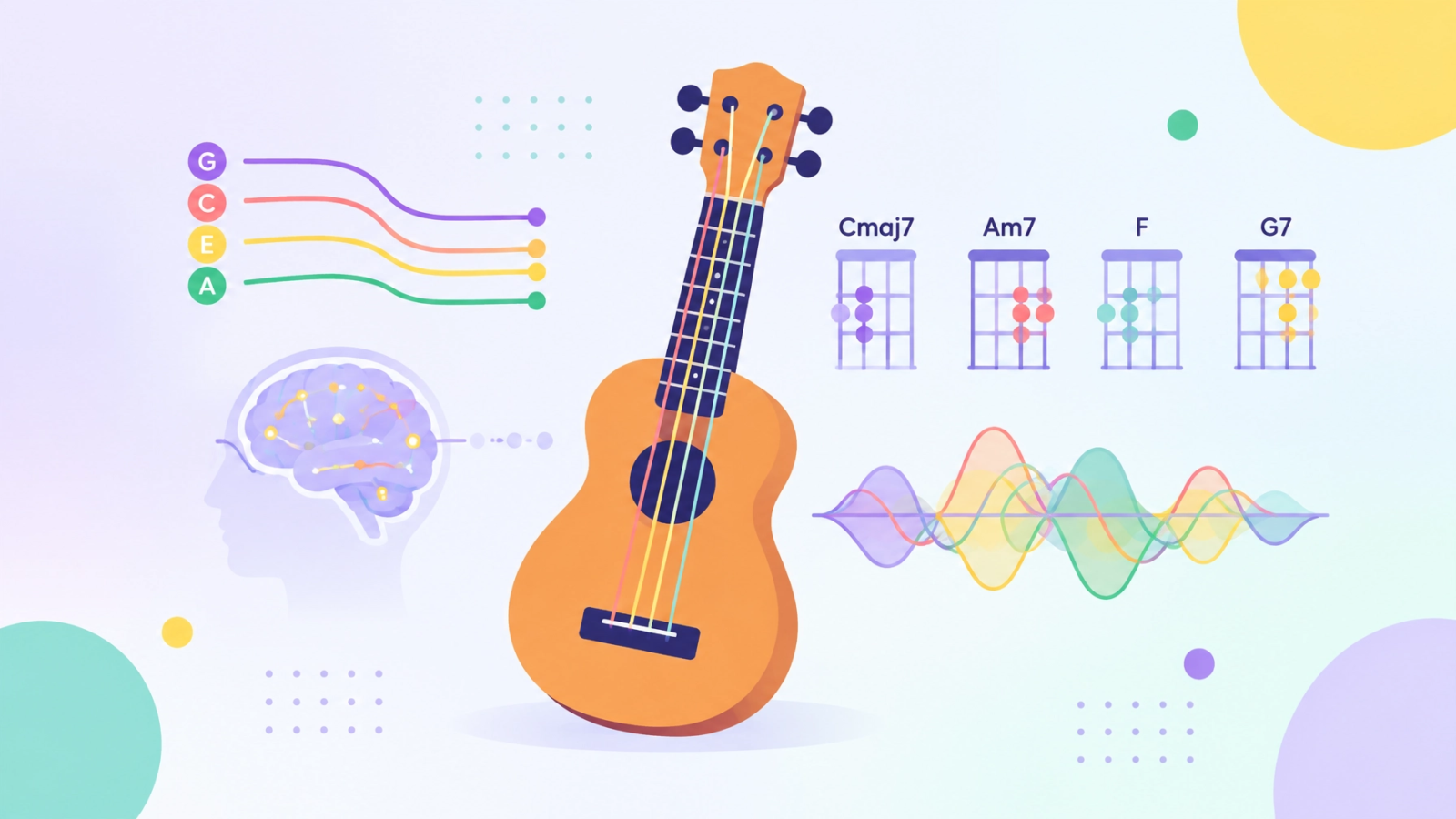
Meta description: Explore ukulele chord voicing, re-entrant tuning, harmonic cognition, and evidence-based practice in music lessons Ottawa with Master-level teachers.
When you search for music lessons Ottawa, you may focus on instrument choice. However, the instrument is not the primary variable. Your musical goals come first.
You may want to play chord melodies, Latin repertoire, jazz harmony, pop songs, or original arrangements. The ukulele can serve each goal. Its re-entrant tuning also creates a distinct harmonic environment.
High-G ukulele tuning usually follows G4–C4–E4–A4. The fourth string sits higher than the C and E strings. Therefore, the pitch sequence does not rise in a simple linear order.
This design changes how your fingers produce voicings. It also changes what your auditory system receives. In advanced instruction, those two processes should develop together.
Music lessons Ottawa: why re-entrant tuning changes voicing
On a guitar, the strings generally move from low to high. On a high-G ukulele, the fourth string interrupts that pattern.
The result is a non-linear pitch layout:
- G4 appears above C4 and E4.
- A4 remains the highest open string.
- Chord shapes often remain within a compact register.
- The same chord symbol can produce a different bass-to-treble order.
- Small fingering changes can alter inversion and colour.
Consider an open C6 voicing. The sounding pitch collection is G4–C4–E4–A4. The chord symbol stays stable. However, the register order produces a particular texture.
Now consider a C major shape with the A string fretted at the third fret. The instrument produces G4–C4–E4–C5. The repeated C creates a clear upper boundary. Meanwhile, the high G adds an internal colour tone.
This is why ukulele harmony often sounds compact and bright. The tuning places chord tones close together. It also places a higher pitch where a guitarist might expect a bass note.
You can describe this as a voicing problem. You can also describe it as an auditory prediction problem. Your brain must learn which pitch will emerge from each familiar shape.

Harmonic cognition begins with prediction
Music perception relies on prediction. Before a chord sounds, you form an expectation about its likely pitch content and function.
A chord shape supports this prediction. However, the ear must also confirm the result. This creates a continuous feedback loop:
- Your visual system identifies the chord shape.
- Your motor system prepares the fingers.
- Your fingers press and release the strings.
- Your auditory system evaluates pitch and timbre.
- Your brain compares the result with the expected voicing.
- Your next movement adjusts through feedback.
This process involves auditory working memory, attention, motor planning, and error monitoring. It also depends on tonal hierarchy.
For example, you may hear a dominant seventh chord and anticipate resolution. The ukulele’s re-entrant layout adds another layer. You must predict not only the chord function, but also the register of each chord tone.
In practical terms, advanced ukulele study should include three forms of recognition:
- Chord-symbol recognition.
- Fretboard-shape recognition.
- Sound-based voicing recognition.
The third skill deserves particular attention. You should learn to hear whether the third, fifth, seventh, or melody note sits on top. This skill supports chord-melody playing and more independent arranging.
A 2025 study by Lisanne G. Bogaard, Juraj Mesik, and Andrew J. Oxenham examined harmonicity in polyphonic music. Listeners found it easier to count and follow voices when harmonic structure remained intact. Performance declined as harmonicity weakened and the number of voices increased.
The study did not examine ukulele players. Still, it offers a useful auditory framework. Harmonic relationships help the brain organise simultaneous musical information. Ukulele voicing therefore provides a practical setting for studying voice separation and chord colour.
Read the full study in Scientific Reports.
Re-entrant tuning is not a proven cognitive shortcut
It is important to separate acoustical facts from cognitive claims.
High-G tuning clearly changes:
- String pitch order.
- Chord inversions.
- Register spacing.
- Melody placement.
- Harmonic density.
- The physical distance between some voicings.
However, no peer-reviewed 2025–2026 study directly proves that re-entrant ukulele tuning creates superior general cognition. Current evidence supports more limited conclusions.
The tuning changes the input structure. Your teacher can then use that structure to develop specific skills. These skills include auditory discrimination, harmonic analysis, motor coordination, and working memory.
A large 2025 meta-analysis examined musical training and executive function in children. Yumeng Cai, Dan Kang, and Xiwu Xu analysed 46 studies with 3,530 participants. They reported a small overall effect, with Hedges’ g = 0.350.
The authors also found stronger results for inhibitory control than for cognitive flexibility. Yet, they noted substantial variation across studies. Therefore, music lessons should not be presented as a universal cognitive treatment.
Read the study through Frontiers in Psychology.
How to practise ukulele chord voicings
You can build voicing awareness through a gradual sequence. Begin with familiar shapes. Then, increase the auditory demand.
Stage 1: Identify the register
Play one chord slowly. Let every string ring.
Then answer these questions:
- Which pitch sounds lowest?
- Which pitch sounds highest?
- Which chord tone appears twice?
- Is the third above or below the fifth?
- Does the high-G string create an inversion effect?
Do not rely on the chord diagram alone. Listen to the completed sound.
Stage 2: Compare two voicings
Choose one chord, such as C major. Play two shapes with the same chord tones.
Compare:
- Bass note.
- Top note.
- Spacing between adjacent tones.
- Perceived tension.
- Ease of melodic continuation.
This develops the distinction between chord identity and voicing identity. The chord may remain C major. The auditory experience can still change significantly.
Stage 3: Add a melody note
Place a short melody above a static chord. Use the top string when possible.
Next, change the chord shape so the melody remains audible. This practice develops voice leading. It also trains selective attention because you must monitor the upper voice while maintaining the harmony below.
Stage 4: Use harmonic substitutions
Once the voicing feels stable, add seventh chords and extensions.
For example:
- Compare C6 with Cmaj7.
- Compare Am7 with Am9.
- Compare G7 with G7sus4.
- Resolve G7 to C with different top notes.
- Use passing diminished shapes between stable chords.
The objective is not to collect shapes. The objective is to hear function, colour, and movement.

What recent auditory research suggests
Recent research supports a careful, evidence-based approach.
Liu, Ning, Ma, and Chen studied music training and inhibitory control in 2025. Their experiment compared auditory and visual Stroop tasks. Music-trained participants showed more efficient neural recruitment during auditory conflict resolution. The effect did not generalise in the same way to visual inhibition.
This result matters for ukulele instruction. Musical training may produce task-specific adaptations. It does not automatically improve every cognitive domain.
A second 2025 study provides an important counterpoint. Kelly L. Whiteford and colleagues conducted a large, preregistered, multi-site study with more than 260 participants. They found no association between musical training and early auditory neural encoding measured through the frequency-following response.
This does not reduce the value of music education. Instead, it limits exaggerated claims. Musical learning clearly develops trained musical abilities. Broader transfer remains more variable.
A 2025 study by Alexander Kirsanov, Maria Koriakina, Denis Panasenko, Uliana Nikishkina, and Evgeny Blagovechtchenski also found distinct behavioural and electrophysiological responses to consonant and dissonant piano chords. The research used non-musicians and piano timbre. It did not test ukulele voicing.
Together, these studies suggest a useful principle. Your lessons should measure musical outcomes directly.
Track:
- Chord recognition.
- Voicing identification.
- Intonation.
- Timing.
- Voice leading.
- Chord-melody fluency.
- Auditory recall.
- Transfer across keys and repertoire.
Review the chord-perception study in Frontiers in Human Neuroscience. You can also read the large-scale auditory replication in Nature Communications.
Ukulele lessons Ottawa for advanced musical goals
At Allegro Ma Non Troppo, ukulele lessons Ottawa can begin with the music you want to play.
Your instrument choice is not a ranking system. Ukulele, flute, clarinet, piano, and voice can all develop musicianship. The right choice depends on your repertoire, comfort, and goals.
You can also explore:
- Flute lessons for breath control, tone, and melodic phrasing.
- Clarinet lessons for articulation, voicing, and ensemble preparation.
- Piano lessons for harmonic layout, reading, and coordination.
- Music theory lessons online for intervals, tonal prediction, and harmonic analysis.
Instruction is available online or in person at our Ottawa studio. Online lessons provide comfort and reduce travel demands. In-person lessons provide direct studio interaction and immediate acoustic feedback.
You can choose 30-, 45-, or 60-minute lessons. Shorter sessions can target one technical variable. Longer sessions can combine technique, repertoire, arranging, and theory.
Bundle discounts are available. The booking system shows the current comparison between the individual-lesson total and the bundle total as individual-lesson total bundle price. Families with three or more members can also ask about Family Plan savings.
Bilingual music lessons are available in English and Spanish. You can discuss chord symbols, voicing, and practice goals in the language that gives you the clearest access to the material.
A practical conclusion
Re-entrant tuning does more than create a recognisable ukulele sound. It changes the relationship between string layout, register, and chord voicing.
That change creates useful material for advanced study. You can investigate:
- How a high-G string changes inversion.
- How compact voicings affect auditory streaming.
- How chord shapes become sound predictions.
- How melody and harmony share a limited register.
- How deliberate practice strengthens sensorimotor feedback.
- How theory supports accurate musical decisions.
The current evidence does not show that ukulele tuning creates universal cognitive benefits. It does show that structured music training can develop specific auditory, motor, and analytical skills.
Your goals should guide the instrument. The repertoire should guide the technique. The teacher should connect both through clear scaffolding and measurable feedback.
Book Your Free Trial Lesson Now
Selected research citations
-
Cai, Y., Kang, D., & Xu, X. (2025). “Boosting executive function in children aged 3–12 through musical training: a three-level meta-analysis.” Frontiers in Psychology, 16, 1659927. DOI: 10.3389/fpsyg.2025.1659927
-
Liu, Y., Ning, J., Ma, J., & Chen, J. (2025). “Music Training Enhances Auditory Inhibitory Control but Not Visual.” Journal of Integrative Neuroscience, 24(12), 45358. DOI: 10.31083/JIN45358
-
Whiteford, K. L., Baltzell, L. S., Chiu, M., Cooper, J. K., Faucher, S., Goh, P. Y., Hagedorn, A., Irsik, V. C., Irvine, A., Lim, S.-J., Mesik, J., Oakes, B., Rajappa, N., Roverud, E., Schrlau, A. E., Van Hedger, S. C., Bharadwaj, H. M., Johnsrude, I. S., Kidd, G. Jr., Luebke, A. E., Maddox, R. K., Marvin, E. W., Perrachione, T. K., Shinn-Cunningham, B. G., & Oxenham, A. J. (2025). “Large-scale multi-site study shows no association between musical training and early auditory neural sound encoding.” Nature Communications, 16, 7152. DOI: 10.1038/s41467-025-62155-5
-
Bogaard, L. G., Mesik, J., & Oxenham, A. J. (2025). “The role of harmonicity on listeners’ ability to hear out voices in polyphonic music.” Scientific Reports, 15, 31686. DOI: 10.1038/s41598-025-16404-8
-
Kirsanov, A., Koriakina, M., Panasenko, D., Nikishkina, U., & Blagovechtchenski, E. (2025). “Electrophysiological and behavioural responses to consonant and dissonant piano chords as standardised affective stimuli.” Frontiers in Human Neuroscience, 19, 1689067. DOI: 10.3389/fnhum.2025.1689067
-
Bugos, J. A., Laubisch, K. R., Zhu, A., Avendaño, J. S., & Bryant, J. B. (2026). “Associations between music training and language fluency on cognitive control and processing speed.” Frontiers in Psychology, 16, 1662938. DOI: 10.3389/fpsyg.2025.1662938
Leave A Comment