
 Cart is empty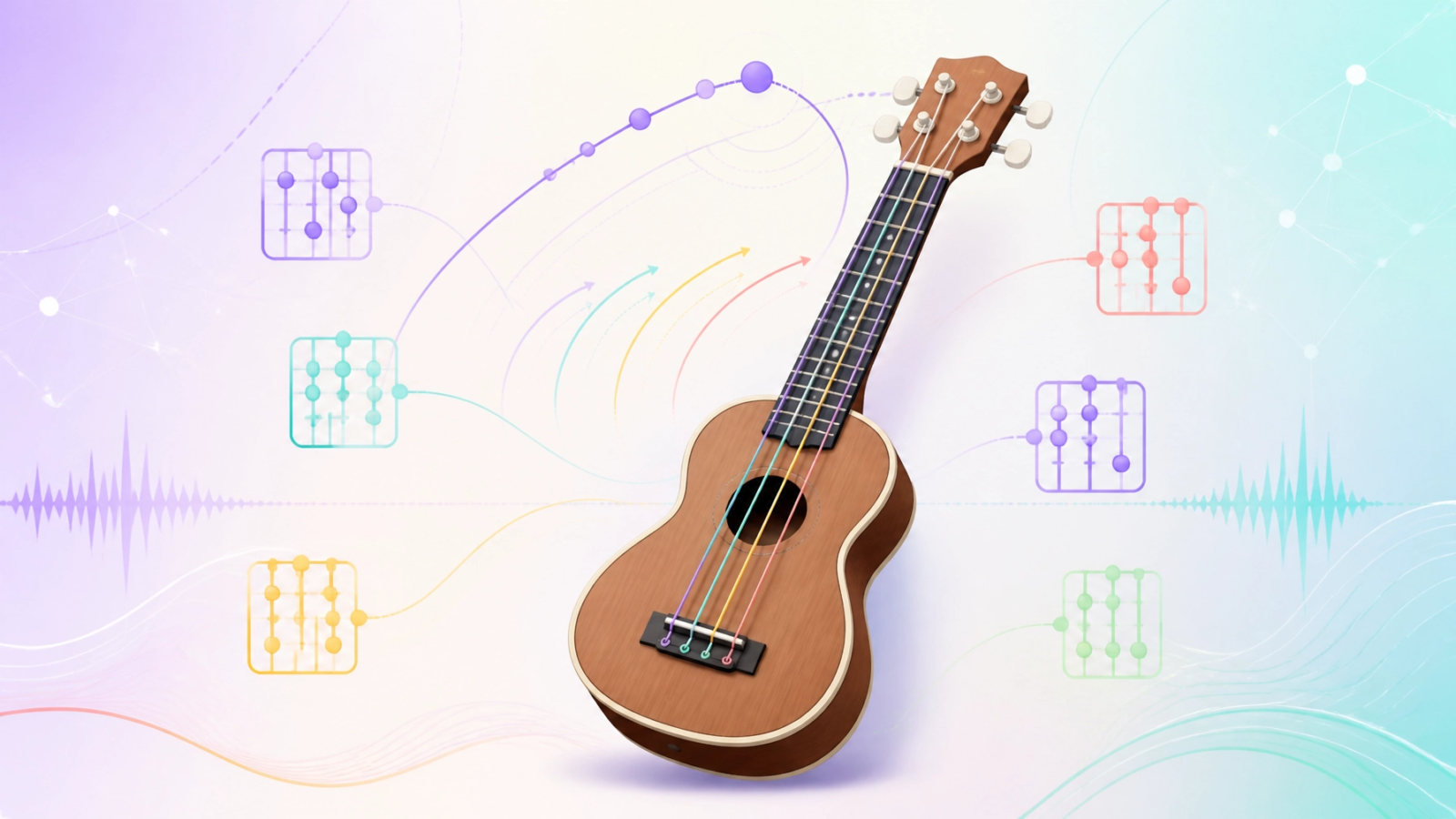
When you play a ukulele chord, your brain processes more than a hand shape. It analyzes pitch relationships, predicts the next sound, and compares incoming notes with stored musical patterns.
This process makes harmony a useful subject for music lessons Ottawa students. Ukulele study can connect motor learning with auditory processing, working memory, and musical prediction.
However, researchers have not yet established unique cognitive effects for ukulele training alone. Current evidence mainly examines music learning and instrumental expertise more broadly. Therefore, ukulele instruction should apply this evidence carefully. It should also include measurable listening, technique, and theory goals.
How music lessons Ottawa develop harmonic expectation
Harmonic expectation describes your anticipation of a future chord or tonal event. When you hear a dominant chord, you may expect the tonic to follow. Your brain forms this expectation from tonal context, previous exposure, and the current progression.
Recent neuroscience describes music perception as a dynamic process. Neural systems synchronize with musical patterns across several timescales. They track individual pitches, chord changes, phrase boundaries, and larger formal structures.
Harding and colleagues describe these mechanisms in their 2025 review of musical neurodynamics. Their account emphasizes stability, attunement, and anticipation in music perception. In practical terms, your brain does not treat each chord as an isolated object. It interprets each chord within a developing harmonic model.
A ukulele provides a compact environment for this work. Standard high-G tuning uses the string arrangement G–C–E–A. The G string sits above the C string in pitch, creating re-entrant tuning. As a result, chord tones often remain within a relatively narrow register.
This arrangement makes small pitch movements perceptually clear. It also requires you to listen beyond the lowest note. You must track chord quality, inner voices, and the highest sounding pitch.

Why chord voicing changes what you hear
A chord name identifies pitch content. A voicing identifies the arrangement of those pitches.
For example, C major contains C, E, and G. You can arrange these notes in several ways on the ukulele. One shape may place E as the highest note. Another may double G. A third may omit one chord tone and include a seventh.
These arrangements influence perception through:
- Register, or the vertical pitch range of the chord.
- Spacing, or the distance between adjacent notes.
- Voice leading, or the movement of individual notes between chords.
- Doubling, or the repetition of a chord tone.
- Omission, or the removal of a less essential pitch.
Consequently, two C major shapes can have different musical functions. One may sound stable and compact. Another may create a melodic top line. A third may prepare a transition toward a dominant chord.
Voice leading provides a direct bridge between technique and cognition. When common tones remain in place, your auditory system can compare fewer changing variables. When other notes move by a semitone or whole tone, you can associate those small intervals with larger harmonic functions.
Try the progression Cmaj7–Am7–Dm7–G7. The chord labels show a familiar tonal sequence. However, the internal movement also creates direction:
- B in Cmaj7 may move to A or C in Am7.
- G can remain as a common tone across several chords.
- F may remain present as the progression moves from Dm7 toward G7.
- B in G7 creates a strong tendency toward C.
During ukulele lessons Ottawa, you can study these movements through slow transitions. First, play the chords without a metronome. Next, identify the top note. Finally, describe which notes remain stable and which notes move.
Interval perception provides a cognitive scaffold
An interval is the distance between two pitches. A harmonic interval occurs when you hear two pitches simultaneously. A melodic interval occurs when you hear them in sequence.
Interval perception supports chord recognition because chords contain several simultaneous pitch relationships. For example, a major triad includes a major third and a perfect fifth above its root. A minor triad changes the quality of the third. A seventh chord adds another interval with a distinctive directional role.
Kendüzler’s 2026 scoping review examined interval training across 35 peer-reviewed studies. The review connected interval learning with pitch discrimination, auditory feedback, tonal awareness, and vocal-motor mapping.
The review does not focus specifically on ukulele. Still, its pedagogical principles apply well to chord study. You can strengthen interval perception by combining:
- Listening before labeling.
- Singing or humming a target note.
- Playing the interval on the ukulele.
- Comparing the sound with a reference.
- Repeating the interval in another key.
- Using both blocked and varied practice.
Blocked practice means repeating one interval or chord type several times. It can support early accuracy. Varied or interleaved practice alternates different intervals and progressions. It can improve transfer and long-term retention.
A balanced lesson uses both methods. First, isolate one sound. Then place it in several harmonic contexts.

Prediction error makes practice informative
Learning improves when you compare a prediction with an outcome. In harmony, this means anticipating the next chord before you play it.
Use the following sequence:
- Establish the key with the tonic and scale.
- Play a short progression.
- Stop before the final chord.
- Predict the next harmonic function.
- Play the expected chord.
- Compare the result with your prediction.
- Try an unexpected chord.
- Describe the change in tension and stability.
This method uses prediction error as feedback. A wrong prediction does not represent failure. It identifies a gap between your current internal model and the musical context.
Cassano-Coleman, Izen, and Piazza reported in a recent study that listeners integrate hierarchical tonal context, regardless of formal musical training. Their findings suggest that listeners use broader tonal relationships when processing musical material.
Mischler and colleagues also reported that musical expertise influences contextual neural encoding. Their 2025 study used generative music models to examine how the brain represents musical information across different timescales.
These studies do not prove that ukulele lessons independently produce neural changes. They do support a narrower conclusion. Structured music practice repeatedly engages prediction, auditory discrimination, working memory, and error monitoring.
Therefore, avoid purely mechanical chord repetition. Ask yourself what the next chord should be. Then test that prediction through sound.
A practical harmony protocol for ukulele students
Use a 20-minute practice session several times each week. Adjust the duration for your age, experience, and physical comfort.
- Spend three minutes naming the key and tonic.
- Spend four minutes comparing major, minor, seventh, and major-seventh qualities.
- Spend five minutes practising smooth chord transitions.
- Spend three minutes tracking the top voice.
- Spend three minutes predicting the next chord.
- Spend two minutes recording one observation.
You can also practise without looking at your fretting hand. This shifts attention toward auditory feedback. Begin with simple progressions. Then add inversions, suspended chords, or seventh chords.
For example, compare C, Cmaj7, C7, and Cm7. Identify which note changes in each chord. Then sing that note before playing it. This exercise separates chord quality from physical shape.
Next, track the soprano voice. Play a progression and hum the highest note. Then change one voicing to create a smoother melodic line.
Finally, remove the chord chart. Play the progression from memory. If you forget a chord, reconstruct it from its function rather than from finger placement.

Bilingual music lessons and the learning environment
Your learning environment affects attention, posture, and practice consistency. Use a stable chair, suitable lighting, and a ukulele position that reduces wrist tension. A comfortable setting can help you sustain focused repetition.
Online lessons offer scheduling flexibility and easy access to digital chord charts. In-person lessons at the Ottawa studio provide direct observation of posture, finger placement, and sound production.
Allegro Ma Non Troppo offers bilingual music lessons in English and Spanish. You can request explanations in the language that best supports your understanding. This access can help when a technical distinction requires precise vocabulary, such as voicing, inversion, interval, or tonal function.
You can also connect ukulele study with music theory instruction. Theory lessons can help you label chord functions and understand harmonic expectation. In addition, flute lessons and clarinet lessons can apply similar concepts to phrasing, intonation, and ensemble timing.
What the evidence supports
Current research supports several cautious conclusions:
- Interval perception can improve through structured training and auditory feedback.
- Tonal context influences prediction and musical memory.
- Musical expertise relates to richer contextual encoding of musical structure.
- Active practice engages auditory, motor, and cognitive systems together.
- Practice should include prediction, feedback, variation, and gradual scaffolding.
- Evidence for ukulele-specific neural outcomes remains limited.
The final point matters. Scientific accuracy requires a distinction between general music-learning evidence and direct ukulele research. A well-designed ukulele lesson can apply established principles without overstating the evidence.
Harmony becomes cognitively meaningful when you hear relationships rather than memorize shapes. Each voicing becomes a set of intervals. Each progression becomes a sequence of predictions. Each correction strengthens the connection between sound, movement, and theory.
Research cited
-
Cassano-Coleman, R. Y., Izen, S. C., & Piazza, E. A. (2025, online; 2026 issue). “Listeners systematically integrate hierarchical tonal context, regardless of musical training.” Psychological Science, 37(1), 3–17. https://doi.org/10.1177/09567976251400331
-
Harding, E. E., Kim, J. C., Demos, A. P., Roman, I. R., Tichko, P., Palmer, C., & Large, E. W. (2025). “Musical neurodynamics.” Nature Reviews Neuroscience, 26, 293–307. https://doi.org/10.1038/s41583-025-00915-4
-
Kendüzler, M. (2026). “Intervals as musical fingerprints: Perceptual and pedagogical insights: a scoping review.” Frontiers in Psychology, 17, 1740840. https://doi.org/10.3389/fpsyg.2026.1740840
-
Kunikullaya, U. K., Pranjić, M., Rigby, A., Pallás-Ferrer, I., Anand, H., Kunnavil, R., & Jaschke, A. C. (2025). “The molecular basis of music-induced neuroplasticity in humans: A systematic review.” Neuroscience & Biobehavioral Reviews, 175, 106219. https://doi.org/10.1016/j.neubiorev.2025.106219
-
Mischler, G., Li, Y. A., Bickel, S., Mehta, A. D., & Mesgarani, N. (2025). “The impact of musical expertise on disentangled and contextual neural encoding of music revealed by generative music models.” Nature Communications, 16(1), 8874. https://doi.org/10.1038/s41467-025-63961-7
-
Putkinen, V., Saarikivi, K., Chan-Devaere, T. M. V., Huotilainen, M., & Tervaniemi, M. (2025). “Auditory change detection in musically trained adolescents and young adults: An EEG-fMRI study.” Annals of the New York Academy of Sciences, 1550(1), 199–205. https://doi.org/10.1111/nyas.70008
Leave A Comment