
 Cart is empty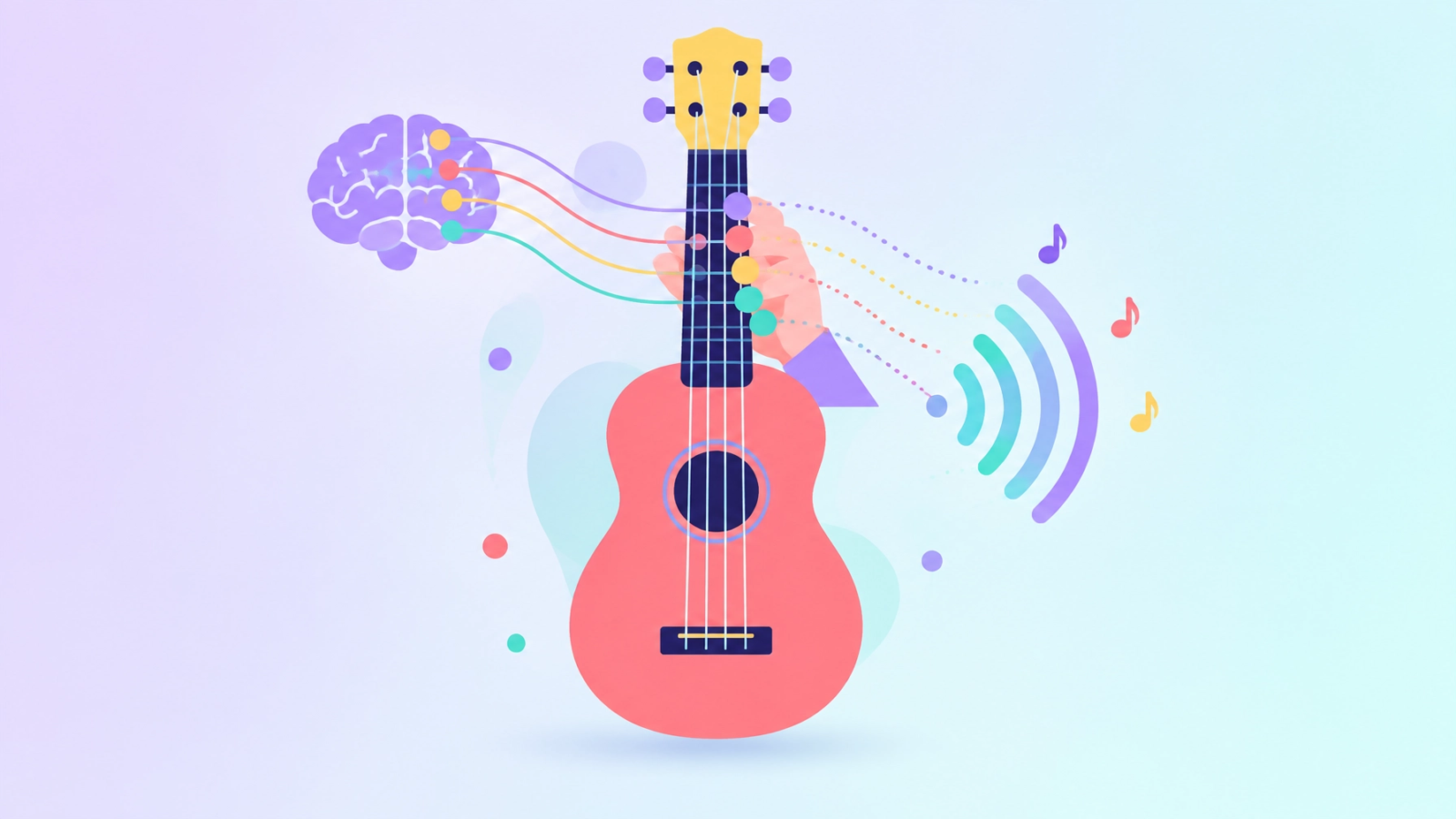
Meta description: Learn how ukulele practice develops fine motor control, auditory-motor coupling, and error correction through evidence-based music lessons Ottawa for all ages.
When you evaluate music lessons Ottawa, you should consider more than repertoire and chord vocabulary. Ukulele practice is also a structured form of sensorimotor learning. Each chord requires your nervous system to coordinate visual information, finger placement, pressure, timing, and sound.
This coordination can strengthen task-specific fine motor control. It can also develop auditory-motor coupling, which links what you hear with how you move. However, scientific accuracy matters. Ukulele practice does not automatically improve every form of dexterity. Instead, it develops motor abilities that relate closely to fretting, strumming, timing, and musical feedback.
How music lessons Ottawa support motor learning
Motor skill acquisition depends on repeated, purposeful actions. In ukulele playing, your fretting hand must position several fingers within a small space. Meanwhile, your strumming hand must produce a controlled movement across the strings.
These actions require several forms of fine motor coordination:
- Finger individuation, or moving one finger without unnecessary movement in the others.
- Force gradation, or applying enough pressure to produce a clear tone without excess tension.
- Temporal precision, or coordinating chord changes with the pulse.
- Bimanual coordination, because both hands complete different parts of the same musical action.
- Postural control, including stable wrist, shoulder, and instrument positioning.
- Error detection, such as recognizing a muted string, buzz, or late chord change.
Initially, you may rely heavily on visual monitoring. You look at the fingerboard and consciously calculate each movement. With deliberate repetition, the sequence becomes more efficient. Neural plasticity supports this change by adapting networks involved in attention, movement planning, sensory feedback, and timing.
Nevertheless, automaticity should not be the only goal. Skilled performance requires flexible control. You must adjust your grip when a chord changes, respond to tempo variation, and correct an error without stopping the musical phrase.

Fine motor control develops through constraints
The ukulele creates a compact motor-learning environment. Its short scale and four strings reduce the number of simultaneous variables compared with many larger instruments. As a result, you can focus attention on precise movements without managing an excessive physical load.
For example, a basic C major chord may require one finger. An F chord adds more complex finger positioning. A progression between C, Am, F, and G then introduces rapid changes in finger configuration.
A teacher can use these constraints to apply scaffolding. Scaffolding means reducing task difficulty at first and then increasing complexity as your control improves.
A progressive sequence may include:
- Practising each chord shape without a time limit.
- Moving between two chords at a slow tempo.
- Adding a consistent down-strum.
- Introducing alternating strums and rests.
- Changing chords within a musical phrase.
- Varying the tempo, starting position, or repertoire.
This sequence uses both blocked and variable practice. Blocked practice repeats one action, which can help you establish an initial movement pattern. Variable practice changes the context, which can improve adaptability and transfer.
You should also monitor unnecessary tension. Excessive pressure can reduce movement efficiency and cause discomfort. A technically precise approach uses the minimum force needed for a clean tone.
Auditory-motor coupling links movement and sound
Ukulele playing is not a purely mechanical activity. Your brain continuously compares intended sound with actual sound.
Before you play a chord, you form an auditory prediction. You expect a particular harmony, rhythm, and tone. After the strings sound, auditory processing systems compare the result with that prediction. If the sound differs, your motor system can modify the next action.
This process is called auditory-motor coupling. It connects auditory perception with movement planning and correction. It is particularly important when you:
- Adjust finger pressure after hearing a muted string.
- Change strumming depth after producing an uneven attack.
- Correct a chord transition that arrives late.
- Modify wrist movement after hearing inconsistent rhythm.
- Anticipate a musical entrance based on the surrounding pulse.
The sound therefore becomes part of the movement instruction. You do not simply repeat a finger pattern. You listen, interpret, and update.
This principle also explains why practice without auditory attention has limitations. If you look only at your fingers, you may repeat an inefficient movement while missing the musical result. Instead, combine visual, tactile, and auditory information.
Error monitoring improves correction
Error monitoring is the process through which you identify a difference between an intended action and its outcome. In music, this difference may involve pitch, timing, loudness, articulation, or coordination.
A 2025 EEG study offers useful evidence about this process. Blanco and colleagues examined expert violinists while manipulating the pitch of notes during performance. The researchers studied both naturally occurring playing errors and externally altered auditory feedback.
The participants produced neural responses associated with error detection, including a frontal error-related negativity and a later P300 response. The study also found differences related to the speed of corrective movements. The authors proposed a faster error-monitoring system associated with medial frontal regions and a slower system involving posterior parietal areas.
The findings do not show that ukulele practice produces identical neural responses. A violin is fretless, while a ukulele has frets. However, the underlying principle remains relevant. When you hear an unexpected result, your brain can evaluate the error and select a correction.
On ukulele, correction may involve:
- Replacing a finger that missed its fret.
- Increasing or reducing fretting pressure.
- Isolating a string to identify the source of the problem.
- Delaying a chord change until the movement is reliable.
- Repeating the passage at a slower tempo.
- Testing the same movement in a different musical context.
Use errors as information rather than as a general judgment of ability. A useful correction loop has four stages:
- Predict the intended sound.
- Perform the movement.
- Identify the difference between prediction and outcome.
- Change one variable and test again.
This method makes practice more precise. It also prevents unstructured repetition from reinforcing the same error.

Inclusive frameworks for diverse motor profiles
Motor learning does not follow one universal pathway. Learners may differ in strength, joint mobility, coordination, sensory processing, attention, visual perception, and prior musical experience.
Effective instruction should therefore vary the route while preserving the musical objective. For instance, the goal may be a stable chord transition. One student may use a conventional fingering. Another may use a simplified voicing, slower tempo, visual cue, or adapted instrument position.
Fernández-Barros, Bono-Félix, and Veniel-Martí present a 2026 framework titled “Color as Conductor: A Participatory Framework for Ukulele Instruction in General Music.” The article describes a five-step, color-guided approach. Consistent colors identify strings and chords. Multimodal resources and flexible ensemble roles then help students participate with different levels of motor ability and experience.
The authors report anecdotal classroom evidence from Grades 4 to 6. They describe possible gains in chord-change fluency, ensemble confidence, engagement, and inclusive participation. Because the evidence is anecdotal, it should not be treated as a controlled test of motor improvement. Still, the framework offers practical instructional principles.
A more inclusive ukulele lesson can include:
- Color cues paired with string names and chord symbols.
- Large-print chord diagrams with clear spatial spacing.
- Verbal, visual, auditory, and tactile explanations.
- Alternate chord shapes when a standard shape creates excessive strain.
- Slower tempos and additional preparation time.
- Seated or standing playing options.
- Rhythm, percussion, singing, or listening roles within an ensemble.
- Short practice intervals with planned recovery.
- Multiple ways to demonstrate musical understanding.
Color should not be the only cue. Some learners have color-vision differences or process color less efficiently. Pair colors with letters, numbers, shapes, and sound.

A research-informed practice protocol
You can apply these principles during a 20-minute practice session.
- Spend three minutes checking posture, instrument position, and wrist comfort.
- Spend four minutes forming one chord slowly while listening for a clear tone.
- Spend four minutes alternating between two chord shapes.
- Spend three minutes practising the same transition at two different tempos.
- Spend three minutes recording one error and one successful correction.
- Spend three minutes playing a short musical phrase without looking continuously at your hands.
Keep the practice objective specific. “Improve ukulele” is too broad. “Change from C to Am without a muted first string at 60 beats per minute” gives you a measurable target.
You should also vary the conditions after the movement becomes reliable. Change the rhythm, progression, starting chord, or tempo. This challenges retrieval and supports transfer beyond one memorized sequence.
Bilingual music lessons with flexible learning conditions
Your environment can influence practice consistency and physical comfort. A stable chair, suitable lighting, correct instrument height, and reduced wrist tension can make focused repetition easier.
At Allegro Ma Non Troppo, ukulele lessons are available in person at the Ottawa studio or online. Online study can reduce travel demands and offer a comfortable home environment. In-person instruction allows direct observation of posture, hand position, and sound production.
Lessons are also available as bilingual music lessons in English and Spanish. Clases en inglés y español are available for learners who prefer technical explanations in either language.
You can review the ukulele lesson plan and connect ukulele study with music theory and harmonic expectation. The service offers 30-, 45-, and 60-minute options. The website lists a free trial lesson, with individual rates of $35 for 30 minutes, $48 for 45 minutes, and $63 for 60 minutes. Bundle savings are listed transparently, such as 4 lessons for $140 $120 in the 30-minute plan.
What the evidence supports
Current evidence supports a careful conclusion. Ukulele practice can repeatedly engage fine motor control, auditory processing, movement planning, and error monitoring. These mechanisms are relevant to skill acquisition.
However, the available studies do not prove that ukulele training alone produces broad cognitive or neurological benefits for every learner. The 2025 EEG study investigated expert violin performance. The 2026 ukulele framework described classroom implementation and anecdotal outcomes.
Therefore, high-quality instruction should combine evidence with individual observation. Your teacher should identify the movement problem, select an appropriate scaffold, and measure whether the adjustment improves sound and control.
The objective is not merely to memorize chord shapes. It is to develop a reliable loop between intention, movement, sound, and correction. With structured practice, each note provides information. Each chord becomes a motor plan. Each error becomes an opportunity to refine the next attempt.
Research cited
-
Blanco, Ángel David, Jordi Costa-Faidella, Alfonso Pérez Carrillo, David Dalmazzo, Rafael Ramirez-Melendez, and Iria SanMiguel. “Error monitoring and correction in violin performance: An EEG study.” NeuroImage, 2025, article 121365. DOI: 10.1016/j.neuroimage.2025.121365. PubMed record
-
Fernández-Barros, Andrea, Sergio Bono-Félix, and Francisco Veniel-Martí. “Color as Conductor: A Participatory Framework for Ukulele Instruction in General Music.” Journal of General Music Education, 40(1), 26–34, 2026. DOI: 10.1177/27527646261450756. Publisher record
Leave A Comment