
 Cart is empty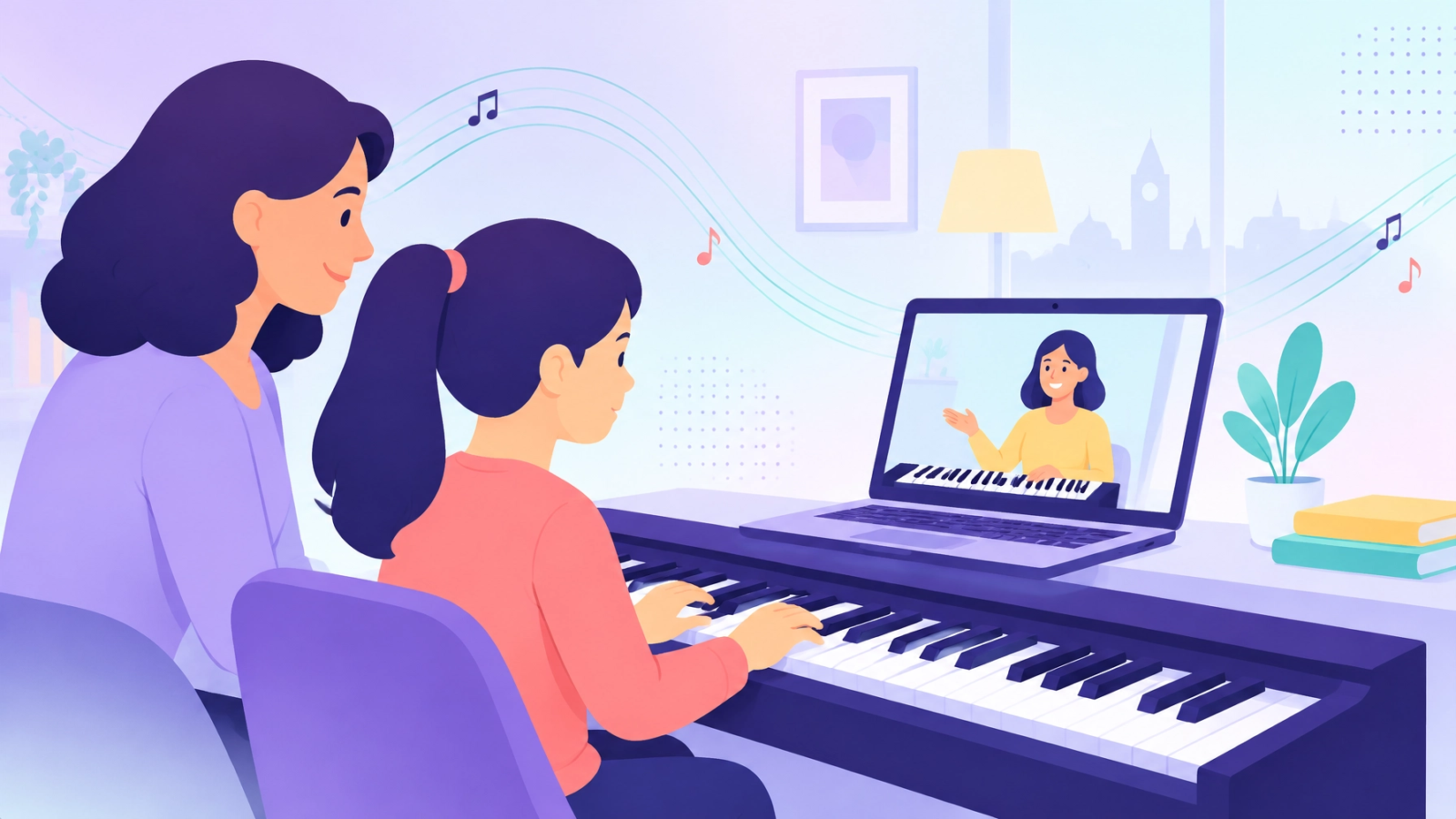
Meta description: Compare online piano lessons in Ottawa: audio latency, camera setup, practice accountability, hybrid scheduling, costs, and in-person learning.
When you compare online piano lessons, you are evaluating more than convenience. You are choosing an environment that must support attention, motor learning, auditory processing, and consistent practice.
For families researching music lessons Ottawa, online instruction can reduce travel and simplify weekly scheduling. However, it also requires a reliable setup and a clear teaching structure. The same applies to adults who want piano lessons Ottawa without adding another commute to the week.
This guide explains what matters most. It covers audio latency, camera placement, motivation, hybrid scheduling, and situations where in-person instruction may be more appropriate.
How online piano lessons fit into music lessons Ottawa
Online piano lessons work best when the teacher designs instruction around the technology. A video call cannot reproduce every feature of an in-person lesson. However, it can support focused teaching, observation, demonstration, and feedback.
A strong online lesson usually includes:
- Short demonstrations by the teacher.
- Student performance while the teacher listens and observes.
- Specific feedback on rhythm, fingering, posture, and musical interpretation.
- Screen-shared scores or digital resources.
- Clear practice goals for the following week.
- Regular review of progress and technical setup.
Piano also has a practical advantage online. Your instrument remains in the same environment where you practise. The teacher can help you solve real issues involving keyboard height, bench position, lighting, and sightline.
For younger beginners, an adult should remain nearby during the first lessons. This reduces interruptions and helps with camera adjustments. Over time, the student can take more responsibility for preparation and practice.
Audio latency: what parents should expect
Audio latency is the delay between playing a note and another person hearing it. Internet transmission, audio processing, and video platforms all contribute to this delay.
As a result, teacher and student should not expect to play a precise duet together through a standard video call. Even small delays disrupt rhythmic alignment. Zoom’s music audio guidance describes settings that improve audio quality. These settings do not eliminate the delay.
Effective online teaching works around latency through structured sequencing:
- The teacher demonstrates a passage.
- The student listens without playing.
- The student performs the passage independently.
- The teacher gives immediate feedback.
- The student repeats the passage with one specific adjustment.
This approach resembles scaffolding in pedagogy. The teacher reduces unnecessary task demands while preserving the central musical challenge.
A student can also use a local metronome. The metronome provides a stable pulse in the student’s room. The teacher then evaluates the student’s timing through the transmitted sound.
For the clearest result, use:
- A stable high-speed internet connection.
- Ethernet instead of Wi-Fi when practical.
- Headphones, especially when the teacher uses enhanced audio settings.
- A modern laptop or tablet.
- A quiet room with limited background noise.
- No simultaneous streaming or large downloads.
The main question is not whether latency exists. It is whether the teacher has a method that works with it.

Camera and piano setup basics
Your teacher needs to see more than your face. The camera should show your hands, keyboard, and enough of your upper body to assess posture.
A practical setup includes:
- A laptop or tablet placed beside the keyboard.
- A stable stand that prevents the device from moving.
- A side or diagonal camera angle.
- A clear view of both hands.
- Adequate light from the front or side.
- The piano bench at a height that allows relaxed shoulders and level wrists.
A single camera often works for beginners. However, some students benefit from a second device. One camera can show the student’s side profile. The other can show the keyboard from above.
You do not need professional recording equipment. A built-in microphone and webcam can be sufficient when the room is quiet. Clearer microphones become more useful as the student develops dynamic control and plays more complex repertoire.
Prepare the environment five to ten minutes before the lesson. Place the score, pencil, eraser, and metronome within reach. Charge the device or connect it to power. Test the camera view before the teacher joins.
These small actions reduce lost lesson time. They also help the student develop executive-function skills related to planning and task initiation.

Keeping a beginner motivated and accountable online
Online learning removes travel, but it also removes the physical transition into a studio. Therefore, parents should create a consistent structure at home.
For most young beginners, a weekly 30-minute lesson offers an appropriate starting point. The session can address technique, reading, rhythm, and repertoire without creating excessive cognitive fatigue.
A 45-minute lesson may suit an older beginner or an intermediate student. A 60-minute lesson can support more advanced repertoire, theory, sight-reading, or multiple musical goals.
The appropriate schedule depends on the student’s age, attention span, experience, and objectives. Regularity matters more than selecting the longest session.
To support accountability, use a visible practice system:
- Choose specific practice days and times.
- Set one or two measurable goals after each lesson.
- Use a calendar or practice log.
- Ask the student to perform one short passage for a parent.
- Record occasional practice clips for teacher feedback.
- Review progress at the end of each month.
Practice goals should be concrete. “Practise piano” is less useful than “play measures 9–16 slowly three times with consistent fingering.”
Research on music training suggests that structured practice engages working memory, inhibitory control, and cognitive flexibility. A 2025 three-level meta-analysis examined 46 studies involving 3,530 children. It found a small-to-moderate overall association between musical training and executive function, with the strongest findings involving inhibitory control. You can review the study through Frontiers in Psychology.
These findings do not mean that piano lessons automatically improve every academic skill. They do support a measured conclusion: regular musical tasks can provide repeated practice in attention, prediction, error monitoring, and coordinated movement.
How to choose between 30, 45, and 60 minutes
Lesson duration should match the learner’s available attention and musical workload.
At Allegro Ma Non Troppo, online and in-person plans are available in 30-, 45-, and 60-minute formats. The Piano Beginner Lesson Plan lists these options for students and families to review.
A practical guide is:
- 30 minutes: appropriate for many young beginners, busy schedules, or a focused return to piano.
- 45 minutes: useful for students who need time for technique, repertoire, reading, and theory.
- 60 minutes: suitable for intermediate or advanced students and lessons with several goals.
Shorter lessons can also reduce screen fatigue. Longer lessons may provide greater instructional depth when the student can maintain attention.
The studio also offers bundle discounts and a Family Plan for three or more members. This can help families coordinate lessons for siblings, parents, or multiple household members. Ask for the current plan details before booking because availability and pricing can change.
Transparent booking information should show:
- The lesson duration.
- Whether the lesson is online or in person.
- Any bundle savings.
- The rescheduling policy.
- The number of participating family members.
- Whether the plan includes one instrument or multiple students.
A free trial lesson lets you evaluate the teaching approach before choosing a longer schedule.
When hybrid scheduling is the better option
Hybrid scheduling combines online and in-person lessons. It can provide continuity when a family’s weekly circumstances change.
Online lessons may be preferable when:
- Ottawa weather makes travel difficult.
- A student is mildly ill but able to participate from home.
- Several activities create a scheduling conflict.
- A parent cannot manage another round trip.
- The student focuses better in a familiar environment.
- An adult learner wants to study before or after work.
In-person lessons may be preferable when:
- The teacher needs to assess posture in greater detail.
- The student is struggling with hand position or physical tension.
- A beginner needs more direct physical demonstration.
- The family wants a change of environment.
- The student benefits from the accountability of travelling to a studio.
- An upcoming performance requires detailed technical preparation.

A hybrid plan can also provide a practical response to seasonal barriers. You can attend in person when conditions are convenient and switch online when comfort, safety, or time makes that option better.
Before enrolling, ask whether the teacher permits format changes. Confirm how much notice is required and whether online and in-person lessons follow the same cancellation policy.
What current neuroscience says about piano learning
Piano requires simultaneous control of two hands. Each hand may play a different rhythm, articulation, or dynamic level. The learner must also read notation, anticipate movement, monitor sound, and correct errors.
This creates a complex sensorimotor task. It engages auditory processing, motor planning, working memory, and performance monitoring.
A longitudinal study of novice pianists found changes in neural networks related to bimanual coordination after 26 weeks of training. The researchers also observed improved coordination. However, they did not find significant changes in basic auditory processing. You can read the PubMed record for the study.
This distinction is important. Piano training can improve trained musical actions without producing universal improvements in intelligence or every auditory skill.
For beginners, the most useful teaching methods remain practical:
- Learn short musical sections.
- Practise each hand separately when needed.
- Combine the hands at a manageable tempo.
- Isolate the transition where an error occurs.
- Use consistent fingering.
- Increase complexity gradually.
- Track specific improvements in rhythm, accuracy, memory, and coordination.
These methods support neural plasticity because they provide repeated, accurate feedback. Repetition alone is not enough. The nervous system benefits most when the repeated action remains precise and appropriately challenging.
Choosing an online piano teacher in Ottawa
When comparing online piano lessons, ask the teacher these questions:
- How do you handle audio latency?
- What camera angle do you recommend?
- Will you provide practice goals after each lesson?
- How do you measure progress?
- What lesson length do you recommend for this student?
- Can we switch between online and in-person lessons?
- How do you support younger beginners between lessons?
- Do you offer instruction in English and Spanish?
- Are bundle discounts or a Family Plan available?
At Allegro Ma Non Troppo, instruction is available in English and Spanish. Lessons are personalized for children, adults, beginners, intermediate students, and school-band families. Master-level teachers can connect piano study with music theory, sight-reading, and broader musicianship.
You can also explore music theory instruction when a student needs stronger support with rhythm, notation, harmony, or school requirements.
A practical conclusion for Ottawa families
Online piano lessons can be academically rigorous and technically effective. Their success depends on more than the video platform. It depends on audio planning, camera placement, structured feedback, and consistent practice.
For many Ottawa families, online instruction offers comfort and flexibility. It reduces travel and creates a direct connection between the lesson and the home practice environment. In-person instruction remains valuable for students who need detailed physical observation or a distinct studio setting.
A hybrid schedule can combine both advantages. Start with a free trial lesson, evaluate the setup, and choose the format that your family can maintain consistently.
Leave A Comment