
 Cart is empty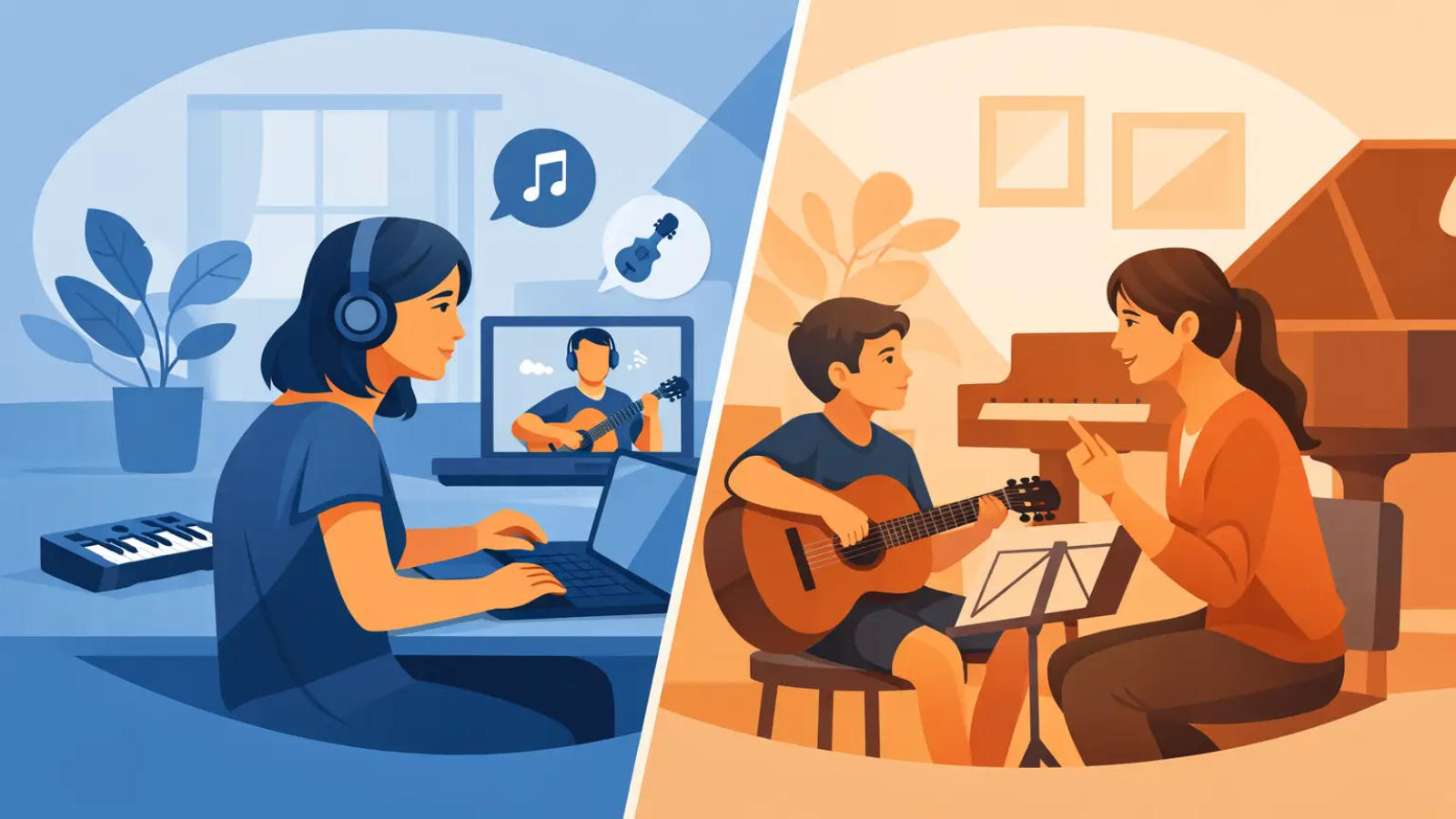
A seven-year-old rushing in from school with a flute case has very different lesson needs than an adult fitting ukulele into a packed workweek. That is why the question of online vs in person music lessons is not really about which format is better in the abstract. It is about which format helps a specific student learn more consistently, more comfortably, and with more enjoyment.
For many families and adult learners, both options can lead to strong musical growth when the teaching is thoughtful and personalized. The real difference often comes down to attention, routine, technology, travel time, and the kind of support a student needs at a particular stage. If you are choosing between formats, it helps to look beyond convenience alone and think about how lessons fit into real life.
Online vs in person music lessons: what actually changes?
At the core, a good private lesson still depends on the same essentials. A student needs clear goals, a teacher who can diagnose problems and explain solutions, repertoire that feels motivating, and enough consistency to build skill week after week.
What changes between online and in-person instruction is the learning environment. In person, the teacher and student share the same physical space. That can make posture adjustments, instrument setup, breathing reminders, hand position, and ensemble-style interaction feel especially immediate. For younger children or very early beginners, that physical presence can also help lessons feel grounded and easier to follow.
Online lessons shift some of that dynamic, but they offer strengths of their own. Students are already in their own space, with their own music stand, instrument setup, and home routine. Teachers can often spot habits that matter because they are seeing the exact environment where practice happens. Online learning also removes commuting, weather issues, and the scramble that can come with getting everyone out the door on time.
Neither format is automatically more serious, more effective, or more motivating. The better fit depends on the student.
When in-person lessons are especially helpful
In-person instruction tends to shine when a student benefits from direct physical modeling and fewer digital distractions. This is often true for young children, new instrumentalists, and students who need a lot of help with body awareness.
For flute and clarinet, small details matter. Embouchure shape, hand balance, breathing, instrument angle, and tone production can all improve quickly when a teacher is in the room demonstrating and responding in real time. A beginner piano student may also find it easier to understand finger shape, bench position, and keyboard geography when those ideas are taught face to face.
There is also a focus factor. Some students simply settle more easily in a studio setting than they do at home. Walking into a dedicated lesson space can create a mental shift: now it is time to listen, experiment, and work. That structure can be especially helpful for students who are easily distracted or who already associate home with everything except concentrated practice.
For school band students preparing for auditions, festivals, chair placements, or performances, in-person lessons can be valuable when the goal is fine-tuning. A teacher can catch subtle issues in articulation, dynamic control, phrasing, and stage readiness while helping the student build confidence under pressure.
That said, in-person lessons are not always the most practical choice every week. Travel time, winter conditions, after-school traffic, and family scheduling can turn a great plan into an inconsistent one. And inconsistency is one of the biggest obstacles to progress.
When online music lessons can be the better choice
Online lessons work especially well when flexibility is the difference between taking lessons consistently and not taking them at all. For busy families, teens balancing academics and activities, or adults with unpredictable schedules, virtual learning often makes music study sustainable.
The biggest advantage is momentum. If a student can log in from home instead of missing a lesson because of bad weather, transportation issues, or a packed evening, progress stays on track. Over time, that matters more than many people expect.
Online lessons can also encourage independence. Students learn to set up their own materials, adjust their camera, keep pencils and books nearby, and take more ownership of the learning process. For motivated older children, teens, and adults, this can be a real strength rather than a compromise.
For beginner piano, ukulele, and music theory, online instruction can be very effective when the teacher is organized and the lesson is tailored well. Screen sharing, digital annotation, rhythm work, listening exercises, and close-up demonstrations can all support efficient learning. Even for winds like flute and clarinet, online lessons can lead to excellent progress when sound and camera setup are handled carefully and the teacher knows how to teach through the medium rather than just replicate an in-person lesson on a screen.
Online learning is not perfect, of course. Internet quality matters. Younger students may need a parent nearby for the first few sessions. Some students miss the energy of being physically present with a teacher. But if virtual lessons make regular study possible, they often become a much stronger option than people first assume.
The question is not just format. It is fit.
A common mistake is choosing based on a general opinion rather than a student profile. A child who is energetic, social, and physically responsive may thrive in person. A thoughtful teen with a long commute and a busy academic schedule may do better online because they can actually keep the routine going. An adult beginner who feels nervous might prefer the comfort of learning from home. Another adult may enjoy the accountability of coming into the studio each week.
Learning style matters, but so do personality and logistics. The best lesson format is the one a student can show up for consistently with enough energy and focus to benefit from the teaching.
This is where personalized instruction makes such a difference. A strong teacher does not force every student into the same path. They notice whether a learner needs more visual support, more structure, more encouragement, more technical correction, or more creative repertoire to stay engaged. Format matters, but pedagogy matters more.
How to choose between online and in-person lessons
Start with the practical question: which format can realistically happen every week? If one option looks ideal on paper but will regularly be disrupted by traffic, weather, or family schedule conflicts, that is worth taking seriously.
Next, think about the student’s age and stage. Very young beginners often benefit from the physical clarity and routine of in-person teaching. Older beginners, returning musicians, and theory students may do beautifully online. Intermediate and advanced students can succeed in either setting, depending on their goals and how they respond to instruction.
Then consider temperament. Does the student focus better in a dedicated studio, or are they more relaxed and receptive at home? Do they need hands-on modeling, or do they learn well from verbal explanation and demonstration through a screen? Do they enjoy technology, or does it create friction?
It also helps to be honest about support at home. If a child needs a parent to help with logging in, setting up the instrument, or staying on task, online learning may still work very well, but it works best when that support is available.
For many families, the answer is not permanent. A student might begin in person to build fundamentals, then move online for flexibility. Another might study online most of the year and schedule in-person lessons before a performance or exam. Good teaching can adapt.
What matters most in either format
Whether lessons happen online or in person, students grow fastest when they feel seen. They need repertoire that fits their level and interests, technical instruction that is clear without being intimidating, and a teacher who knows how to balance correction with encouragement.
That is especially important for beginners and developing students who may be deciding, week by week, whether music feels frustrating or rewarding. A lesson should challenge a student, but it should also make them want to come back.
In a student-centered studio, format becomes one part of a larger picture. The real goal is not just attendance. It is building confidence, musicianship, and a relationship with music that lasts. Sometimes that happens best across a piano bench or music stand in the same room. Sometimes it happens on a screen after dinner, when a family finally has a quiet hour and a child can focus without the stress of rushing across town.
If you are weighing online vs in person music lessons, try to choose the format that makes steady, enjoyable learning most likely for you or your child. The best lessons are the ones that fit real life well enough to become part of it.
Leave A Comment