
 Cart is empty
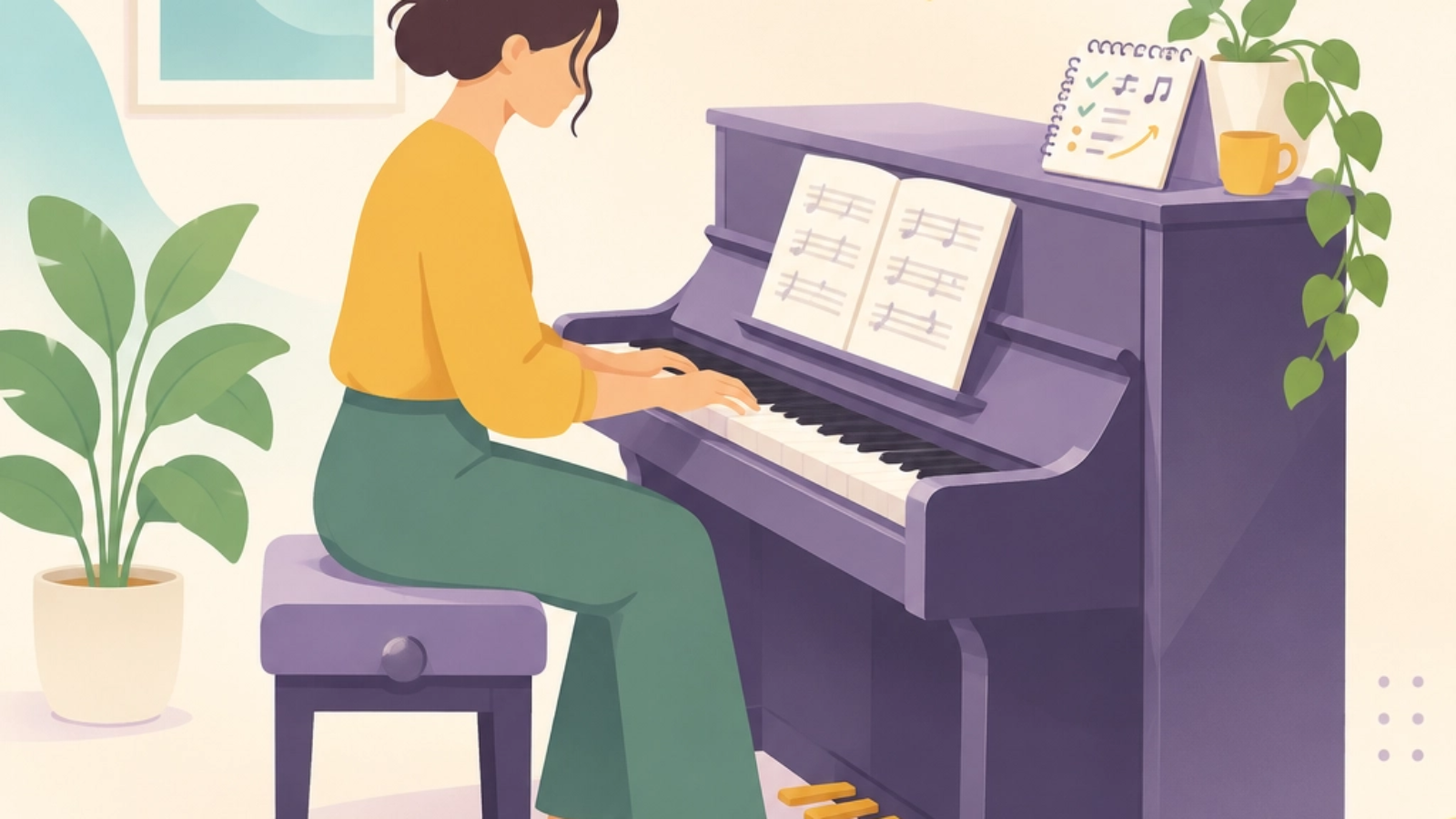
SEO title: Piano Lessons Ottawa: The Science of Strategic Practice
Meta description: Learn what 2026 research says about strategic piano practice, and how piano lessons Ottawa students and families can apply it at Allegro Ma Non Troppo.
Author: Karen Erazo
Repetition is often treated as the main ingredient in piano progress. Yet repeating a passage can make it feel smoother without showing whether you can play it accurately tomorrow or adapt it to a new musical demand.
For families comparing music lessons Ottawa offers, and for anyone considering piano lessons Ottawa, the more useful question is how each practice attempt helps you learn. This article reviews two 2026 studies and turns their findings into a practical, measured routine.
Why more repetitions is not automatically better practice
Li’s 2026 review describes piano practice as intentional work to prepare, stabilise, evaluate, or adapt a performance. That work can include playing, analysing a score, mentally rehearsing, or reviewing a recording.
The review synthesized 63 empirical, review, and theoretical sources across music education, psychology, neuroscience, and motor learning. It identifies strategies such as segmentation, tempo changes, hands-separate practice, auditory imagery, goal setting, self-monitoring, and delayed self-assessment. These approaches are most useful when you select and revise them in response to evidence from your playing.
By contrast, unvaried repetition may create immediate fluency without guaranteeing durable retention. A strategically varied trial can make an error easier to detect and help you assess whether a passage holds up under a changed tempo or task. However, variation should serve a goal; random changes are not automatically beneficial.
Li’s article is an integrative review, not a new experiment. It focuses mainly on advanced and professional pianists in Western classical solo and studio traditions. The authors use evidence from children, beginners, and other instruments to identify boundaries, but the findings should not be treated as a universal prescription for every learner.
The practice cycle: plan, play, reflect
Li’s model aligns with cyclical self-regulated learning. First, you set an intention and choose an approach. Then, you play and monitor what happens. Finally, you reflect on the result and adjust the next attempt.

Each strategy has a specific role in that cycle:
- Segmentation: Isolate a short phrase or transition rather than restarting the entire piece after an error.
- Tempo manipulation: Slow a passage enough to identify its demands, then adjust the tempo deliberately to test control.
- Hands-separate work: Practise one hand at a time when coordination, fingering, or rhythm needs focused attention.
- Auditory imagery: Hear a phrase internally before playing it, then compare the imagined sound with the actual result.
- Goal setting: Choose an observable target, such as an even rhythm across four measures.
- Self-monitoring: Notice where the sound or movement differs from the target while you practise.
- Delayed self-assessment: Record a short passage, wait, and listen later so you can evaluate it with fresh attention.
The aim is not to use every strategy in every session. Instead, use the evidence you gather. If a passage sounds fluent only at one slow tempo, for example, try a controlled tempo change and assess what remains stable.
What a 2026 motor-learning study adds about practising with a partner
Loria and colleagues studied 73 university-trained musicians who had no prior marimba experience. Participants practised an 18-note excerpt individually or in pairs. In the dyad groups, partners alternated between physically playing and observing one another.
During acquisition, only the dyad groups improved right-mallet accuracy; the individual group showed no such gains. At retention, only the full-dyad group showed an advantage. The authors note that this group also received greater total task exposure, which may help explain the result.
Both dyad groups outperformed the individual group on transfer for the right mallet, when participants played a changed version of the excerpt. That benefit was limb-specific, not a general improvement across both mallets. Reported interest, perceived competence, and pressure or tension did not differ significantly between groups.

These findings offer a reason to consider structured observation, such as having a sibling or practice partner watch a short passage and name one detail to notice. However, this is an application of the study, not a result directly tested in piano lessons. The experiment involved marimba, trained musicians, and a short training period. It did not test piano or children, and the retention result may reflect unequal total exposure.
A strategic practice week you can try at the piano
The following routine applies the review’s principles to a home practice session. It is a practical suggestion, not a schedule tested directly by either study.

- Choose one goal before you play. Keep it specific, such as steady rhythm in a four-measure phrase.
- Select a short passage and divide it into manageable sections. Mark the section that needs attention.
- Practise hands separately if coordination or fingering makes the passage difficult. Then bring the hands together at a tempo you can control.
- Change tempo deliberately. Try a slower trial, then return toward the target tempo and check whether accuracy remains.
- Record one attempt. Listen later and note one detail to keep and one detail to adjust.
- If a sibling or partner also practises, take one observation turn. Ask them to listen for the goal you chose, then switch roles.
- End with one line in a practice notebook: what improved, what remains difficult, and what you will try next time.
For younger learners, an adult can help define a clear goal and keep the passage short. Over time, you can invite the student to identify the next step independently. This scaffolding builds planning and self-monitoring without expecting a beginner to diagnose every technical issue alone.
Piano lessons and music lessons Ottawa families can access
Allegro Ma Non Troppo offers piano instruction in Ottawa and online. In-person lessons take place at the studio at 90 Genest Street; online lessons let you practise and learn in a familiar home environment. Both options provide flexibility around travel, comfort, and scheduling.
Instruction is available in English and Spanish, including clases de piano en español. Students can choose 30-, 45-, or 60-minute lessons, and families can review the Piano Beginner Lesson Plan or music lesson plans and pricing.
Current listed prices are:
- Single lessons: 30 minutes, $35; 45 minutes, $48; 60 minutes, $63.
- 30-minute bundles: 2 lessons,
$70$65; 3 lessons,$105$100; 4 lessons,$140$120. - 45-minute bundles: 2 lessons,
$96$94; 3 lessons,$144$140; 4 lessons,$192$180. - 60-minute bundles: 2 lessons,
$126$124; 3 lessons,$189$185; 4 lessons,$252$240. - Family Plan: 10% off individual plans when three or more family members participate.
A free trial lesson gives you a chance to discuss goals and experience the teaching approach before choosing a plan. For additional context, read the online piano lessons guide or explore music theory and tonal cognition. These areas can complement piano study by connecting notation, listening, and performance.
Research sources
- Li, Y. (2026). “Strategic piano practice in cognitive and metacognitive regulation.” Music Education Research. Published online October 15, 2026. https://doi.org/10.1080/14613808.2026.2747894. Read at abstract level via the publisher page; this article is an integrative review, not a new experiment.
- Loria, T., Tian, G., Karlinsky, A., Burke-Kleinman, E., John, B., Thaut, M. H., Roth, T., Huang, A., & Zhang, J. J. (2026). “Dyad practice facilitates motor learning in music.” Scientific Reports, 16, 13603. https://doi.org/10.1038/s41598-026-43485-w. Read at full text; open access. The authors identify limits involving marimba performance, short-term training, and greater total task exposure in the full-dyad condition.
Leave A Comment