
 Cart is empty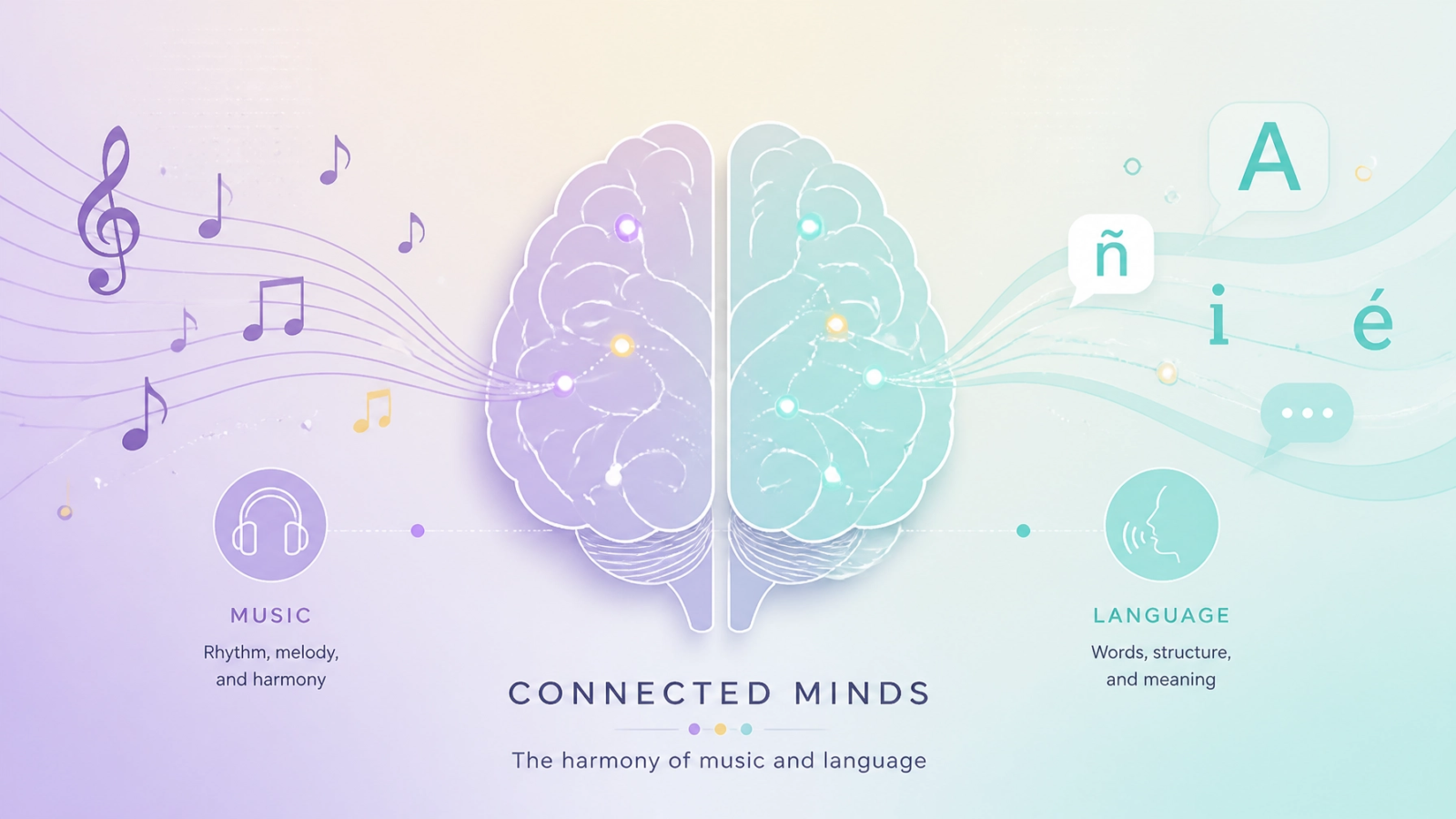
The human auditory system is not a passive receiver of sound. Instead, it is a highly plastic network that reshapes itself based on your experiences and environment. When you engage with complex acoustic signals, such as those found in music and language, you are participating in a form of sensory enrichment that fundamentally alters how your brain encodes and interprets the world. This second installment of our Science Expansion Series examines the intersection of bilingualism and music training, exploring how these two forms of auditory expertise share neural pathways and enhance cognitive development.
The Architecture of Auditory Expertise
Auditory expertise refers to the brain's ability to process sound with heightened precision and efficiency. Research indicates that both bilingualism and music training act as powerful catalysts for neural plasticity. When you learn to navigate two languages or master a musical instrument, your brain must develop sophisticated mechanisms for sound discrimination, timing, and pitch perception.
The similarities between these two domains are grounded in the way the brain handles acoustic information. Whether you are distinguishing between phonemes in Spanish and English or identifying intervals in a music theory lesson, you are utilizing overlapping neural circuits. These circuits span from the subcortical auditory brainstem to the high-level cortical regions responsible for executive function.

Subcortical Encoding and the Auditory Brainstem
Significant evidence regarding the neural benefits of bilingualism comes from the work of Jennifer Krizman and colleagues. Their research focuses on the auditory brainstem, a region that provides a biological snapshot of how the brain encodes sound. In a series of studies (e.g., Krizman et al., 2012, 2014), researchers discovered that bilingual individuals exhibit more robust subcortical encoding of speech sounds compared to monolinguals.
Specifically, bilinguals show enhanced representation of the fundamental frequency, often referred to as F0. This component of sound is critical for pitch perception and allows the brain to group sounds into meaningful categories. For a student taking flute lessons or clarinet lessons, this enhanced F0 encoding translates to a superior ability to tune their instrument and perceive subtle changes in intonation.
- Bilingualism functions as a form of auditory training that strengthens the brain’s response to sound.
- Enhanced neural consistency in the brainstem is directly linked to better language proficiency and musical ability.
- The subcortical enhancements observed in bilinguals are remarkably similar to those found in trained musicians.
The Cocktail Party Effect and Inhibitory Control
One of the most profound advantages of the bilingual brain is its ability to handle complex auditory scenes, a phenomenon often discussed in relation to the "cocktail party effect." Viorica Marian and her research team have extensively documented how bilingualism enhances sensory-cognitive coupling (Marian et al., 2012, 2015).
In a typical acoustic environment, your brain must filter out irrelevant background noise to focus on a specific signal, such as a teacher's voice or a solo melody. This requires strong inhibitory control: the ability to suppress distracting information. Bilinguals, who must constantly manage two active language systems, develop highly efficient inhibitory control mechanisms. This skill is directly transferable to music. When you participate in group workshops or school bands, your brain uses these same pathways to isolate your own part from the collective sound of the ensemble.

Phonetic Discrimination and Music Instruction
The integration of bilingualism and music instruction provides a unique scaffolding for phonetic discrimination. Music training emphasizes the fine-grained analysis of rhythm, pitch, and timbre. When these musical elements are taught in a bilingual context: such as our English and Spanish instruction: the learner receives a double dose of auditory enrichment.
Research suggests that music training enhances the brain's sensitivity to the prosody and rhythm of language. By learning music in two languages, you are essentially training your brain to recognize a wider array of phonetic nuances. This is particularly beneficial for young learners whose neural pathways are still in a state of high plasticity.
- Musical rhythm training aids in the perception of syllabic structure in speech.
- Bilingual instruction encourages the brain to remain flexible and adaptive to different phonological systems.
- Integrated learning models facilitate better memory retention through multi-modal association.
Strategic Advantages of Bilingual Music Lessons
Choosing bilingual music lessons is not merely a matter of convenience; it is a strategic decision for cognitive development. The bilingual experience demands constant monitoring and switching, which exercises the brain's executive functions, including working memory and cognitive flexibility.
When you study music theory lessons online in a second language, you are engaging in a high-level cognitive task that requires you to translate abstract musical concepts across linguistic boundaries. This process reinforces the neural connections between the auditory and executive control centers of the brain.

Practical Implications for Auditory Learning
The evidence presented by Krizman, Marian, and other neuroscientists underscores the importance of early and consistent auditory engagement. For families in Ottawa, accessing specialized music education that acknowledges and utilizes these scientific principles can provide long-term academic and social advantages.
Our approach at Allegro Ma Non Troppo is designed to maximize these cognitive benefits. We provide a structured environment where students can explore the technical demands of instruments like the flute or clarinet while benefiting from the cognitive lift of bilingual instruction. Our logistics are designed to support this development with total transparency:
- 30-minute lessons for focused, high-intensity training.
- 45 and 60-minute options for advanced technical development.
- Free trial lessons to ensure the pedagogical fit is correct before any commitment.
- Lesson bundle discounts:
Standard RatePrice Reduction for commitment to consistent practice. - Family Plan: Savings available for 3 or more members to encourage community learning.

Conclusion: The Synergistic Future of Music and Language
The intersection of bilingualism and music represents a frontier in neuroplasticity research. By understanding that language and music are not isolated silos but rather interconnected systems of sound, we can better appreciate the profound impact of a comprehensive music education. The bilingual brain is an expert auditory brain, and when combined with professional music instruction, it becomes a powerful tool for lifelong learning and cognitive resilience.
As we continue this Science Expansion Series, we will further delve into the specific motor and psychological benefits of instrumental mastery. For now, the evidence is clear: the harmony of two languages and one instrument creates a neural resonance that lasts a lifetime.
Leave A Comment