
 Cart is empty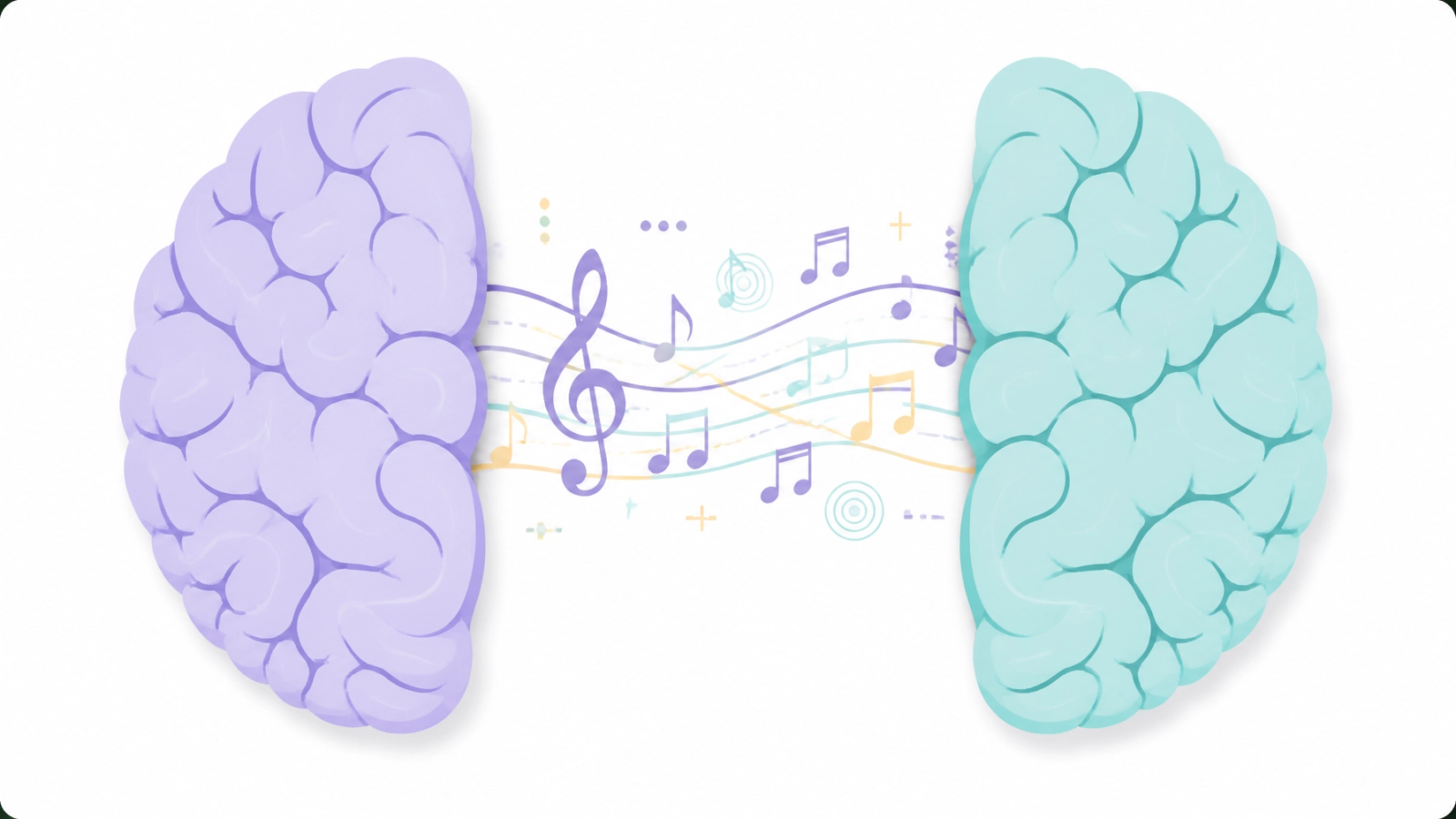
The human brain is a marvel of compartmentalized specialization, yet its true power lies in the efficiency of its internal communication. In this fourth installment of our Science Expansion Series, we examine the neurological mechanisms of interhemispheric synchronization. While the left hemisphere typically governs logical, sequential, and linguistic processing, and the right hemisphere excels in spatial, emotional, and holistic recognition, the mastery of a musical instrument requires these two halves to function as a singular, high-velocity unit. Through the lens of neuroscience, specifically the research conducted by Schlaug et al. and the broader frameworks of Wan and Schlaug, we can observe how specific instrumental training on the piano and flute restructures the very architecture of the brain.
The Corpus Callosum: Architecture of the Neural Bridge
The primary conduit for communication between the cerebral hemispheres is the corpus callosum, a massive bundle of white matter fibers. Research by Schlaug et al. (1995, 2001) provided groundbreaking evidence that professional musicians possess a significantly larger anterior corpus callosum compared to non-musicians. This anatomical divergence is not merely a byproduct of general activity but is a direct result of experience-dependent neural plasticity.
When you engage in instrumental training, the corpus callosum undergoes structural adaptation to facilitate the rapid exchange of motor, sensory, and cognitive information. The anterior portion of this bridge is particularly relevant to musicians as it connects the premotor and supplementary motor areas of the frontal lobes. These regions are responsible for planning and executing complex, timed sequences of movement. In the Schlaug studies, it was noted that the degree of enlargement was most pronounced in musicians who began their training before the age of seven, suggesting a sensitive period where the brain is most receptive to callosal expansion.

Bimanual Coordination: The Piano Perspective
The piano is perhaps the most demanding instrument in terms of bimanual independence. Unlike many tasks that require the hands to work in a mirrored or complementary fashion, piano lessons Ottawa challenge you to execute completely distinct rhythmic and melodic patterns with each hand simultaneously. This necessitates a high degree of interhemispheric communication to manage the competing motor signals while maintaining a cohesive temporal structure.
From a physiological standpoint, the motor cortex of each hemisphere controls the opposite side of the body. To play a complex fugue, the left motor cortex must manage the right hand’s intricate melodic line while the right motor cortex oversees the left hand’s harmonic accompaniment. The corpus callosum must synchronize these signals so that the two hands resonate together in perfect timing. This process involves reducing interhemispheric inhibition: the tendency of one hemisphere to suppress the other: allowing for greater independence of movement. As you progress through advanced piano training, the structural density of the corpus callosum increases, which correlates with improved bimanual synchronization and executive function.
Fine Motor and Respiratory Integration: The Flute Perspective
While the piano focuses on bimanual independence, the flute introduces a different set of neurological challenges: the integration of fine motor control, complex auditory feedback, and precise respiratory management. When you participate in online flute lessons, your brain must coordinate the bilateral finger movements required to manipulate the keys with the autonomic and somatic systems controlling your breath.
The flute is a woodwind instrument that demands simultaneous processing across multiple sensory modalities. Your brain must integrate the tactile feedback from your fingertips, the auditory feedback of the pitch and tone, and the internal monitoring of your diaphragm and embouchure. This multimodal integration relies heavily on the posterior midbody and isthmus of the corpus callosum, which facilitate the flow of sensory information between hemispheres. Research suggests that this type of training enhances fractional anisotropy, a measure of white matter integrity, in the pathways connecting the primary motor and sensory regions. This ensures that the motor output is constantly adjusted based on the auditory input, a loop that is essential for maintaining perfect intonation and rhythmic accuracy.

The Sensitive Period and Structural Scaffolding
The work of Wan and Schlaug (2010) highlights music training as a potent model for studying brain plasticity. One of the most critical findings in this field is the concept of scaffolding. Early musical training provides a structural framework that other cognitive skills can build upon. By strengthening the corpus callosum early in life, music lessons create a more efficient neural network that benefits academic performance, particularly in areas requiring spatial-temporal reasoning and mathematical logic.
This scientific evidence underscores the importance of the sensitive period before the age of seven, but it also validates the benefits of music education at any age. While the most dramatic structural changes occur in childhood, the adult brain remains plastic. Engaging in music theory lessons online or beginning a new instrument as an adult continues to challenge the interhemispheric pathways, maintaining cognitive flexibility and delay the effects of neural aging.
Music Theory as a Cognitive Framework
The study of music theory provides the logical foundation for instrumental performance. It acts as a bridge between the intuitive, creative aspects of the right hemisphere and the analytical, structured functions of the left hemisphere. When you analyze the harmonic structure of a piece or learn to transcribe melodies, you are engaging in a form of mental gymnastics that requires both hemispheres to work in tandem.
Music theory lessons involve decoding symbols, understanding mathematical ratios in rhythm, and recognizing patterns in sound. This high-level cognitive processing reinforces the neural pathways developed during physical practice. It provides the "why" behind the "how," allowing you to internalize musical concepts more deeply. This synchronization of theory and practice is what ultimately leads to mastery and the ability to perform with both technical precision and expressive depth.

Cognitive Benefits and Academic Performance
The implications of interhemispheric synchronization extend far beyond the music studio. Enhanced communication between the two halves of the brain is linked to improved executive function, which includes skills such as working memory, cognitive flexibility, and inhibitory control. These are the same skills necessary for solving complex problems, managing time effectively, and succeeding in rigorous academic environments.
Students who participate in consistent musical training often demonstrate superior auditory processing and linguistic skills. This is because the neural networks used to process music overlap significantly with those used for language. By refining the brain's ability to distinguish subtle variations in pitch, timing, and timbre, music training enhances your ability to perceive and process speech, even in noisy environments. The brain becomes a more efficient processor, capable of handling multiple streams of information with greater clarity.
Professional Instruction at Allegro Ma Non Troppo
At Allegro Ma Non Troppo, we apply these scientific principles to our pedagogical approach. Our instructors hold Master-level qualifications and understand the cognitive demands of musical training. We provide a structured yet personalized environment designed to optimize neural development and technical skill. Whether you are seeking in-person instruction in Ottawa or the convenience of online learning, our programs are designed to facilitate this essential interhemispheric communication.
We offer a transparent and flexible pricing structure to accommodate the needs of our community. Our goal is to ensure that high-quality music education is accessible to everyone.
- Individual Trial Lesson: $36.00 (one-time introductory rate)
- 30-Minute Lesson Plan: $36.00 per lesson
- 45-Minute Lesson Plan: $54.00 per lesson
- 60-Minute Lesson Plan: $72.00 per lesson
To encourage sustained commitment, which is necessary for long-term neural adaptation, we provide significant discounts on lesson bundles:
- 5-Lesson Bundle: 5% discount
- 10-Lesson Bundle: 10% discount
- 20-Lesson Bundle: 15% discount
Furthermore, our Family Plan provides a 10% discount for households with three or more students enrolled, supporting a community-focused approach to learning. We also offer specialized support for school band students, helping them integrate their individual progress with their ensemble requirements.
How to Begin Your Training
The process of starting your musical journey is designed to be streamlined and professional. We believe that an informed choice is the best choice, which is why we offer a comprehensive trial experience.
- Step 1: Visit our contact page to request a free trial lesson.
- Step 2: Meet with one of our expert instructors to discuss your goals and assess your current skill level.
- Step 3: Choose the lesson duration and frequency that aligns with your schedule and cognitive objectives.
- Step 4: Access our flexible scheduling system to manage your lessons with ease.
By choosing Allegro Ma Non Troppo, you are not just learning an instrument; you are investing in the long-term health and efficiency of your brain. The synchronization of your neural hemispheres through piano or flute training is a powerful tool for cognitive expansion.
Leave A Comment