
 Cart is empty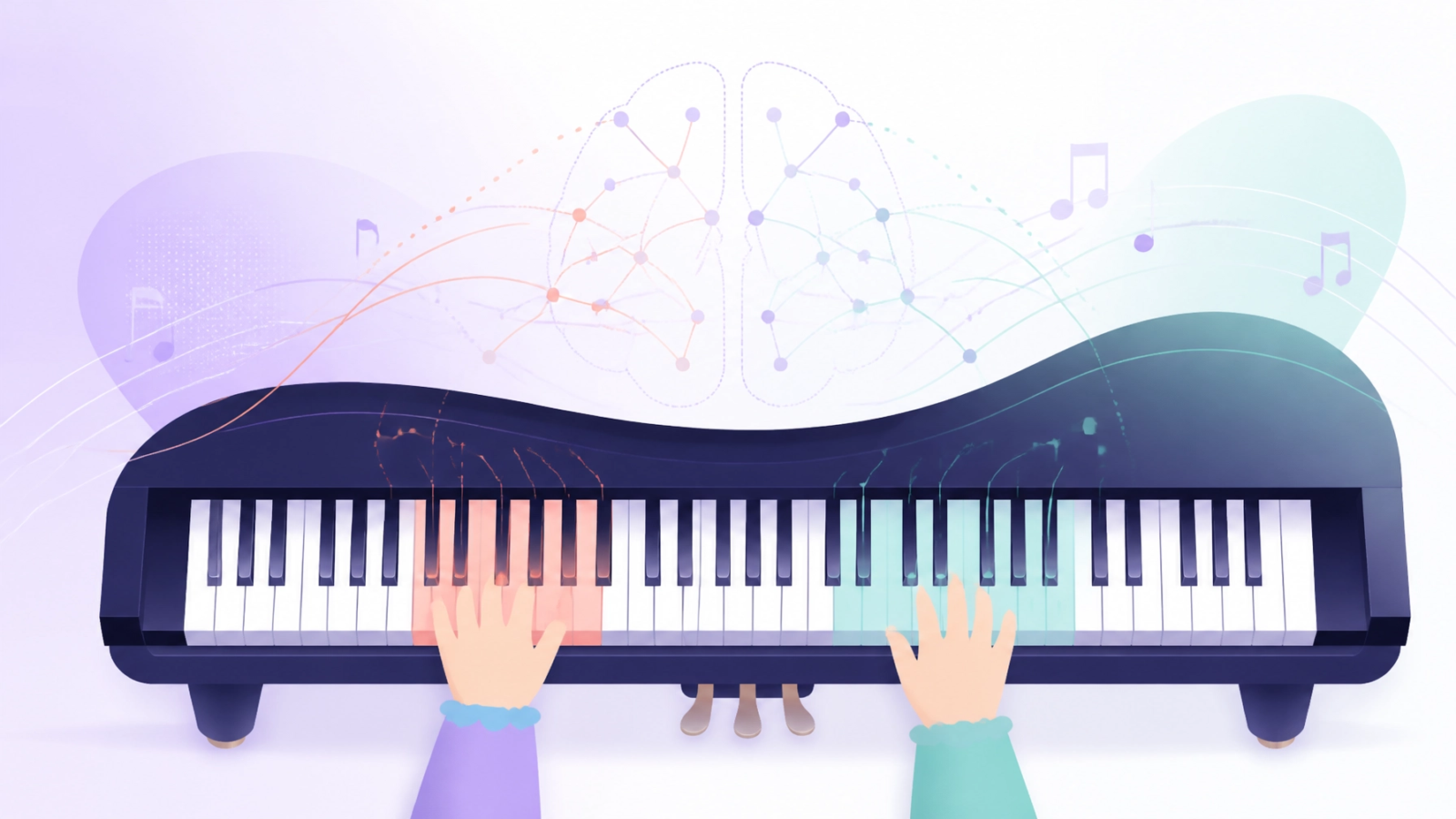
Learning piano is not simply the acquisition of a repertoire. It is a sustained form of sensorimotor learning that requires your brain to coordinate visual information, auditory feedback, motor planning, attention, memory, and timing. Every passage you practise asks neural systems to communicate with increasing precision.
This makes piano a particularly useful model for understanding experience-dependent neuroplasticity. The developing brain is not reshaped by passive exposure to music alone. It adapts through repeated, cognitively demanding action: reading a symbol, predicting a sound, selecting a movement, monitoring the result, and correcting the next attempt.
Research on instrumental training suggests that this process can influence bimanual coordination, auditory processing, executive function, and fine motor control. The evidence is promising, but it must be interpreted carefully. Piano lessons do not guarantee higher intelligence or academic achievement. Rather, they provide structured practice in several cognitive operations that are also relevant to learning more broadly.
For students seeking evidence-informed piano lessons in Ottawa, understanding these mechanisms can make practice more purposeful.
Piano playing as a whole-brain learning task
Piano performance combines multiple systems rather than activating one isolated “music centre.” You must integrate:
- Visual decoding of notation, patterns, intervals, and spatial relationships
- Auditory processing of pitch, harmony, rhythm, dynamics, and timbre
- Motor planning for finger selection, hand position, articulation, and timing
- Working memory for temporarily holding patterns and instructions
- Inhibitory control for suppressing incorrect or premature movements
- Error monitoring to compare intended and produced sounds
- Attention shifting between melody, accompaniment, rhythm, and expression
This integration is one reason piano learning can be cognitively demanding from the first lesson. Even a beginner reading a short melody is converting visual symbols into a timed sequence of coordinated movements.
The brain adapts through repeated cycles of prediction and feedback. Initially, movements are slow and consciously controlled. With practice, neural representations become more stable, and some actions become increasingly automatic. This does not mean that advanced playing requires less cognition. Instead, automation releases attentional resources for interpretation, phrasing, harmonic awareness, and expressive decision-making.
A 2024 review in Brain Sciences describes piano performance as a combination of fine motor control, complex bimanual coordination, temporal precision, and motor sequence learning. The authors emphasize that successful performance depends on the interaction of cognitive and motor functions rather than on finger technique alone (Cognito-Motor Functions and Neural Plasticity).

Bimanual coordination and interhemispheric communication
One defining feature of piano performance is that your hands often execute different actions at the same time. The right hand may articulate a melody while the left hand plays an accompaniment pattern with a different rhythm, register, or movement direction.
This is not ordinary symmetrical coordination. It is differentiated bimanual control, requiring each hand to maintain an independent motor plan while remaining synchronized within a shared metric structure.
The corpus callosum, a large bundle of neural fibres connecting the cerebral hemispheres, is central to communication between left- and right-sided motor systems. Piano training does not simply make the hands stronger. It refines the timing and information exchange required for two hands to operate as separate but integrated performers.
In a study of adults with no previous piano experience, ten days of bimanual piano training produced measurable changes in sensorimotor activity and interhemispheric communication. Participants also demonstrated substantial performance improvements, suggesting that the adult nervous system can adapt rapidly to coordinated musical movement (Cortical Motor Circuits after Piano Training in Adulthood).
A 2019 study comparing group piano, percussion, and music-listening interventions also found improvements in bimanual rhythmic accuracy. The piano condition showed particularly strong gains in motor synchronization and visual scanning outcomes (The Effects of Bimanual Coordination in Music Interventions).
For younger learners, this type of coordination may support broader motor development. However, the most defensible conclusion is specific: regular piano practice trains precise, timed, bilateral action. Any transfer to other skills depends on age, practice quality, instructional design, and the particular outcome being measured.
Harmonic processing and auditory prediction
Piano provides an unusually rich auditory environment because it can produce melody, harmony, bass lines, chord progressions, and multiple simultaneous voices. Your auditory system must identify individual notes while also interpreting their relationships.
Harmonic processing involves sensitivity to pitch combinations, tonal hierarchies, tension and resolution, and the probability of what may occur next. When you learn to recognize a dominant chord moving toward a tonic, for example, your brain is not merely naming isolated sounds. It is constructing a predictive model of musical context.
This predictive processing is relevant to efficient performance. A pianist who understands harmonic structure can anticipate common progressions and organize passages into larger units. Instead of memorizing every note as a separate event, the learner encodes patterns, relationships, and expectations.
Music training has been associated with enhanced central auditory processing, including temporal resolution, selective attention, and speech perception in competing sound environments. Kraus and Chandrasekaran’s influential review proposed that musical training can shape auditory skills involved in timing, working memory, and sensitivity to sound regularities (Music Training for the Development of Auditory Skills).
A later meta-analysis found a small but reliable positive association between music training and auditory and linguistic performance, while also noting the importance of publication bias and methodological limitations (Does Music Training Enhance Auditory and Linguistic Skills?).
These findings should not be interpreted as proof that piano lessons automatically improve language or hearing in every student. They indicate that structured musical practice exercises auditory discrimination and attention. The magnitude of transfer depends on how consistently and deliberately those skills are trained.

Motor sequencing, memory, and gradual automation
A piano passage is a motor sequence: an ordered set of actions that must unfold at the correct speed and with appropriate force. The sequence may involve finger substitution, hand repositioning, articulation changes, pedalling, and rhythmic subdivisions.
Early in learning, you may rely heavily on visual information. You look at the score, locate a note, identify the corresponding key, and consciously select a finger. With practice, the brain begins to group actions into chunks. A scale becomes a patterned movement rather than a series of unrelated key presses. A chord progression becomes a recognizable harmonic route.
This process involves procedural learning, working memory, and error-based adaptation. Slow practice is useful because it increases the quality of feedback. When a passage is played too quickly, errors can become embedded before the learner has identified their source. When it is practised at a manageable tempo, you can distinguish problems of fingering, rhythm, visual decoding, tension, or auditory expectation.
Recent longitudinal research using piano training and neuroimaging reported time-dependent reorganization in regions involved in bimanual coordination. The researchers observed a progression from spatially guided movements toward more automated performance, demonstrating that practice changes the organization of the task as well as the learner’s behaviour (Piano Training Induces Dynamic Neuroplasticity of Bimanual Coordination).
The practical implication is that repetition should not be mechanical. Each repetition should have a defined target:
- Stabilize the rhythm
- Clarify the fingering
- Improve independence between the hands
- Reduce unnecessary movement
- Strengthen auditory prediction
- Increase tempo only after accuracy is reliable

Executive function and cognitive development
Piano learning places repeated demands on executive function. You must maintain a goal, monitor progress, inhibit impulsive movements, shift attention, and remember instructions while coordinating sensory feedback.
Research in older adults provides some of the clearest intervention evidence. In a randomized study, six months of individualized piano instruction was associated with improvements in executive functioning, working memory, and processing speed compared with a no-lesson control group (Individualized Piano Instruction Enhances Executive Functioning and Working Memory in Older Adults).
Other research has reported improvements in fine motor control after one year of piano lessons, with relationships between motor development, cognitive measures, and brain structure (Fine Motor Control Improves in Older Adults after 1 Year of Piano Lessons).
Evidence in children is more variable. Some studies report gains in inhibitory control or working memory, while systematic reviews emphasize that effects are not uniform across all programmes and age groups. Factors such as lesson duration, frequency, baseline ability, instructional quality, and the comparison activity all matter.
For this reason, piano should be understood as a structured cognitive training environment, not as a universal academic shortcut. The strongest educational rationale is that it gives you repeated practice in attention, sequencing, auditory discrimination, motor control, and self-correction.
Applying the evidence to piano lessons in Ottawa
At Allegro Ma Non Troppo, instruction is designed around the student’s current level, repertoire interests, and measurable goals. Private piano lessons Ottawa are available for beginners and intermediate learners, with personalized work in technique, reading, theory, coordination, and musical interpretation.
You can choose:
- In-person lessons at the Ottawa studio, located at 90 Genest Street
- Online instruction from a comfortable and consistent home environment
- 30-, 45-, or 60-minute sessions
- Individualized repertoire appropriate to your age and objectives
- Instruction in English or Spanish through bilingual music lessons
- Integrated support through music theory lessons
The environmental conditions of learning matter. A quiet, comfortable space can reduce distractions and support sustained attention. Online lessons also eliminate commuting and can make scheduling more flexible. In-person instruction offers direct observation of posture, movement, and hand coordination.
A free trial lesson allows you to evaluate the instructional fit before committing. Lesson bundles and a Family Plan for three or more members can reduce the overall cost. For current scheduling, policies, and availability, review the contact page.
Piano mastery is built through a sequence of manageable adaptations. Each accurate repetition strengthens the relationship between perception and action. Each corrected error improves the motor plan. Each harmonic pattern that becomes familiar reduces cognitive load and creates space for more advanced musical decisions.
The developing brain responds to this structured challenge through neural plasticity. Your task is not to practise endlessly, but to practise with clear goals, reliable feedback, and a progression that aligns technique with cognition.
Book Your Free Trial Lesson Now.
References
[1] Herholz, S. C., and Zatorre, R. J. “Musical Training as a Framework for Brain Plasticity.” Neuron, 2012. https://doi.org/10.1016/j.neuron.2012.10.011 [2] Tanaka, S., et al. “Cortical Motor Circuits after Piano Training in Adulthood: Neurophysiologic Evidence.” PLOS ONE, 2016. https://doi.org/10.1371/journal.pone.0157526 [3] Bugos, J. A., et al. “Individualized Piano Instruction Enhances Executive Functioning and Working Memory in Older Adults.” Aging & Mental Health, 2007. https://doi.org/10.1080/13607860601086504 [4] Seinfeld, S., et al. “The Effects of Bimanual Coordination in Music Interventions on Neural and Motor Outcomes.” Frontiers in Integrative Neuroscience, 2019. https://doi.org/10.3389/fnint.2019.00068 [5] Kraus, N., and Chandrasekaran, B. “Music Training for the Development of Auditory Skills.” Nature Reviews Neuroscience, 2010. https://doi.org/10.1038/nrn2882 [6] Sala, G., and Gobet, F. “Does Music Training Enhance Auditory and Linguistic Skills? A Systematic Review and Meta-Analysis.” Neuroscience & Biobehavioral Reviews, 2022. https://doi.org/10.1016/j.neubiorev.2022.104777 [7] “Piano Training Induces Dynamic Neuroplasticity of Bimanual Coordination but Not Auditory Processing in Young Adults.” Journal of Neuroscience Research, 2025. https://doi.org/10.1002/jnr.70067 [8] “What Does It Take to Play the Piano? Cognito-Motor Functions and Neural Plasticity.” Brain Sciences, 2024. https://doi.org/10.3390/brainsci14040405SEO metadata
Meta title: Music Lessons Ottawa: Piano and Brain Science
Meta description: Explore how piano lessons Ottawa develop bimanual coordination, harmonic processing, motor sequencing, and evidence-informed cognitive skills across ages.
Leave A Comment