
 Cart is empty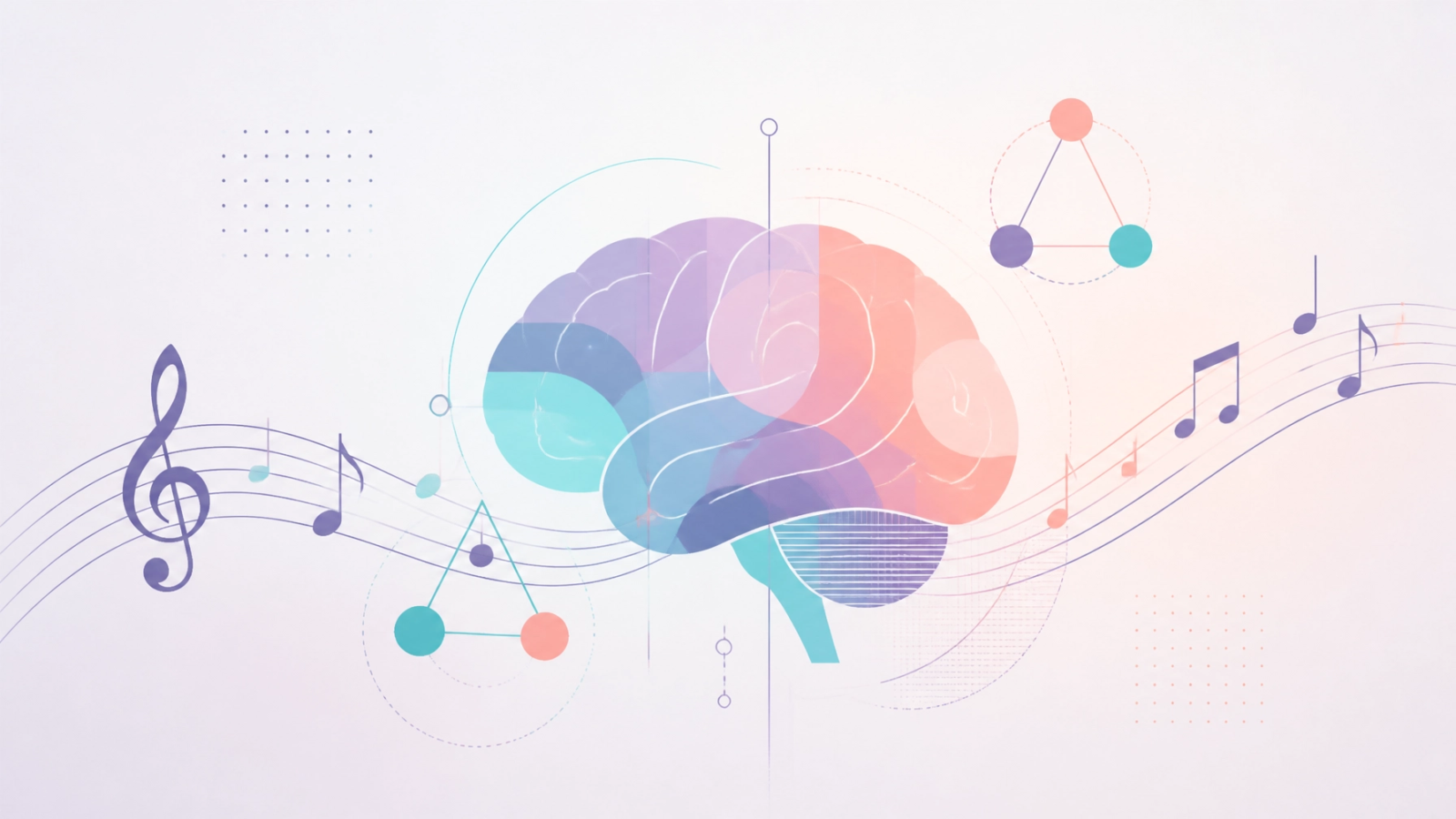
The study of harmonic analysis: the systematic decomposition of chordal structures and their functional relationships within a tonal framework: represents one of the most cognitively demanding tasks in music education. Beyond the technical ability to identify a Neapolitan sixth or a secondary dominant, the practice of music theory engages a complex architecture of neural networks. Recent advancements in cognitive neuroscience demonstrate that this training specifically reshapes auditory processing, enhances working memory capacity, and fortifies executive function. By engaging in music theory lessons online or at our Ottawa studio, students undergo a significant reorganization of the neural substrates responsible for high-level cognitive control.
Neural Networks in Harmonic Processing
Harmonic processing consistently recruits a robust network of frontal executive regions. Meta-analyses of functional magnetic resonance imaging (fMRI) studies indicate that the brain does not process harmony in isolation; rather, it utilizes the same infrastructure required for complex problem-solving and linguistic syntax. Key areas such as the inferior frontal gyrus (IFG), specifically the pars orbitalis (BA 47), and the dorsolateral prefrontal cortex (DLPFC) are central to the perception of Western tonal harmony.
The DLPFC acts as a hub for executive control and rule application. This aligns with research showing that frontoparietal network topology serves as a neural marker of musical perceptual abilities, with the dorsolateral prefrontal cortex playing a central role in predicting musical competence (Sihvonen et al., 2024, Nature Communications). When you perform an analysis of a complex progression, your brain must hold multiple pitches in mind simultaneously while applying theoretical rules to categorize their function. This creates a scaffolding effect where musical training supports the development of neural pathways that are also utilized in mathematical reasoning and analytical thinking.

The Role of Harmonic Syntax in Executive Function
Music theory is often described as a form of musical syntax. Much like grammar in language, harmony follows probabilistic rules that the brain tracks through statistical learning. Disruption of these expected patterns elicits a specific neural response known as the Early Right Anterior Negativity (ERAN). Research by Koelsch and colleagues suggests that the magnitude of the ERAN is directly modulated by selective attention and prior musical expertise. The ERAN has been established as a distinct neural marker of music-syntactic processing, differentiating harmonic rule violations from general auditory mismatch detection (Koelsch et al., 2001, Psychophysiology; Koelsch et al., 2007, Brain Research).
This suggests that training in music theory acts as a rigorous exercise for the brain's error-detection and predictive mechanisms. When you study the rules of voice leading or counterpoint, you are effectively training your auditory system to anticipate future events and monitor for structural irregularities. This heightened state of predictive control is a hallmark of superior executive function, allowing for better focus and cognitive flexibility in non-musical environments. Chromatic harmony, in particular, elicits greater activation in frontoparietal regions linked to working memory and conflict resolution, supporting the role of predictive coding in complex harmonic processing (Sankaran et al., 2021, Brain and Cognition).
Auditory Working Memory and Hierarchical Structure
Processing hierarchical musical structures: where small harmonic cells build into larger phrases and sections: places a significant load on auditory working memory. The brain must maintain the current tonal context while simultaneously integrating incoming acoustic data. This process primarily involves the dorsal stream of the auditory system, including the superior temporal gyrus and the premotor cortex.
For students engaged in flute lessons or clarinet lessons, the ability to analyze these structures while performing is essential. The simultaneous manipulation of sensory input and theoretical knowledge strengthens the neural connections between the auditory and motor systems. This cross-modal plasticity ensures that the brain becomes more efficient at processing information across multiple domains, a benefit that is particularly pronounced in younger learners whose brains exhibit higher levels of neural plasticity. Musically trained children show higher activation in frontoparietal cognitive control regions, including the DLPFC and superior parietal lobule, during bimodal attention and working memory tasks (Sachs et al., 2020, Frontiers in Neuroscience).

Cognitive Benefits of Bilingual Music Education
At Allegro Ma Non Troppo, we emphasize the advantages of bilingual music lessons. Instruction is provided in both English and Spanish (teoría musical), which introduces an additional layer of cognitive demand and benefit. Bilingualism is known to enhance executive function by requiring the brain to navigate between two linguistic systems, effectively training the inhibitory control mechanisms.
When this is combined with the study of harmonic analysis, the cognitive load encourages the development of a more resilient and flexible brain. Understanding concepts like chord progressions or analysis armónico in two languages reinforces the abstract nature of these musical principles, making them more deeply rooted in the student's cognitive framework. This unique approach is part of why many families seek out our bilingual instruction in the Ottawa community.
Musicians trained in harmonic analysis demonstrate enhanced planning and problem-solving abilities, with the degree of harmonization skill directly correlating with executive function performance (Frischen et al., 2022, Frontiers in Psychology).

Practical Application and Music Lessons in Ottawa
Our pedagogical approach prioritizes the integration of theoretical analysis with practical performance. Whether you are a student in a school band looking to improve your intonation through a better understanding of acoustics or an adult beginner exploring the ukulele, the cognitive benefits of theory are accessible to all. We provide expert, Master-level instruction that scales to your specific objectives.
Our studio is located in Ottawa, offering a professional environment for in-person learning, though many students prefer the convenience of music theory lessons online. The flexibility of our scheduling and the personalized nature of our curriculum ensure that each student receives the necessary support to master complex musical concepts.
Logistics and Enrollment Information
We provide transparent pricing and flexible options to accommodate different learning needs. Our instructors specialize in flute, clarinet, beginner piano, ukulele, and music theory, ensuring a high-end educational experience for every student.
- Free Trial Lesson: ~ $35.00 ~ $0.00 (Try before you commit)
- 30-Minute Lessons: Ideal for younger beginners or focused theory sessions.
- 45-Minute Lessons: Recommended for intermediate students.
- 60-Minute Lessons: For advanced students or those combining theory and performance.
- Lesson Bundles: Discounted rates available for pre-paid blocks.
- Family Plan: Savings for three or more family members enrolled concurrently.

The evidence-based benefits of harmonic analysis training are clear. By systematically engaging with the structure of music, you are not only becoming a better musician but also enhancing the very neural architecture that supports your executive function and auditory cognition. Our bilingual music lessons provide a rigorous and professional path toward musical and cognitive excellence.
References
Frischen, U., Schwarzer, G., & Degé, F. (2022). Music training, and the ability of musicians to harmonize, are associated with enhanced planning and problem-solving. Frontiers in Psychology, 12, 805186.
Koelsch, S., Gunter, T. C., Schröger, E., Tervaniemi, M., Sammler, D., & Friederici, A. D. (2001). Differentiating ERAN and MMN: an ERP study. NeuroReport, 12(7), 1385–1389.
Koelsch, S., Jentschke, S., Sammler, D., & Mietchen, D. (2007). Untangling syntactic and sensory processing: an ERP study of music perception. Psychophysiology, 44(3), 476–490.
Sachs, M., Kaplan, J., Der Sarkissian, A., & Habibi, A. (2020). Neural dynamics of improved bimodal attention and working memory in musically trained children. Frontiers in Neuroscience, 14, 554731.
Sankaran, N., Thompson, W. F., Carlile, S., & Bosnyak, D. J. (2021). Predictive processing, cognitive control, and tonality stability of music: An fMRI study of chromatic harmony. Brain and Cognition, 151, 105736.
Sihvonen, A. J., Särkämö, T., Ripollés, P., et al. (2024). Frontoparietal network topology as a neural marker of musical perceptual abilities. Nature Communications, 15, 8204.
Leave A Comment