
 Cart is empty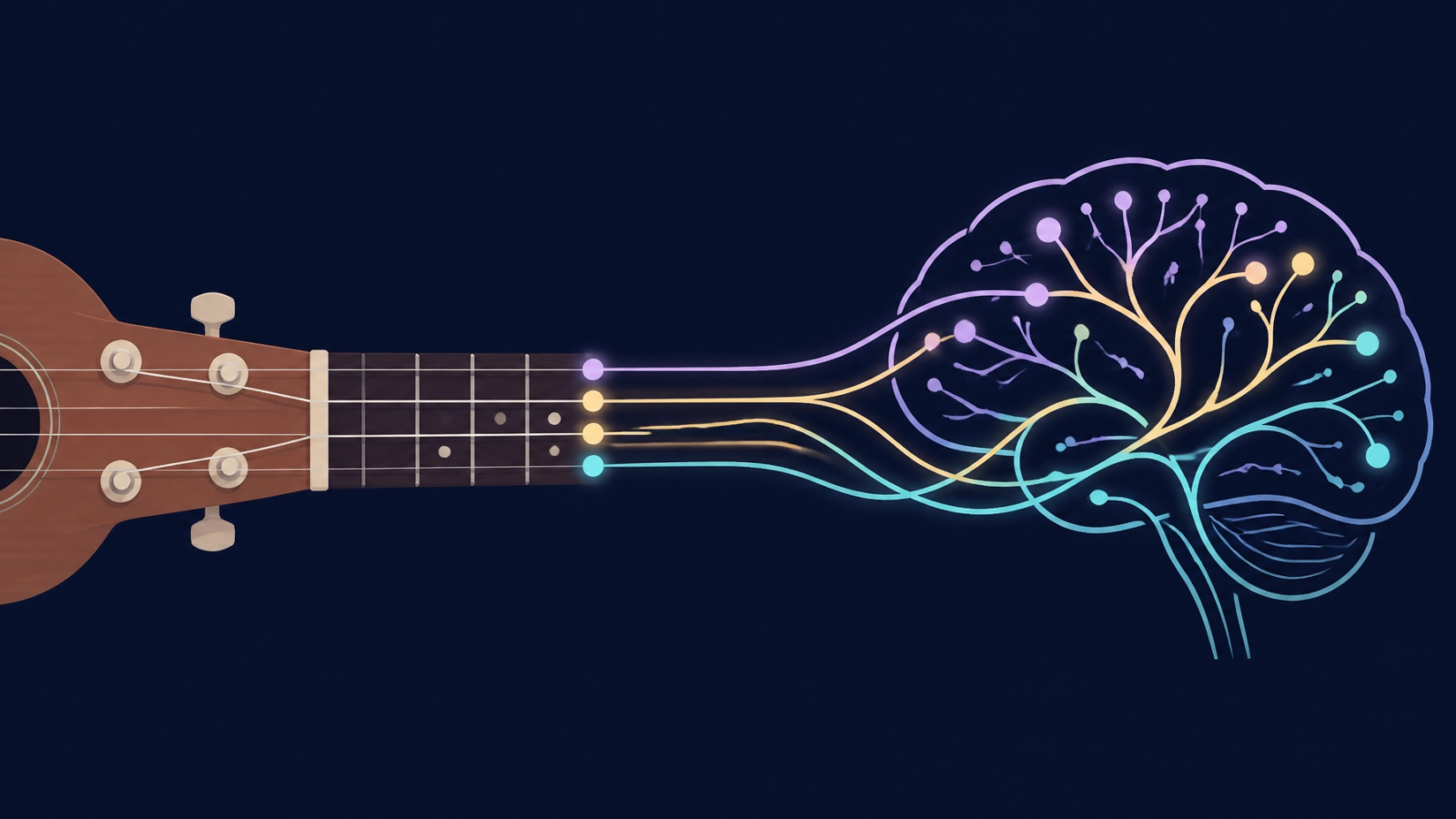
When you engage in instrumental practice, your central nervous system orchestrates a remarkably complex symphony of sensory integration, motor planning, and cognitive control. While many perceive learning an instrument purely as an artistic pursuit, contemporary cognitive neuroscience demonstrates that mastering fretboard mechanics directly stimulates neural plasticity and strengthens executive function. Among various acoustic instruments, the ukulele offers a uniquely accessible yet demanding cognitive paradigm. Because you must coordinate bimanual finger placement with precise rhythmic strumming, your brain activates distributed networks responsible for working memory, inhibitory control, and cognitive flexibility.
Examining this through the lens of recent empirical research reveals how structured musical training alters brain structure and function. Whether you are pursuing ukulele lessons Ottawa or expanding your auditory processing capabilities through complementary disciplines, understanding the underlying neurobiology transforms your approach to deliberate practice.
The Neurobiological Foundations of Fretboard Motor Sequences
When your fingers depress nylon strings across the frets, your primary motor cortex, supplementary motor area, and cerebellum engage in high-speed computational processing. Every chord transition requires spatial calculation and precise force modulation. Phillips et al. (2026), in their ongoing investigations into instrumental interventions such as the Music4MS clinical trials at the University of Texas at Austin, highlight how active string instrument engagement serves as a potent catalyst for motor control and cognitive rehabilitation. Although initial trials focus on specific clinical cohorts, the underlying principles apply universally: navigating fretboard geometry forces your brain to establish robust sensorimotor pathways.

When you study at Allegro Ma Non Troppo, your instruction is guided by expert, Master-level teachers who understand the biomechanics of motor learning. Your fingers must execute discrete spatial sequences while your right hand maintains rhythmic stability. This bimanual asymmetry demands accelerated interhemispheric communication via the corpus callosum. As you progress from basic major triads to complex seventh chords, your motor cortex refines its somatotopic representation of your hands, leading to greater dexterity and reduced cognitive load during complex physical execution.
Executive Function, Working Memory, and Chord Transitions
Executive functions encompass the top-down mental processes that enable you to plan, focus attention, remember instructions, and juggle multiple tasks successfully. Recent systematic reviews and meta-analyses examining musical expertise and executive functions, published via White Rose Research Online (2026), confirm that instrumental training yields consistent effect sizes in working memory and cognitive flexibility.
When you transition between chords in a harmonic progression, you are not merely moving your fingers. You are holding auditory and visual templates in your working memory while inhibiting extraneous motor impulses and preparing the next postural configuration before the current measure concludes. This continuous loop of anticipation, execution, and error correction strengthens the dorsolateral prefrontal cortex.
You can experience these cognitive benefits across our comprehensive curriculum. Beyond our specialized ukulele lessons Ottawa, you can integrate disciplines such as online flute lessons, clarinet lessons, and music theory lessons online. Each discipline targets distinct cognitive domains, reinforcing your overall neurocognitive architecture.
Dyad Practice and Collaborative Motor Learning
Cognitive development is rarely an isolated endeavor. Recent empirical findings from Loria et al. (2026), published in Scientific Reports under the title dyad practice facilitates motor learning in music, demonstrate that practicing musical motor skills in pairs significantly enhances both acquisition and transfer. When you observe a peer or partner executing chord transitions, your mirror neuron system activates, simulating the motor sequence internally before you physically attempt it yourself.

At our Ottawa studio and through our virtual platforms, we incorporate collaborative group workshops and creative projects that leverage this dyad framework. Working alongside others accelerates your motor learning efficiency and fosters shared cognitive engagement. Whether you participate in-person or online, these collaborative settings ensure you receive immediate feedback and social reinforcement, which amplify neuroplastic adaptations.
Pedagogical Frameworks and Bilingual Cognitive Advantage
The cognitive advantages of musical training compound significantly when paired with linguistic enrichment. Operating in a diverse community requires cognitive flexibility that extends beyond musical notation. At Allegro Ma Non Troppo, we provide fully bilingual instruction in English and Spanish. Bilingualism itself is well-documented to enhance executive control by constantly requiring the brain to select one language while inhibiting another. Combining bilingual instruction with instrumental learning creates a dual-layer cognitive stimulus.
Furthermore, structured pedagogical frameworks: incorporating visual cues, structured graphic notation, and systematic scaffolding: help bridge abstract harmonic concepts with concrete physical actions. As explored in recent educational research regarding visual cueing and participatory frameworks, lowering the barrier to entry through intuitive visual representation allows learners of all ages to access complex music theory without cognitive overload.
Practical Curriculum, Scheduling Flexibility, and Inclusive Offerings
To ensure that rigorous cognitive training remains accessible, our educational offerings are designed with total flexibility and transparency. You can select instruction tailored to your exact learning preferences and lifestyle:
- Private lessons available in flute, clarinet, beginner piano, ukulele, and music theory.
- Flexible session durations of 30, 45, and 60 minutes to accommodate your schedule.
- Choice of learning formats: fully online or in-person at our welcoming Ottawa studio.
- Bilingual instruction delivered in both English and Spanish by expert, Master-level teachers.
- Specialized support for school band students aiming to improve sight-reading and tonal precision.
- Engaging group workshops and collaborative creative projects.

Program Structure and Transparent Pricing Architecture
We believe in complete transparency regarding our educational investments. Our pricing structures reflect our commitment to the Ottawa community, offering clear savings through bundles and family plans:
- Standard 30-minute private lesson: $45 per session.
- Standard 48-lesson annual bundle: ~~ $2,160 ~~ $1,944 (reflecting a ten percent bundle discount).
- Family Plan (for households with three or more enrolled members): ~~ $1,800 per term ~~ $1,530 per term (reflecting a fifteen percent family savings rate).
- Introductory assessment: Complimentary for all prospective students.
By structuring our programs to reduce logistical friction, we ensure that you can focus entirely on your cognitive and musical development. Environmental comfort, flexible cancellation policies, and ergonomic studio layouts further support your sustained practice.
Begin your cognitive and musical journey today by experiencing our methodology firsthand. Claim your introductory session and discover how targeted instrumental practice transforms your neural pathways.
Leave A Comment