
 Cart is empty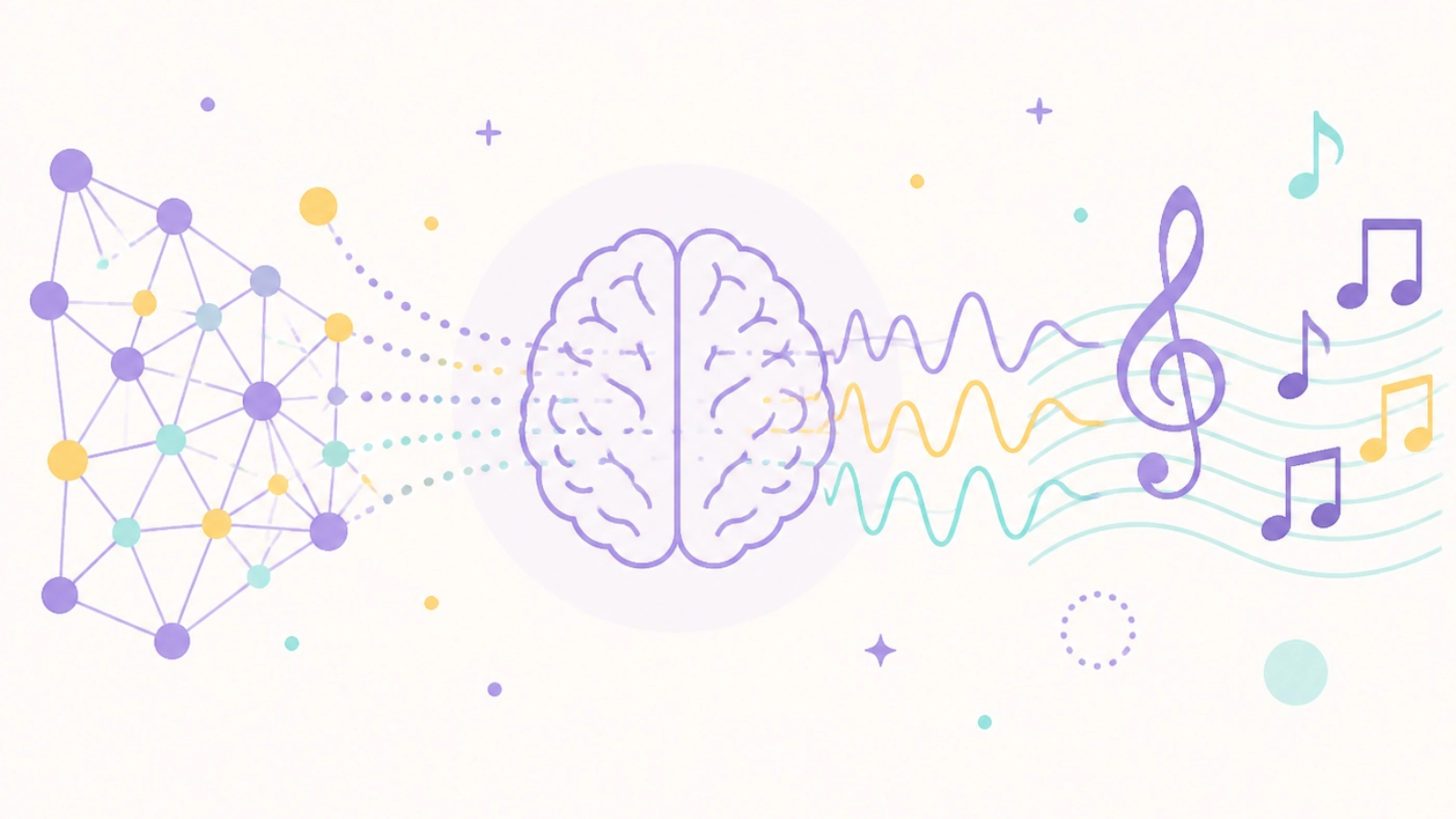
Introduction: The Predictive Architecture of the Auditory Cortex
Contemporary cognitive neuroscience increasingly characterizes the human brain not as a passive receiver of sensory stimuli, but as an active prediction machine. Across perception, the central nervous system continuously extracts statistical regularities from the environment to generate top-down predictions regarding upcoming sensory inputs. In the domain of auditory processing, this predictive coding framework explains how listeners comprehend complex sonic structures with remarkable speed and metabolic efficiency. When engaging with structured auditory sequences, the brain minimizes computational load by predicting forthcoming events and processing only the discrepancies between expected and actual inputs, known as prediction errors.
Music theory provides a formal system of rules and relationships that mirrors these underlying neural mechanisms. Specifically, harmonic analysis formalizes the probabilistic transitions of chords, keys, and cadences that govern Western tonal music. By studying music theory, students cultivate refined internal generative models that sharpen auditory prediction. Whether you are pursuing music theory lessons online or participating in music lessons Ottawa, systematic engagement with harmonic structures fundamentally alters how neural circuits process auditory information.
Harmonic Analysis and Tonal Hierarchy: Mapping Probabilistic Transitions
To understand how harmonic analysis reshapes neural processing, one must examine the concept of tonal hierarchy. Human listeners acquire implicit statistical knowledge of pitch distributions simply through cultural exposure. However, formal music theory codifies these probabilities into explicit frameworks of functional harmony, voice-leading, and chord progressions.

In this predictive architecture, a chord progression functions as a grammar of probabilistic transitions. Certain harmonies, such as the tonic triad, represent stable attractors with low entropy, whereas dominant or diminished chords create high-entropy states that demand resolution. When you analyze a score or engage in music theory lessons Ottawa, you are training your auditory system to anticipate these transitions with greater precision. This explicit structural mapping reduces the cognitive overhead required to parse complex auditory streams, enabling advanced listeners to anticipate melodic and harmonic trajectories seconds before they occur.
Recent neuroscientific investigations into chord prediction uncertainty demonstrate that non-harmonic chord sequences elicit distinct electrophysiological responses, such as the stimulus preceding negativity (SPN) and modulation of heartbeat-evoked potentials (HEP). These biomarkers indicate that formal training in harmonic relationships directly scales the brain's anticipatory engagement, transforming passive listening into an active, highly efficient predictive dialogue.
Neural Efficiency, Prediction Error, and Gain Modulation
The primary evolutionary advantage of predictive coding lies in metabolic and cognitive efficiency. Neural transmission is metabolically costly, and processing every single acoustic detail of a continuous auditory stimulus would overwhelm neural resources. Predictive processing solves this bottleneck by suppressing predictable sensory inputs through top-down feedback loops, reserving high-resolution processing capacity for informative prediction errors.

Dynamic causal modeling and EEG studies reveal that musical training enhances precision weighting and local neural gain within the auditory cortex. When structural expectations are well-established through rigorous music theory education, the brain sharpens its internal models. Consequently, when a deceptive cadence or unexpected modulation occurs, the resulting prediction error is amplified with optimal neural gain. This mechanism explains why musicians detect subtle pitch deviations and harmonic nuances with vastly superior accuracy compared to untrained controls.
Importantly, the choice of physical instrument is entirely secondary to the cognitive engagement with the underlying musical structure. Whether your primary medium involves piano lessons Ottawa, clarinet lessons Ottawa, or specialized online flute lessons, the neurological benefits derive from internalizing tonal hierarchies, interval relationships, and harmonic syntax.
Empirical Evidence from Peer-Reviewed Neuroimaging
Recent literature in cognitive neuroscience provides robust empirical backing for the intersection of harmonic theory and predictive processing. A seminal study by Lumaca et al. (2024), published in the Journal of Cognitive Neuroscience, investigated the neural correlates of chord prediction certainty, demonstrating that temporal expectancies in harmonic sequences modulate late auditory ERP components and interoceptive markers. The researchers established that subjective prediction certainty correlates directly with the structural complexity of harmonic progressions (DOI: 10.1162/jocn_a_02145).
Furthermore, a comprehensive review by Vuust et al. (2022/2025 updates) in Nature Reviews Neuroscience synthesized decades of research on musical neurodynamics, highlighting how predictive coding, neural resonance, and precision weighting unify our understanding of perception, motor control, and aesthetic reward (DOI: 10.1038/s41583-022-00579-5). The authors note that musical training optimizes the brain's predictive machinery by refining generative models of acoustic environments, leading to enhanced executive function and auditory working memory.
These findings validate the pedagogical approach utilized in professional music education programs, where theoretical analysis is integrated directly into instrumental instruction to accelerate cognitive development across all age groups.
Practical Implementation: Structured Learning Across Instruments
Translating neuroscientific principles into effective educational practices requires structured scaffolding, systematic progression, and individualized instruction. At Allegro Ma Non Troppo, our curriculum is designed to align with the brain's natural mechanisms of statistical learning and pattern recognition.

Students engage in comprehensive musical training that bridges theory and performance. For individuals balancing demanding schedules, our programs offer exceptional environmental advantages, including the flexibility to study either in-person at our Ottawa studio or through seamless online platforms. This flexibility eliminates commuting barriers while providing a comfortable, controlled acoustic environment conducive to deep cognitive focus.
Moreover, our instructional framework is fully accessible to the broader community through bilingual instruction in English and Spanish. Providing bilingual music lessons ensures that linguistic background never impedes cognitive development, allowing students to access complex theoretical concepts in their preferred language.
Logistical Flexibility, Bilingual Instruction, and Transparent Investment
Transparent operational policies and flexible scheduling are essential components of an effective educational ecosystem. Our studio accommodates diverse learning needs through customized lesson durations, including thirty, forty-five, and sixty-minute sessions tailored to individual attention spans and developmental stages.
To support long-term cognitive engagement, transparent pricing structures and bundle discounts are integrated into our enrollment framework. Standard single-lesson rates of ~-$55$ per session are reduced through our multi-lesson packages, offering a ~-15% savings on standard bundles. Additionally, families enrolling three or more members benefit from our comprehensive Family Plan, which applies a ~-20% reduction across collective tuition fees. There are no hidden administrative fees, and every prospective student is invited to evaluate the instructional methodology prior to financial commitment.
Conclusion and Scientific Summary
Music theory is far more than an academic set of rules; it is a formal description of the brain's predictive architecture. By engaging in systematic harmonic analysis and structured instrumental practice, you actively reshape your auditory prediction circuits, optimize neural efficiency, and enhance cognitive plasticity.
Whether you are beginning your journey with beginner piano, exploring woodwinds through our flute and clarinet curricula, or mastering advanced harmonic structures, the underlying neurological rewards are profound and enduring.
Leave A Comment