
 Cart is empty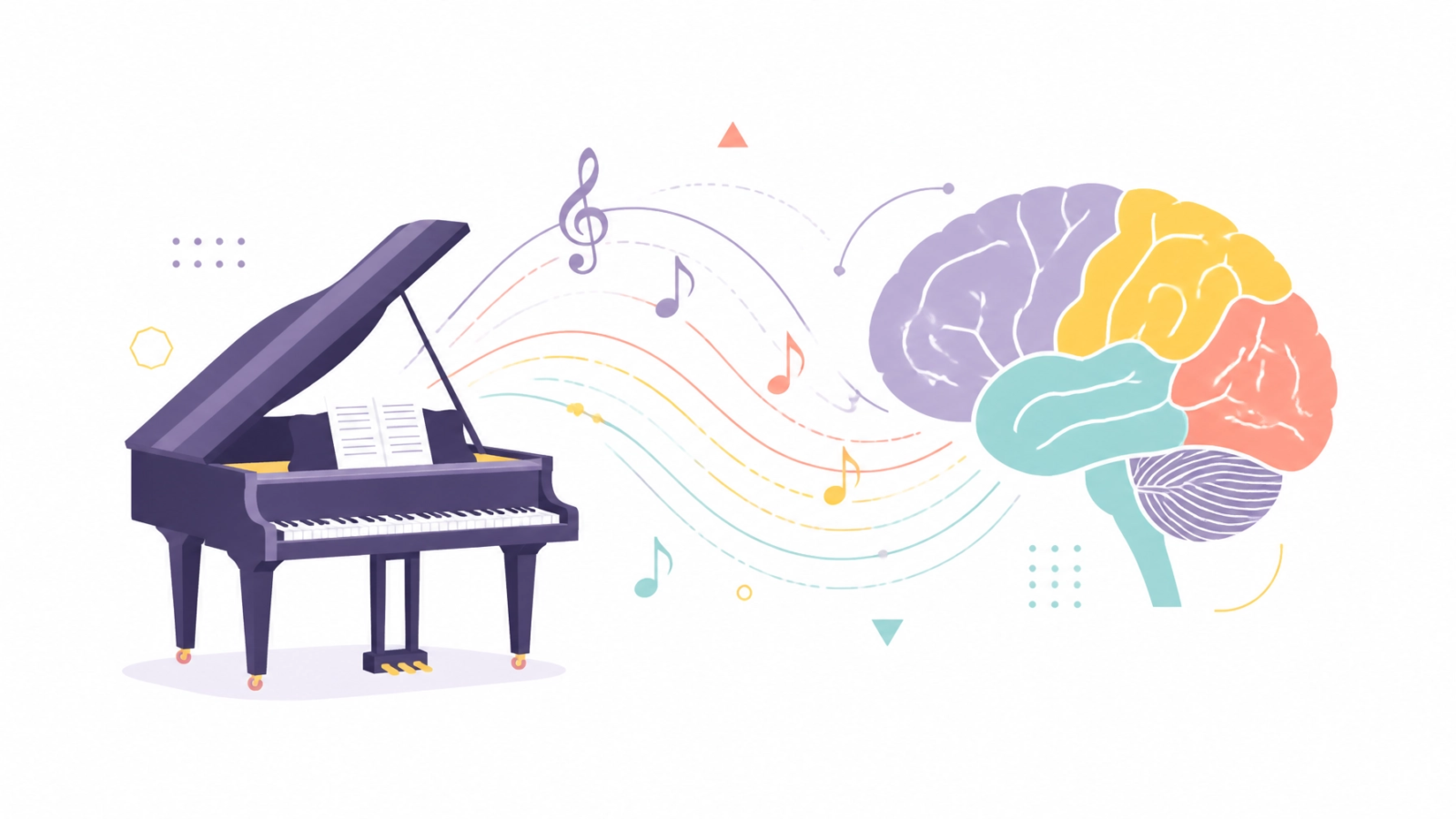
The human brain is a highly specialized organ designed to identify patterns, optimize energy expenditure, and seek structural logic. When you sit down at a piano, you are not merely engaging in a cultural hobby; you are initiating a complex sequence of neurobiological events. The process of learning an instrument is one of the most cognitively demanding tasks a human can undertake, requiring the simultaneous coordination of visual, auditory, and motor systems.
However, many students at our Ottawa studio find that their progress plateaus despite hours of effort. This is often the result of practice habits that conflict with the fundamental principles of neural plasticity and cognitive psychology. To master piano lessons, one must align their methodology with how the brain actually encodes information. By understanding the science behind the music, you can transform your practice sessions from repetitive labor into high-efficiency cognitive development.
1. Falling into the Hebbian Trap of Mindless Repetition
One of the most frequent errors in piano practice is the belief that volume of repetition equals mastery. In neuroscience, Hebbian theory states that neurons that fire together, wire together. This principle is agnostic to accuracy; your brain does not possess an inherent filter for right and wrong notes. It simply strengthens the pathways you use most frequently.
When you repeat a passage mindlessly while distracted, you are often encoding errors alongside correct movements. This creates a "noisy" motor program that is prone to failure under the pressure of performance. To fix this, you must engage in deliberate practice. This involves isolating a single measure or a specific technical transition and applying absolute focus to each finger movement. At Allegro Ma Non Troppo, our master-level teachers emphasize that five minutes of focused, analytical practice is superior to sixty minutes of distracted repetition.

2. The Velocity Fallacy and the Speed-Accuracy Tradeoff
The desire to play at tempo is a natural impulse, yet practicing too fast too soon is a biological mistake. High-speed execution of an unrefined skill triggers the speed-accuracy tradeoff, a phenomenon where the error rate increases exponentially as velocity rises. When you practice at a speed where you occasionally stumble, you are effectively training the brain to be inconsistent.
Myelination, the process of forming a fatty sheath around nerve fibers to increase the speed and efficiency of electrical signals, requires consistent and accurate repetition. If the signal is inconsistent, the myelin sheath cannot properly insulate the pathway. The solution is slow practice: so slow that it is impossible to make a mistake. By slowing down the tempo, you give your auditory processing centers time to verify every pitch and your motor cortex time to refine every gesture.
3. The Primacy Effect and the Beginning-to-End Habit
Many students begin every practice session at the first measure of a piece and play through until they reach a difficult section, stop, fix it briefly, and then restart from the beginning. This utilizes the "primacy effect," where the brain better remembers the information presented at the start of a sequence. Consequently, the beginning of your repertoire becomes over-learned while the middle and end remains unstable.
To optimize memory consolidation, you must disrupt this linear habit. Practice should be distributed and targeted. Start with the most cognitively demanding sections: the "climax" or the complex developmental passages: when your executive function is at its peak. This ensures that the hardest parts of the music receive the most high-quality attention.
4. The Illusory Success of the Single Correct Repeat
A common psychological pitfall is the "at last" moment: playing a difficult passage correctly once and immediately moving on to the next task. In the context of motor learning, a single successful trial is often a statistical fluke rather than a sign of a stable motor program. Mastery is not defined by being able to get it right, but by being unable to get it wrong.
To ensure long-term retention, you must employ a strategy of "overlearning." Once a passage is played correctly, you must repeat it multiple times in a row without error at a controlled tempo. This stabilizes the neural representation and ensures that the movement pattern is resilient to the cognitive load of a live environment, whether in our Ottawa studio or during online lessons.
5. Neglecting Structural Logic and Music Theory
Treating a piece of music as a series of individual, disconnected notes is an inefficient use of working memory. The brain craves logic, and in music, that logic is found in music theory. Without an understanding of harmony, form, and syntax, every note is a new piece of data that must be managed independently.
By learning to recognize patterns: such as a ii-V-I progression or a specific scales-based run: you allow your brain to "chunk" information. Chunking reduces the cognitive load on the prefrontal cortex, allowing you to process larger segments of music as single units. This is why our bilingual instructors (English and Spanish) integrate theory into every lesson. Understanding the "why" behind the notes accelerates the "how" of the performance.

6. Disconnecting the Auditory-Motor Feedback Loop
Piano playing is not just a motor task; it is a sensory-motor loop. A common mistake is practicing "visually," focusing solely on the sheet music and the physical location of the hands while neglecting the sound produced. If you are not actively listening to the tone quality, articulation, and duration of the notes, you are bypassing the brain's most powerful error-correction mechanism: auditory feedback.
The brain compares the intended sound with the actual sound produced. If there is a discrepancy, it adjusts the motor command for the next attempt. If you are not mentally present and listening, this feedback loop is broken. Practicing with a focus on auditory outcomes ensures that your neural pathways for "hearing" and "doing" are tightly coupled, which is essential for advanced techniques in instruments like the flute and clarinet as well.
7. Treating Expression as a Post-Learning Phase
Many students believe they should learn the "notes and rhythms" first and add the "feeling and expression" later. From a neuroscientific perspective, this is a significant error. Expression: dynamics, phrasing, and touch: is part of the motor program. If you learn a passage with a flat, mechanical touch, you are encoding a mechanical motor program.
When you later try to add expression, you are essentially asking your brain to overwrite a previously established habit. This creates internal competition between the "old" mechanical way and the "new" expressive way, leading to hesitation and errors. To fix this, incorporate the intended dynamics and articulation from the very first day of slow practice. This ensures a unified and sophisticated motor representation from the outset.
Optimizing Your Environment for Learning
Mastering the piano requires more than just biological understanding; it requires an environment conducive to deep work. Whether you are interested in the ukulele for its introductory string harmony or the technical precision of woodwinds, the logistical framework of your education matters.
At Allegro Ma Non Troppo, we provide the specialized support necessary for school band students and adult learners alike. We offer flexible scheduling with 30, 45, and 60 minute options to accommodate the varying attention spans and goals of our students. Our bilingual instruction (English/Spanish) ensures that the cognitive benefits of music are accessible to the diverse Ottawa community.
For families, we offer a Family Plan with savings for three or more members, making it easier for everyone to engage in the science of sound. We also offer discounts on lesson bundles to encourage the consistency required for neural consolidation.
- Trial Lesson: $0
- 30 Minute Lesson: $35
- 45 Minute Lesson: $50
- 60 Minute Lesson: $65
Our teachers are expert, Master-level educators who understand the pedagogy and psychology of music. We prioritize evidence-based learning to ensure that every minute you spend at the keys is optimized for your development.

The logical structure of music is a mirror to the logical structure of the brain. By avoiding these seven common practice mistakes, you align your efforts with your biology. This leads to faster learning, deeper retention, and a more profound connection to the instrument. We invite you to experience this scientific approach to music education at our studio.
Leave A Comment